Natrajasana (King of Dance) captures Shiva's cosmic dance in a single standing arc — building balance, opening the heart, and stretching the hip flexors with radiant grace.
Shiva dances not in a moment of stillness, but in the eternal present — as do we.
Natrajasana — King of Dance Pose (Lord of the Dance) — is a intermediate-to-advanced-level yoga posture that is an exquisite standing backbend and balance that captures the cosmic dance of Lord Shiva — the divine dancer whose movement sustains the rhythms of creation, preservation, and transformation.
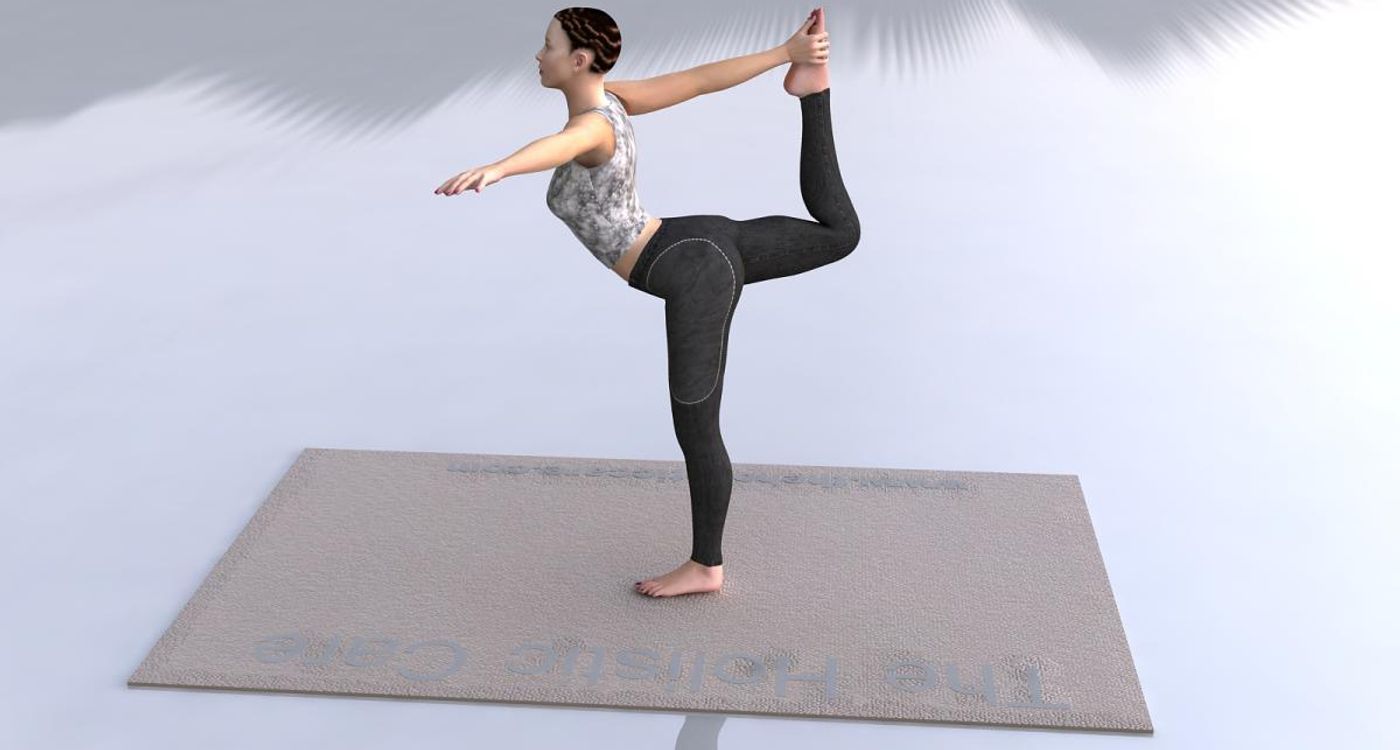
Natrajasana is among the most visually beautiful postures in all of yoga — a single leg grounds in mountain-like stability while the other arches upward behind, and the arm reaches back to catch the lifted foot, creating a living arc of grace and power. The pose requires balance, hip flexibility, shoulder mobility, and an open chest — developing all these qualities simultaneously through sustained, joyful effort.
How to Practise Natrajasana: Step-by-Step Guide
Begin in Tadasana (Mountain Pose) — standing tall with a steady drishti (gaze point). Follow these steps with mindful breath:
- Stand in Tadasana. Shift the weight onto the left foot and fix the gaze at a steady point.
- Bend the right knee and raise the right foot behind you. Reach back with the right hand and hold the inner arch of the right foot.
- Inhale and extend the left arm forward and upward for balance.
- Begin to kick the right foot gently back into the right hand, simultaneously lifting and opening the right shoulder.
- Tilt the torso forward to counterbalance as the leg rises — the body forms a bow shape.
- For the full pose, reach the right arm overhead and catch the foot from above (advanced).
- Hold for 5–8 breaths, gazing softly ahead.
- Release slowly, step both feet to the floor, and repeat on the other side.
Physical Benefits of Natrajasana
- Stretches the hip flexors, quadriceps, and shoulders in one integrated arc.
- Strengthens the standing leg's glutes, hamstrings, and ankle stabilisers.
- Opens the chest and thoracic spine — a beautiful counterpose to forward-flexion habits.
- Develops balance, coordination, and proprioceptive awareness.
- Tones the spinal extensors through the sustained backbend hold.
Mental & Emotional Benefits
- Natrajasana embodies the principle of the cosmic dance: finding grace within the challenges of existence.
- As a heart-opener, it activates the Anahata Chakra — releasing joy, love, and the capacity for celebration.
- The balance demand trains the mind toward singular, clear focus.
- Shiva's dance is both destructive and creative — this pose invites the practitioner to embrace life's full rhythm.
Energetic Benefits: 💚 Anahata (Heart) Chakra
Natrajasana is closely associated with the Anahata (Heart) Chakra, the energy centre governing compassion, openness, and the capacity for love. Regular practice activates and balances this chakra, bringing its qualities more fully into daily life. To deepen your understanding of this chakra and its influence on your wellbeing, explore our beautiful Anahata Poster — a visual anchor for meditation and a reminder of the energy you are cultivating through your practice.
For the complete chakra map and a guide to balancing all seven energy centres, see our Yoga Asanas for the 7 Chakras guide and our Complete 7-Chakra Interactive Chart.
Modifications & Variations
- Use a strap around the raised foot if the hand cannot reach it comfortably.
- Practise near a wall, resting the reaching hand on the wall for balance support.
- Keep the torso more upright (less forward tilt) to reduce the backbend intensity.
- Practise Anjaneyasana (Low Lunge) as a hip-flexor preparation.
Contraindications & Safety Guidelines
- Lower-back pain: avoid excessive arching; keep the lumbar relatively neutral.
- Knee injury in the lifted leg: use a strap to avoid hyperextension of the knee.
- Shoulder rotator cuff injury: avoid the overhead arm catch; keep the arm extended forward.
- Balance disorders: practise only with wall support.
Science & Research
Research on standing balance poses shows that Natrajasana activates the vestibular, proprioceptive, and visual systems simultaneously — producing measurable improvements in postural control, ankle stability, and reaction time. Its combined hip-flexor stretch and backbend quality also mirrors the most beneficial rehabilitation exercises for hip flexor-related lower-back pain.
Related Poses & Practice Resources
Deepen your practice with these related resources: Virabhadrasana III | Vrikshasana (Tree Pose) | Anjaneyasana (Low Lunge) | Dhanurasana (Bow Pose)
Support your yoga practice with our Mega Bundle Chakra Harmony Collection — all 7 chakra posters and guides in one beautiful set — and our Seven Chakra Affirmation Pack to reinforce the energetic shifts your practice creates.
Frequently Asked Questions
Why is it called the 'Lord of Dance' Pose?
Nataraja is an epithet of Lord Shiva as the Cosmic Dancer. His Ananda Tandava (dance of bliss) is depicted in the famous bronze Nataraja statue — the pose echoes this iconic image.
How do I improve my balance in Natrajasana?
Fix a steady, non-moving gaze point (drishti). Root through all four corners of the standing foot. Begin with a light kick against the hand before building the full backbend arc.
Can I practise Natrajasana without a backbend?
Yes — simply hold the foot behind you with a minimal arch as a balance and hip-flexor stretch. The full backbend is optional and comes with time.
Dance with all of it — the effort, the grace, the wobble, and the wild freedom of the form.
Written by
Editorial Team