Explore the yogic science of sound — from Para (transcendent silence) through Pasyanti and Madhyama to Vaikhari (spoken word). Understand how these four stages illuminate mantra, Nada Yoga, and the nature of consciousness itself.
Sound is not merely vibration in air. In the deepest yogic understanding, sound is the very fabric of consciousness — the first emanation of the Absolute, the primordial pulse from which all creation unfolds.
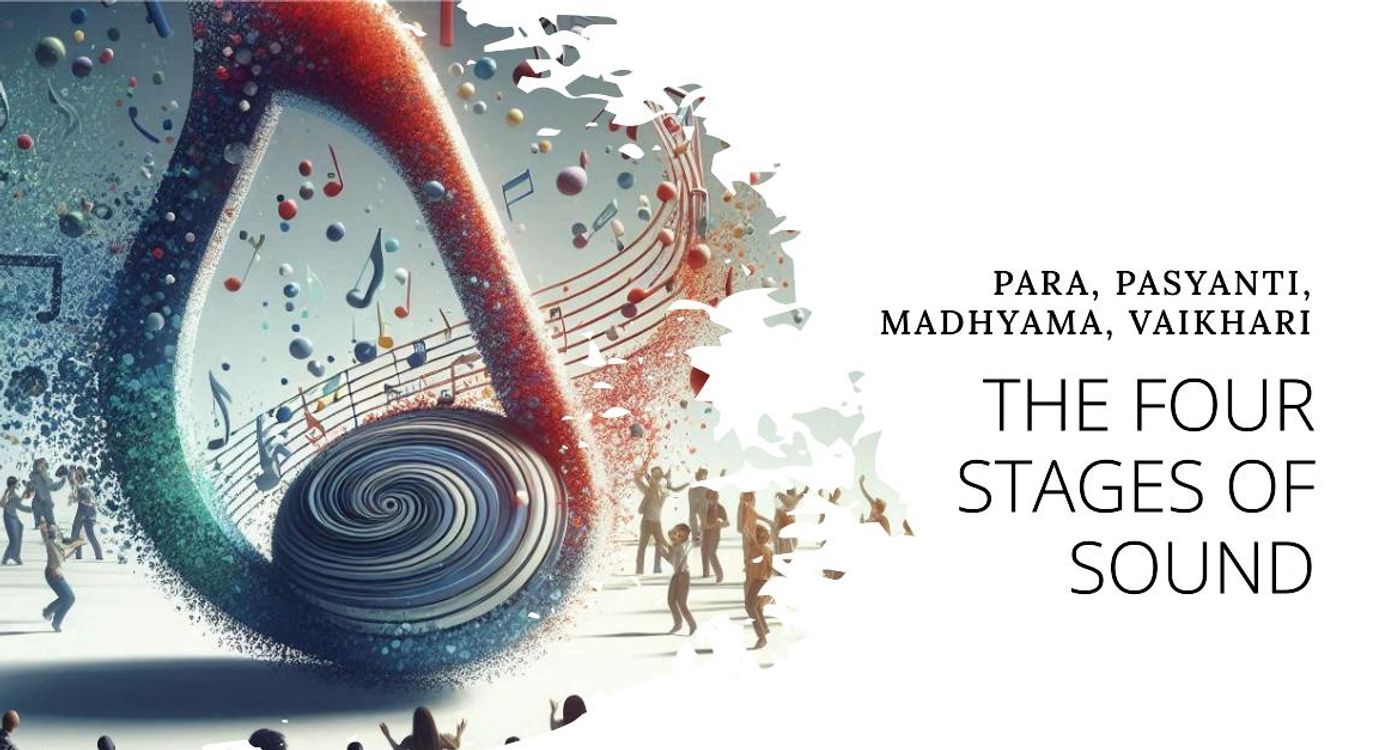
The ancient Sanskrit texts, particularly the Sphota Shastra and the Kashmir Shaiva tradition, describe a profound model of sound that encompasses both the manifest and unmanifest dimensions of reality. The Four Stages of Sound — Para, Pasyanti, Madhyama, and Vaikhari — are not simply phonetic categories; they map the progressive emergence of consciousness from its most subtle, transcendent source into the world of ordinary spoken language.
Why Does the Yogic Model of Sound Matter?
Understanding the four stages of sound transforms how we relate to mantra, to speech, to music, and to the inner nada (sound) experienced in deep meditation. It explains why certain mantras carry transformative power beyond their literal meaning, why the bija (seed) syllables of the chakras are considered sacred, and why Laya Yoga — the yoga of dissolution through sound — is considered one of the fastest paths to samadhi.
The Four Stages of Sound: A Detailed Exploration
1. Para — The Transcendent Sound
Para means 'beyond' or 'supreme.' This is sound in its most subtle, pre-manifest form — pure vibrational potential existing beyond time, space, and causality. Para corresponds to the undifferentiated silence from which all sound arises. It is the sound of the Absolute — what in physics might be called the quantum vacuum, the zero-point field of infinite potential. In meditation, Para is experienced as the profound inner silence that underlies and pervades all experience.
Para is associated with Muladhara Chakra — not because it is located there, but because it is the seed of all manifestation, dormant at the base of consciousness like the coiled Kundalini. Para cannot be heard; it can only be 'known' in states of deep samadhi.
2. Pasyanti — The Seeing Sound
Pasyanti (from the root 'to see') is the first stirring of Para into differentiated awareness. Here, sound begins to take on intention and meaning, though it has not yet acquired linguistic form. Pasyanti is the pre-verbal knowingness — the intuitive flash before words arise, the felt sense of meaning before articulation. Great poets and musicians touch Pasyanti when inspiration strikes before it is filtered through intellectual language.
Pasyanti is associated with Svadhisthana Chakra and is accessible in deep meditation as a kind of shimmering, pre-linguistic awareness. It is the level at which mantra operates most powerfully — the intention embedded in the mantra resonates at Pasyanti, which is why mantras carry their effect even when the intellectual mind doesn't understand the Sanskrit meaning.
3. Madhyama — The Middle Sound
Madhyama is 'sound in the middle' — between the purely internal (Pasyanti) and the fully externalised (Vaikhari). This is the level of mental speech: the inner voice, the subvocalisation that precedes spoken words, the thoughts we 'hear' in our minds. It is differentiated into specific meanings but has not yet become audible vibration.
Madhyama corresponds to Manipura Chakra and the realm of thought-forms. Most of our ordinary mental life operates at this level — the inner commentary, planning, and rehearsal that constitutes our inner monologue. Yogic practices that observe the thinking mind — including Dharana and Pratyahara — directly engage the Madhyama level of sound.
4. Vaikhari — The Spoken Sound
Vaikhari is the fully manifest spoken word — sound vibrating in air, decoded by ears, carrying meaning between minds. It is the grossest level of sound, the one we engage with in ordinary life. Vaikhari is associated with Vishuddha Chakra (the throat centre), the home of authentic expression, creative voice, and truthful communication.
Though Vaikhari is the 'lowest' level in the yogic hierarchy, it is not considered inferior — it is sacred because it carries the seed of all higher levels within it. Every word spoken is, at its deepest root, an expression of Para — the Absolute making itself known through the gift of language.
Nada Yoga: The Practice of Inner Sound
Nada Yoga is the discipline of listening to progressively subtler inner sounds until the meditator dissolves into the primordial sound of the universe — the Anahata Nada (unstruck sound) that arises not from any physical striking of objects but from consciousness itself. This is the OM that yogis describe as the background hum of existence.
Laya Yoga builds directly on the four stages of sound: the practitioner listens inward, moving from Vaikhari (outer sound) through Madhyama (mental sound) to Pasyanti (intuitive pre-verbal vibration) and ultimately into Para — pure silent awareness. See our dedicated exploration of Laya Yoga and Anahata Sound Mystic for the complete practice guide.
Mantra and the Four Stages
Understanding the four stages of sound transforms mantra practice. A mantra chanted at Vaikhari (aloud) creates physical vibration that resonates specific structures in the body and brain. Repeated mentally at Madhyama, it becomes a subtler thought-wave. Held at Pasyanti, it becomes pure intentional awareness without words. At Para, mantra and meditator dissolve together into silence — this is what the tradition calls 'mantra siddhi' (the perfection of mantra).
The Chakra-Sound Map
Each chakra has its associated bija mantra and vibratory frequency. The Complete 7-Chakra Guide maps these in full. For a beautiful visual reference for your practice space, our individual chakra posters — including the Throat Chakra (Vishuddha) Poster and Heart Chakra (Anahata) Poster — serve as both decoration and meditation supports.
Frequently Asked Questions
What is the relationship between the Four Stages of Sound and OM?
OM (or AUM) is the sacred syllable that encapsulates all four stages: A corresponds to the waking state (Vaikhari), U to the dream state (Madhyama), M to deep sleep (Pasyanti), and the silence after AUM to Turiya — the fourth state beyond the three, corresponding to Para. Chanting OM with awareness of these correspondences transforms it from a simple mantra into a complete meditative journey.
Can I actually hear the Anahata Nada (unstruck sound)?
Yes — with training. Beginners may first perceive a high-pitched ringing (often the first audible nada), which with continued practice resolves into progressively subtler and more beautiful inner sounds. The Hatha Yoga Pradipika describes ten stages of nada, culminating in a sound like thunder — the roar of pure consciousness.
How do the four stages relate to modern linguistics?
Modern linguists recognise analogous distinctions: deep structure vs surface structure (Chomsky), pre-linguistic concepts vs linguistic expression (cognitive linguistics). The yogic model is more complete because it includes the transcendent dimension — the source of meaning that precedes even cognitive structure.
The meditator who attains mastery of sound attains mastery of the mind — for mind is nothing but sound made subtle, and sound is nothing but mind made manifest. — Nada Bindu Upanishad
Written by
Editorial Team