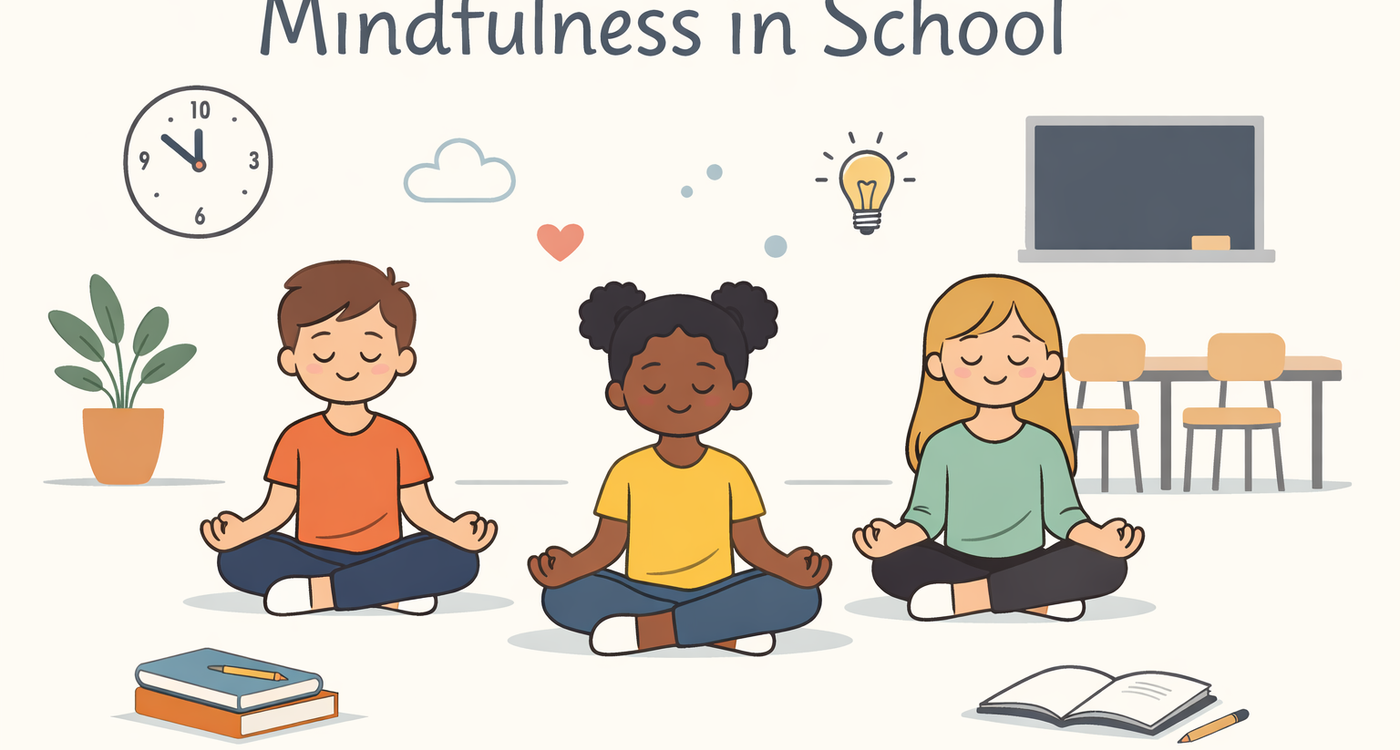
Learn how mindfulness in schools can support student focus, emotional regulation, teacher wellbeing, and calmer classrooms when implemented well.
A strong school mindfulness program does not ask overwhelmed teachers to perform calm. It gives them tools, time, and a structure they can actually use.
Schools do not need more noise. They need practices that help students settle, teachers breathe, and classrooms function with less friction. That is the real case for mindfulness in schools. Not trend, not branding, not a poster on a wall. Schools need tools that improve attention, emotional regulation, and the quality of daily interaction.
The context is serious. The CDC reports that in 2023, 40% of U.S. high school students felt persistently sad or hopeless, 20% seriously considered suicide, and nearly 9% attempted suicide. WHO reports that one in seven adolescents aged 10-19 lives with a mental disorder globally. Schools cannot solve every part of this picture, but they are one of the few places that can create daily protective routines, safer relationships, and consistent emotional language.
Teachers need support too. RAND's 2024 State of the American Teacher Survey found that 59% of teachers reported frequent job-related stress and 60% reported burnout. Any conversation about student wellbeing that ignores teacher wellbeing fails before it starts.
What mindfulness in schools really means
Mindfulness in schools means teaching students and staff how to notice thoughts, emotions, impulses, and body signals with more awareness and less automatic reaction. In practice, that may include brief breathing routines, attention training, emotional check-ins, sensory grounding, reflective writing, mindful transitions, and teacher self-regulation habits.
That sounds simple. The mistake is treating mindfulness as a one-off activity. A five-minute breathing video does not create a mindful school. A real program fits into the rhythm of the day, the language of the classroom, and the culture of the adults leading it.
Your school initiative already positions this clearly. The Holistic Care school mindfulness program ocuses on increased focus, improved academic performance, reduced stress, teacher training, curriculum integration, and parent support. It frames mindfulness as a whole-school practice rather than a one-off activity.
Why mindfulness matters for students
Students do better when they can notice what is happening before it spills into behavior. A child who can recognize "I feel overwhelmed" is already in a better position than a child who only knows how to shut down, lash out, or disappear into distraction.
The CDC also emphasizes school connectedness as a protective factor for mental health. That matters because mindfulness, when taught well, improves more than quietness. It can support attention, emotional language, impulse control, and the sense that school is a place where adults notice and care.
Broad school research points in the same direction. The Education Endowment Foundation reports that social and emotional learning approaches deliver an average of +3 months of additional progress and do so at very low cost. Mindfulness is not the same thing as all SEL, but it fits naturally inside that wider evidence base when it is used to teach self-management, attention, empathy, and calm.
Why mindfulness matters for teachers
Teachers regulate classrooms partly by regulating themselves. A reactive adult often produces a reactive room. A grounded adult produces a different pace, different language, and different outcomes.
This is where many school mindfulness conversations go wrong. They focus only on student behavior. They ignore teacher overload, paper-thin planning time, and the emotional cost of working all day inside other people's stress. RAND's 2024 figures make that impossible to ignore. Frequent stress and burnout are not side issues. They shape how teaching feels and how students experience the room.
That is why the most useful school mindfulness work starts with adults. Not because adults matter more, but because adults set the tone. When teachers have repeatable tools for pausing, breathing, resetting, and responding with intention, students benefit immediately.
What the evidence says - and what it does not
Mindfulness in schools has promise, but the evidence is not a blank check. A 2024 meta-analysis of preadolescent children found supportive effects for mindfulness-based interventions. Another 2024 reanalysis argued that universal school-based mindfulness interventions in adolescents may not deliver the benefits some earlier reviews suggested. In other words, age, implementation quality, and fit matter. One-size-fits-all claims are not supported.
That is why the useful question is not "Does mindfulness work?" The useful question is "For whom, in what format, with what adult support, and for what goal?" A school that wants lower conflict, better transitions, and stronger emotional regulation needs a different program from a school that wants deeper staff wellbeing work or parent engagement.
How to introduce mindfulness in schools without making it another burden
1. Start with routines, not ideology
Use short practices that teachers can repeat:
- one-minute arrival breathing
- transition resets after lunch
- pre-test grounding
- end-of-day reflection
2. Train staff before scaling to students
Teachers need direct experience of the practices. They should know what the exercises feel like, what they help with, and where they may not fit.
3. Use age-appropriate language
Younger children do better with imagery, movement, and metaphor. Older students respond better when the practice feels respectful and real, not childish or forced.
4. Build from regulation to reflection
Start with body and breath. Then move to noticing thoughts, emotional triggers, and attention habits.
5. Involve families
EEF reports that parental engagement is associated with +4 months of additional progress on average. Mindfulness sticks better when the same language shows up at home and at school.
6. Measure outcomes that matter
Track attendance, transition smoothness, classroom conflict, teacher stress, and student self-report. Do not judge a program only by whether students look quiet.
A better model: from isolated activity to school culture
The biggest mistake schools make is treating mindfulness as an event. A visiting workshop may inspire staff, but it does not change school culture on its own.
A better model looks like this:
- staff training
- classroom routines
- student activities
- family support
- review and adjustment
- leadership buy-in
That is exactly where our school mindfulness program fits. It brings together teacher training, curriculum integration, and systemic wellbeing. For classrooms that want a child-facing extension, The Magic Sketchbook offers a story-led way to build emotional awareness and calm.
Frequently Asked Questions
Does mindfulness improve academic performance?
It can support the conditions that improve learning, especially attention, emotional regulation, and classroom readiness. EEF's wider SEL evidence suggests those conditions matter for progress.
Should mindfulness in schools focus on students or teachers first?
Start with teachers and staff. Students benefit most when the adults leading the room can use the tools themselves.
Can mindfulness help reduce behavior issues?
It can help when schools teach self-regulation consistently and pair it with adult support, clear routines, and realistic expectations. It is not a standalone fix.
Is mindfulness enough to address youth mental health?
No. Mindfulness can support wellbeing, but schools still need counseling access, safety, strong relationships, and referral systems when students need more care.
Closing
Mindfulness belongs in schools when it solves real classroom problems and supports real human needs. Keep it practical. Train the adults. Build repeatable routines. Let the culture do the rest.
Written by
Editorial Team