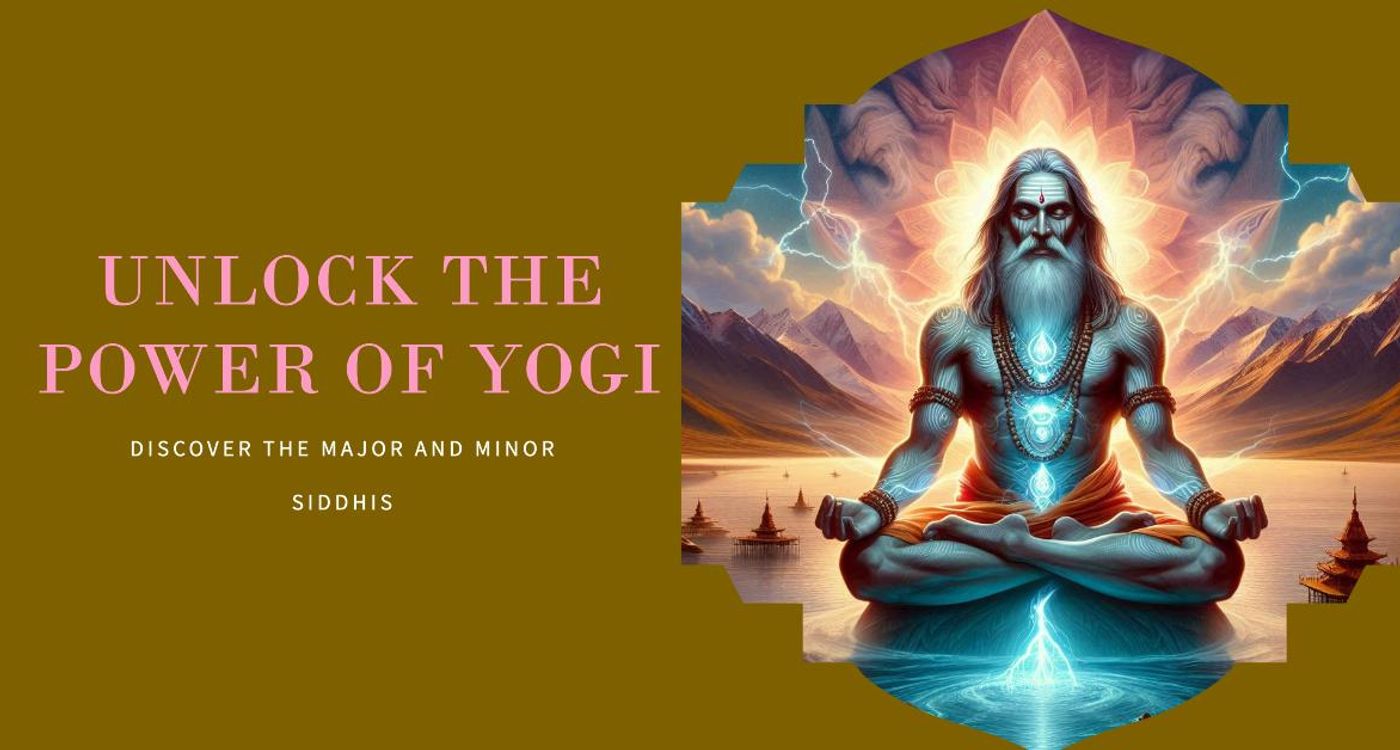
Explore the eight major Siddhis (Ashta Maha Siddhis) and minor powers described in classical yoga. Understand their relationship to Kundalini, the chakras, and why the tradition warns against seeking them as goals.
In the vast literature of yogic philosophy, few subjects provoke as much fascination — and as much misunderstanding — as the siddhis: the extraordinary powers said to arise as by-products of advanced spiritual practice. Whether you have encountered references to levitation in classical texts, read accounts of masters who could perceive distant events, or simply felt a mysterious expansion of awareness in deep meditation, you have brushed against the territory that classical yoga calls siddhi.

The word siddhi (Sanskrit: सिद्धि) derives from the root √sidh, meaning "to accomplish," "to attain," or "to be fulfilled." At its most literal, a siddhi is simply an accomplishment — something perfected through sustained effort. In the specialised vocabulary of yoga, however, the term refers to supernormal powers or perfections that emerge as natural by-products of the most advanced stages of meditative and ascetic discipline.
This guide is the most thorough English-language treatment of the subject: its textual origins in Patanjali's Yoga Sutras and the Bhagavata Purana, the complete catalogue of the eight major (Ashta Maha) siddhis and the thirty-two minor siddhis, their relationship to samyama, chakras, and kundalini, the cross-traditional perspectives from Buddhism, Christian mysticism, and Sufism, and — critically — the important warnings that every serious practitioner must understand. Whether you are a curious beginner or a seasoned yogi, this is the definitive resource on yogic powers.
Quick Answer: What Are the Siddhis?
Siddhis are supernormal powers or spiritual perfections that arise as natural by-products of advanced yogic practice — specifically through mastery of samyama (the combined practice of dharana, dhyana, and samadhi). Classical yoga recognises two primary categories:
- Ashta Maha Siddhis — the 8 major powers enumerated in the Bhagavata Purana (11.15) and elaborated in the Yoga Sutras of Patanjali
- Minor Siddhis — up to 32 secondary abilities catalogued in Puranic, Tantric, and Agamic sources
Virtually every classical yoga tradition regards siddhis as distractions from liberation (moksha) and explicitly cautions against pursuing them as spiritual goals. Patanjali states in Yoga Sutras 3.37: "These are perfections to the outward-turned mind, but obstacles to samadhi."
Etymology and Origins: What "Siddhi" Really Means
The Sanskrit root √sidh (सिध्) carries a rich semantic field: to succeed, to be accomplished, to be fulfilled, to be perfected. The cognate siddha means "one who has accomplished" or "a perfected being" — a term applied across Indian traditions to masters who have fully realised the goals of their path. A siddha in the Shaiva tradition, for instance, may have attained liberation; a siddha in the Tantric Nath lineage may have mastered specific alchemical or yogic techniques that produced transformative powers in the body and mind.
The term appears in some of the earliest strata of Indian literature. The Rigveda speaks of seers (rishis) with visionary powers; the Upanishads describe yogis who perceive the entire cosmos within the Self. By the time of the great epics — the Mahabharata and Ramayana — stories of siddha masters who could travel through space, become invisible, enter other bodies, or live for centuries had become a central part of the cultural imagination.
The most systematic philosophical treatment of siddhis comes from Patanjali's Yoga Sutras (compiled approximately 400 CE, though drawing on far older oral traditions). The entire third chapter — Vibhuti Pada, the "Chapter on Powers" or "Chapter on Manifestations" — is devoted to the mechanism by which supernormal abilities arise and to the crucial warning about their relationship to liberation. It is one of the most technically sophisticated and philosophically challenging texts in the entire yoga canon.
Key Numbers in the Classical Siddhi Literature
The Eight Major Siddhis (Ashta Maha Siddhis)
The Bhagavata Purana's account in Canto 11, Chapter 15 presents the Ashta Maha Siddhis in a dialogue between Lord Krishna and his disciple Uddhava, describing the eight primary powers as accessible to those who fix the mind upon the Supreme with complete absorption. Each power has a Sanskrit name that describes its essential quality, a classical description in the texts, and a deeper philosophical implication that rewards careful study.
| Siddhi | Sanskrit | Literal Meaning | Classical Description | Samyama Object (per YS) |
|---|---|---|---|---|
| Anima | अणिमा | Minuteness | Reducing the body to atomic size | Relationship between body and space |
| Mahima | महिमा | Greatness / Expansion | Expanding the body to infinite size | Vastness of space; the infinite |
| Garima | गरिमा | Heaviness | Making the body infinitely heavy / immovable | Earth element; samyama on gravity |
| Laghima | लघिमा | Lightness | Weightlessness of body; levitation | Relationship between body and prana |
| Prapti | प्राप्ति | Attainment / Reach | Obtaining or perceiving anything, anywhere | Senses and their relationship to objects |
| Prakamya | प्राकाम्य | Irresistible will | Manifesting any desire; entering other bodies | Distinction between consciousness and its modifications |
| Ishitva | ईशित्व | Lordship / Sovereignty | Mastery over elements and natural forces | The five elements and their transformations |
| Vashitva | वशित्व | Dominion / Subjugation | Bringing all beings and forces under influence | Nature of consciousness in all beings |
1. Anima — The Power of Minuteness
Anima derives from anu, meaning "atom" or "minute particle." Classically described as the ability to reduce oneself to the size of an atom — to pass through solid matter, to perceive subatomic reality directly — Anima represents the mastery of the relationship between consciousness and material form. The Bhagavata Purana states that the yogi with Anima can enter stones, water, fire, and wind without obstruction.
Practitioners who report states resembling Anima often describe an experience of consciousness becoming so refined and concentrated that the sense of bodily mass dissolves entirely. Awareness becomes a single point of pure perceiving, unbounded by physical limitation. In Kashmir Shaivism's language, this corresponds to the recognition that consciousness is the substratum of all apparently solid matter — a recognition that, in its completest form, transforms the yogi's relationship to the physical world.
2. Mahima — The Power of Infinite Expansion
The polar opposite of Anima, Mahima involves expanding awareness to encompass infinite space. The Bhagavata Purana describes a yogi with Mahima as capable of touching the sun or moon — a description most practitioners read as referring to the vast, boundless quality of deep meditative awareness rather than literal physical expansion. Mahima experiences in meditation are characterised by the sudden dissolution of the boundary between self and cosmos — the felt sense that one's awareness pervades all of space equally, with no centre and no circumference.
3. Garima — The Power of Infinite Weight
Garima derives from guru, meaning "heavy" or "weighty." Traditional accounts describe siddhas with Garima who could not be lifted by any force, who sat in samadhi while floods and storms passed around them without moving. At the psychological level, Garima is absolute stability — an unshakeable groundedness of consciousness. The practitioner who has cultivated this quality embodies the quality of the earth element in its highest expression: an unmoveable solidity that is not rigidity but profound centredness.
4. Laghima — The Power of Weightlessness
Laghima — from laghu, "light" — is perhaps the most celebrated siddhi in popular culture: levitation. The Yoga Sutras speak of mastery over the relationship between body and prana, with advanced pranayama described as creating literal lightness. The Hatha Yoga Pradipika records that perfection in Khechari Mudra and advanced pranayama can produce levitation. Documented accounts of levitation span cultures — from the Christian saints catalogued by Herbert Thurston (including St. Joseph of Cupertino, described in over 70 eyewitness accounts) to Tibetan lung-gom practitioners. The classical account holds that prana, when fully mastered, can overcome gravity.
5. Prapti — The Power of Infinite Reach
Prapti — "attainment" — describes the capacity to obtain or perceive anything, anywhere, instantly. Classical descriptions include the ability to touch the moon, to taste any flavour regardless of distance, to understand the language of all creatures. In the Yoga Sutras framework, Prapti is related to mastery of the senses and their relationship to their objects. When awareness is no longer confined to the immediate physical environment but can range freely through space, Prapti is present. This maps onto contemporary reports of meditators describing extrasensory awareness — the dissolution of the assumption that consciousness is anchored to a specific spatial location.
6. Prakamya — The Power of Irresistible Will
Prakamya — from prakama, "desire" or "will" — describes a state in which intentions manifest without obstruction. Classical texts describe practitioners with Prakamya as able to enter other bodies (parakaya pravesha), to remain submerged without drowning, and to materialise objects through willpower alone. The deeper philosophical implication is about the alignment of individual will with cosmic will. When the personal self (ahamkara) is sufficiently dissolved, what remains is a will no longer opposed by ego-desire — one that flows without obstruction not because it dominates reality, but because it is in perfect harmony with it.
7. Ishitva — Sovereignty Over Nature
Ishitva — from Isha, "lord" or "master" — represents sovereign mastery over natural forces: the five elements, weather, and natural phenomena. A yogi with Ishitva is described as able to cause rain, calm storms, command fire. In Tantric texts, particularly the Kashmir Shaivism corpus, Ishitva represents the complete integration of the five tattvas (elemental principles) within the practitioner's subtle body. When the inner world is fully aligned with the elemental forces that constitute outer reality, apparent sovereignty over those forces naturally follows — not through coercion, but through resonance.
8. Vashitva — Universal Dominion
Vashitva — from vasha, "control" — is the power to bring any being, force, or element under one's influence. This is the most ethically charged of the eight, since its description can evoke images of manipulation. Classical texts clarify that true Vashitva is not the ego's desire to dominate others but the natural authority that flows from completely purified consciousness. The closest modern analogue is the extraordinary, unforced presence of certain masters — the capacity to hold space such that those nearby feel naturally drawn toward their own highest potential. This "field effect" of awakened consciousness is documented across traditions and represents the experiential reality behind Vashitva.
The 32 Minor Siddhis: A Complete Catalogue
While the Ashta Maha Siddhis are the most celebrated, numerous texts — especially the Bhagavata Purana (11.15.4–5) and various Tantric and Agamic sources — catalogue a much larger set of minor siddhis. The exact number varies by tradition; the most commonly cited list runs to thirty-two, though some sources enumerate ten secondary powers and others list over sixty. The minor siddhis are generally understood as arising earlier on the path, often as natural side effects of sustained concentration and purification.
The 32 Minor Siddhis — Grouped by Category
Powers of Perception
Powers Over the Body
Powers Over the Elements and Matter
Powers of Manifestation and Influence
Powers of Knowledge and Liberation
Patanjali's Vibhuti Pada: How Siddhis Arise Through Samyama
Understanding the mechanism by which siddhis develop requires engaging with Patanjali's technical vocabulary. The Yoga Sutras present a model of consciousness in which the ordinary mind (chitta) is in a state of constant turbulence (vritti). As practice deepens and the fluctuations progressively still, increasingly subtle layers of consciousness become accessible — and specific powers emerge as natural consequences of that deepening.
The Threefold Technique: Dharana, Dhyana, Samadhi
Patanjali introduces the concept of samyama in Yoga Sutras 3.4: it is the simultaneous, seamlessly combined practice of dharana (concentration, holding the mind on a single object), dhyana (meditation, the uninterrupted flow of attention toward that object), and samadhi (absorption, when the distinction between meditator and object dissolves). When these three are perfected and merged, samyama produces what he calls "the light of knowledge" — direct, non-conceptual cognition of the nature of whatever is held in awareness.
This direct cognition is not inferential or theoretical. The yogi who practises samyama on the relationship between their body and the element of space does not reason about weightlessness — they directly perceive the informational structure underlying physical reality, and as a result, the ordinary constraints associated with that structure no longer apply in the usual way. Patanjali then enumerates specific applications throughout Sutras 3.16–3.48: samyama on the moon reveals the arrangement of stars (3.27); samyama on the navel chakra reveals the structure of the body (3.29); samyama on the relationship between the ear and space produces divine hearing (3.41); samyama on the body and the element of space, with the lightness of cotton in mind, produces levitation (3.42).
The list is remarkably specific and systematic — it reads less like mythology and more like a reproducible technology, mapping specific objects of concentrated awareness to specific cognitive and physical outcomes. Whether one interprets this literally or as pointing to subtle shifts in the phenomenology of consciousness, the systematic character of the teaching is one of the most striking features of Vibhuti Pada.
The Warning: Siddhis as Obstacles to Samadhi (YS 3.37)
Patanjali is explicit: having devoted most of Book 3 to describing how siddhis arise, he pivots in Sutra 3.37 to issue a stark warning: "Te samadhav upasarga vyutthane siddhayah" — "These powers are accomplishments for the outward-turned mind, but obstacles to samadhi." The very abilities that might impress others are the same abilities that, if clung to with pride or desire, will halt the practitioner's deepest progress.
Swami Vivekananda, commenting on this sutra, wrote with characteristic directness: "By the power of samyama comes the knowledge of fine, obstructed, and remote things. The great danger of these powers is that they become obstacles to samadhi if they are held to be ends in themselves." Ramana Maharshi typically redirected any question about siddhis: "Find out who it is that wants the siddhi. Investigate the 'I' that seeks power. That investigation is the real practice — siddhis are diversions from it."
The fundamental problem is structural: siddhis are impressive. They attract attention, admiration, discipleship, and devotion. They offer compelling evidence that one is "advanced." Each of these outcomes — if clung to — feeds the very ego-structure that yoga practice is designed to dissolve. The tradition identifies three specific dangers: abhimana (pride in being a siddha), vikshepa (distraction, as the siddhi-holder's attention is perpetually drawn away from the formless ground), and para-pida (exploitation of others, which generates powerful karmic consequences and corrupts the subtle body).
Sutra 3.51 extends the warning: "When invited by celestial beings, the yogi should feel neither flattered nor attached, for there is possibility of undesirable consequences." Even the most subtle forms of recognition — by spiritual entities, not merely by humans — are flagged as potential traps. The warning is not against siddhis themselves but against attachment to them. The tradition affirms that these powers genuinely arise; it simply insists that the practitioner who is truly advancing toward liberation will naturally move beyond the sphere of siddhis, because the quality of awareness itself has fundamentally changed.
Siddhis in Other Traditions: Buddhism, Christianity, and Sufism
The territory of supernormal powers is not unique to the Hindu yoga tradition. A striking convergence across cultures and centuries suggests that these abilities point to something genuine about the deeper capacities of consciousness — rather than being the inventions of any one tradition.
The Six Abhijnas in Buddhism
The Pali Canon describes six higher knowledges (abhinna in Pali; abhijna in Sanskrit) that arise from mastery of the eight jhanas (meditative absorptions). These are: (1) iddhi-vidhā — psychic powers including the ability to multiply the body, walk on water, and fly; (2) dibba-sota — divine ear, hearing any sound anywhere; (3) ceto-pariya-nana — direct knowledge of others' minds; (4) pubbe-nivasanussati-nana — recollection of past lives; (5) dibba-cakkhu — divine eye, clairvoyant knowledge of other beings' deaths and rebirths; and (6) asavakkhaya-nana — knowledge of the destruction of the mental fermentations, which leads to liberation.
The parallels with the yogic siddhi system are unmistakable, though there are important philosophical differences. The Buddhist tradition is equally emphatic about the dangers: the five powers short of liberation are explicitly described as "mundane" (lokiya) as opposed to supramundane (lokuttara), meaning they remain within the conditioned realm and cannot lead to liberation on their own. The Samaññaphala Sutta records that even a monk who possesses all five mundane abhijnas is not yet free. The sixth — the direct knowledge of liberation itself — is the only one that truly matters.
Charismatic Gifts in Christian Mysticism
The Catholic tradition catalogues charismata (gifts of the Holy Spirit) that closely parallel yogic siddhis. These include: glossolalia (speaking in tongues), prophecy, healing, discernment of spirits, working of miracles, levitation, and bilocation. St. Joseph of Cupertino (1603–1663) is the most extensively documented levitating saint, with over seventy eyewitness testimonies, including accounts from inquisitors, cardinals, and a reigning monarch. St. Padre Pio of Pietrelcina was widely reported to have the gifts of bilocation, healing, clairvoyance, and the reading of souls.
The Christian mystical tradition is equally careful to contextualise these gifts: they are understood as evidence of God's presence working through the saint, not as the saint's own achievement or possession. St. John of the Cross, in "The Ascent of Mount Carmel," explicitly warns against attachment to extraordinary spiritual experiences, including miraculous powers, on grounds strikingly similar to Patanjali's: they become obstacles to the pure union with God that is the goal of the contemplative life.
Barakah in Sufism
In Islamic mysticism, the concept of barakah — divine blessing or grace — encompasses a range of abilities that Sufi saints (awliya, "friends of God") are said to manifest: karamat (miraculous gifts), including healing, knowledge of hidden things, clairvoyance, bilocation, and the ability to affect the physical world through prayer and presence. The Sufi tradition distinguishes carefully between karamat (the miraculous acts of the awliya) and mu'jizat (the miracles of the prophets), the latter being definitionally greater. Like the yogic and Buddhist traditions, classical Sufism is unambiguous that karamat are not to be sought, displayed, or taken as evidence of spiritual attainment — they are signs of divine favour, not of the saint's own achievement.
This cross-traditional convergence is philosophically significant. It suggests that the territory described by the siddhi system is not a Hindu cultural construct but a genuine feature of the human contemplative landscape — something that reliably appears wherever consciousness is seriously and systematically cultivated, regardless of the doctrinal framework within which the cultivation takes place.
Major Siddhis: Cross-Reference Table
| Siddhi | Primary Source Text | Chakra Association | Samyama Object (YS) | Buddhist Parallel |
|---|---|---|---|---|
| Anima | Bhagavata Purana 11.15; YS 3.42 | Muladhara / Sahasrara | Body-space relationship; akasha | Iddhi-vidhā (body multiplication) |
| Mahima | Bhagavata Purana 11.15; YS 3.27 | Sahasrara / cosmic | Vastness of space; the infinite | Dibba-cakkhu (expanded sight) |
| Garima | Bhagavata Purana 11.15 | Muladhara (earth element) | Earth tattva; gravity principle | No direct parallel |
| Laghima | Bhagavata Purana 11.15; YS 3.42 | Anahata / Vishuddha | Body-prana relationship; lightness | Iddhi-vidhā (flying / levitation) |
| Prapti | Bhagavata Purana 11.15; YS 3.36 | Ajna (third eye) | Senses and their objects | Dibba-sota (divine hearing) |
| Prakamya | Bhagavata Purana 11.15; YS 3.38 | Ajna / Sahasrara | Consciousness vs. its modifications | Ceto-pariya (mind-reading) |
| Ishitva | Bhagavata Purana 11.15; YS 3.44 | Manipura (fire / will) | Five elements and transformations | Iddhi-vidhā (mastery of matter) |
| Vashitva | Bhagavata Purana 11.15; YS 3.47 | Anahata / Ajna | Consciousness in all beings | No direct parallel |
Are Siddhis Real? A Balanced Treatment
This is the question most practitioners eventually arrive at — and it deserves a thoughtful, honest answer that neither inflates nor dismisses the classical accounts. The traditions that describe siddhis are among the most sophisticated philosophical and contemplative systems humanity has produced; they are not the products of naive or uncritical minds. At the same time, many claimed abilities remain outside the scope of current scientific verification. A genuinely balanced treatment requires holding both of these facts.
What Neuroscience and Clinical Research Suggest
Research on advanced meditators has documented measurable physiological differences that are not present in non-practitioners. Studies conducted at institutions including Harvard Medical School, the University of Wisconsin-Madison's Center for Healthy Minds, and the Max Planck Institute have shown that long-term practitioners display increased gamma wave synchronisation during meditation, reduced default mode network activity (the neural correlate of the "inner voice"), significantly altered pain responses, and, in Tibetan tummo practitioners, the documented ability to raise peripheral body temperature by several degrees through breath-and-visualisation practices. These findings are not siddhis in the classical sense, but they demonstrate that sustained contemplative practice produces genuine, measurable changes in the relationship between consciousness and the body.
The question of more dramatic abilities — levitation, bilocation, materialisation of objects — has not been scientifically investigated in any rigorous, replicated way. A small number of early twentieth-century studies on phenomena like Sai Baba's materialisations and various claims of levitation were conducted, but methodological limitations prevent definitive conclusions. This absence of scientific confirmation does not constitute disproof; it reflects the difficulty of applying laboratory protocols to phenomena whose occurrence is not reproducible on demand and whose conditions include variables (depth of meditative absorption, karmic ripeness, the "grace" element in theistic traditions) that are not controlled for.
The Phenomenological Argument
Perhaps more relevant than the scientific question is the phenomenological one. Practitioners across traditions consistently report experiences that correspond to minor siddhis — not as the result of suggestion or wishful thinking, but as spontaneous occurrences that are often initially confusing or disorienting. Heightened intuition about others' emotional states, apparent pre-cognition of events, the sense of awareness not being confined to the physical body, vivid knowing without a known source — these experiences are reported by a substantial proportion of serious, long-term meditators and are not easily explained by standard psychological frameworks.
The classical tradition's response to "are siddhis real?" would be: you are asking the wrong question. Reality itself, in the non-dual frameworks of Kashmir Shaivism or Advaita Vedanta, is not divided into a physical realm where things "really" happen and an inner realm of mere experience. The practitioner who is investigating the nature of consciousness directly is not asking whether siddhis are "real" in the materialist sense; they are noting what arises and asking what it reveals about the nature of awareness. That is a more interesting and more honest inquiry.
How to Approach Siddhis on the Contemporary Path
Given everything above, how should a sincere modern practitioner relate to the territory of siddhis? The following guidance synthesises the consensus of classical texts with the practical wisdom of contemporary teachers who have worked with advanced meditators.
Do Not Seek Siddhis
The unanimous advice of authentic teachers across all traditions is unambiguous: do not make siddhis a goal of practice. The appropriate goal is liberation — the recognition of the nature of awareness itself. Siddhis may arise as by-products, but pursuing them actively diverts energy from the central inquiry and strengthens the ego rather than dissolving it. This is not puritanical caution; it is a structural understanding of how consciousness works.
Do Not Deny or Suppress Unusual Experiences
Equally, if unusual experiences arise in meditation — extraordinary clarity, apparent perception of distant events, profound knowing of others' inner states — the practitioner should neither inflate these experiences nor anxiously suppress them. The instruction is to acknowledge them with equanimity and return to the practice. A brief journal notation can be useful; extensive analysis outside of practice is not recommended, as it pulls attention toward the phenomenon and away from the source from which it arose.
Prioritise Foundation Practices
The most reliable path to both genuine insight and the natural ripening of authentic siddhis is consistent foundation practice: ethical living (yamas and niyamas), physical preparation through asana, breath regulation through pranayama, and progressive deepening of meditation. Attempting to access siddhi-oriented techniques without this foundation is both ineffective and potentially destabilising. The tree must be mature before unusual fruit appears; attempting to force the fruit before the tree is ready produces nothing except distortion.
Work With a Qualified Teacher
The terrain described in Vibhuti Pada is not suitable for solo navigation. The classical tradition is clear that advanced stages of meditation require the guidance of a qualified teacher — not because the experiences themselves are inherently dangerous, but because the ego's capacity for self-deception is never more active than when impressive states of consciousness are available. The practitioner who believes they have attained a siddhi without any teacher's guidance is particularly at risk of the inflation and distraction that the tradition warns against.
Frequently Asked Questions About Siddhis
Can anyone develop siddhis?
Classical texts suggest that siddhis arise naturally as the by-products of deep, consistent practice — and that the capacity for practice exists in every human being. Yoga Sutra 1.14 specifies the conditions: practice must be sustained over a long time (dirgha kala), without interruption (nairantarya), and with sincere devotion (satkara asevita). The texts do not suggest that siddhis are reserved for a special elite, but they are equally clear that ordinary practice — even sincere and sustained practice — will not automatically produce the major siddhis. The minor siddhis — heightened intuition, expanded perception, unusual clarity — are accessible to serious practitioners within years; the major eight are associated with the highest stages of realisation and are not typical even among accomplished yogis.
What is the difference between siddhi and vibhuti?
The terms are related but not identical. Siddhi (from √sidh, to accomplish) refers specifically to supernormal powers or perfections that arise from yogic practice. Vibhuti (from vi + bhuj, to enjoy fully; or from vibhu, all-pervading) literally means "greatness," "glory," or "manifestation of power." In the Bhagavad Gita Chapter 10, Krishna uses the term vibhuti to describe his divine manifestations — the specific aspects of the cosmos that most powerfully express the divine nature. Patanjali's third chapter is called Vibhuti Pada — the "chapter on powers/glories" — using vibhuti to refer to the extraordinary capacities arising from samyama. In common usage, vibhuti is often used interchangeably with siddhi, but strictly speaking, vibhuti implies divine manifestation or glory, while siddhi implies personal accomplishment or power. Sacred ash used in Hindu rituals is also called vibhuti, pointing to the sanctified, transformative quality the substance represents.
Are siddhis dangerous?
The traditions are consistent: siddhis themselves are not inherently dangerous, but the ego's relationship to siddhis can be deeply problematic. The specific dangers identified are pride (abhimana), spiritual distraction (vikshepa), and the temptation to use powers over others (para-pida), which carries severe karmic consequences. Unexpected siddhic experiences — particularly intense perceptual shifts, spontaneous out-of-body states, or apparent merger with others' consciousness — can also be disorienting for practitioners without an adequate conceptual framework. The most protective factors are a stable practice foundation, an established relationship with a qualified teacher, and a clear primary commitment to liberation rather than to any specific experience or ability.
Are siddhis real, or are they metaphorical?
Classical yoga traditions affirm that siddhis are genuine experiential states that arise in advanced practice. Whether they involve literal physical transformation (levitation as measured by a scale) or represent profound shifts in the phenomenology of consciousness is a question the classical texts do not regard as meaningful — since the distinction between inner and outer reality is itself a product of ordinary, unexamined consciousness. What is clear is that many experiences that correspond to minor siddhis are reported by serious long-term meditators, that measurable physiological effects of advanced practice have been documented, and that the full range of described abilities remains outside current scientific frameworks — which does not constitute disproof, but simply reflects the limits of current methodology.
How long does it take to develop siddhis?
No fixed timeline is given in the classical texts, since the pace of development depends on the intensity and consistency of practice, the karma the practitioner brings to the path, and the presence of skilled guidance. Minor siddhic experiences — heightened intuition, unusual clarity, expanded perception — can arise for serious practitioners within years. The major siddhis described in the texts are associated with the very highest stages of meditative realisation and are not common even among dedicated practitioners who have practised for decades. The tradition is clear that attempting to accelerate siddhi development through effort and impatience is counterproductive; the qualities that produce authentic siddhis (samadhi depth, purity, non-attachment) are the very qualities that cannot be forced.
Which yoga practices most directly support siddhi development?
According to Patanjali, samyama — the combined, sustained practice of dharana, dhyana, and samadhi on a specific object — is the primary mechanism. More generally, any practice that deeply purifies and concentrates awareness creates the conditions in which siddhis can arise: advanced pranayama (especially kumbhaka, breath retention), prolonged tratak (steady-gazing), mantra japa practised with deep absorption, intensive vipassana meditation, and Tantric practices involving chakra work and kundalini. In the Hatha Yoga tradition, certain mudras (notably Khechari and Shanmukhi) and bandhas are specifically associated with siddhi development. The warning, however, remains: these should all be practised in the context of a complete path toward liberation, not as techniques for acquiring powers.
Why does Patanjali spend a whole chapter on siddhis if they are obstacles?
The structure of Vibhuti Pada is itself the teaching. Patanjali first maps the territory exhaustively — demonstrating that the yoga tradition takes full account of these experiences and does not deny or suppress them — and then delivers the pivotal warning in sutra 3.37. This sequence communicates: "Yes, all of this is real. Yes, it arises in serious practice. And here is why you must not stop here." The chapter is also important as a map: practitioners who encounter unusual experiences in meditation need a framework for understanding what is happening and how to respond. Without that map, practitioners can become lost in the territory. The chapter provides orientation precisely so that the practitioner knows how to continue moving toward the ultimate goal rather than camping in the impressive foothills.
Can siddhis be lost? Are they permanent once attained?
The classical texts note that siddhis arising from samyama depend on the continuing depth of meditative absorption. If a practitioner lapses in practice, allows the mind to become turbulent again, or — critically — becomes attached to the siddhi itself (which paradoxically undermines the quality of samadhi required to sustain it), the ability fades. This is another reason why non-attachment to siddhis is not merely ethical advice but a practical necessity: clinging to a siddhi will, by definition, generate the mental turbulence that dissolves it. The only attainment described as permanent and unconditional in the yoga tradition is liberation (kaivalya) itself — the recognition of the nature of pure awareness, which cannot be gained or lost because it was never absent.
The Siddhi Path in Perspective
The subject of siddhis, approached with care and discernment, opens a window onto one of the most ambitious and sophisticated accounts of human potential in any spiritual tradition. The yoga system does not ask us to believe in extraordinary powers on the basis of faith, nor does it encourage us to pursue them as spiritual trophies. It simply maps the terrain of consciousness with extraordinary precision and invites us to investigate that territory ourselves.
The message is ultimately simple: consciousness is far vaster, far more capable, and far more wondrous than ordinary experience suggests. And yet — even this recognition, even the most astonishing display of powers, pales against the recognition of one's own nature as pure, unbounded awareness. That recognition is what the tradition calls liberation, and it is the destination toward which all genuine yoga practice — with or without siddhis — is steadily moving.
Whether you approach your mat tomorrow as a complete beginner or a seasoned practitioner, the invitation is the same: investigate the nature of the awareness that is reading these words right now. Everything else, including the siddhis, will take care of itself.
Written by
Editorial Team