
Kundalini yoga uses asanas to stimulate glands and direct prana, not just for physical alignment. Learn key postures, mudras, bandhas and how kriyas work.
Quick Answer: In Kundalini yoga, asanas serve a different purpose than in Hatha yoga. Rather than prioritising physical alignment or flexibility, postures are selected to stimulate specific glands, activate the nervous system, and direct prana along the energy channels. Each kriya uses postures as tools alongside breath, mudra and mantra to produce a defined energetic effect.
How Kundalini Yoga Uses Asana Differently
In Hatha yoga and its derivatives, the quality of a posture is assessed largely in anatomical terms: the angle of the joints, the engagement of the muscles, the alignment of the spine. A skilled teacher uses this framework to make the posture safer, more effective, and appropriate for each student's body. The refinement of physical alignment is itself a significant part of the practice.
Kundalini yoga takes a different approach. Postures are selected and held because of their specific effects on the endocrine system, the nervous system, and the flow of prana through the nadis and chakras. The question asked is not "is this posture anatomically correct?" but "what effect does this posture produce in the body and energy system, and how does it serve the overall intention of the kriya?"
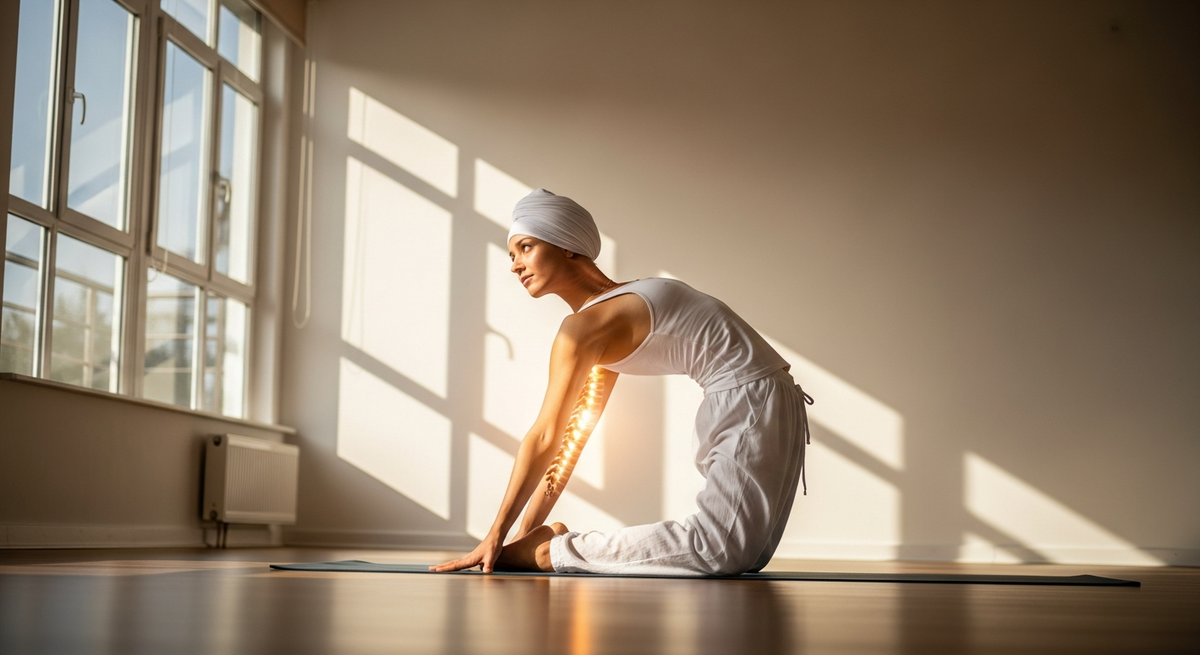
This does not mean alignment is ignored. Spinal alignment is consistently emphasised in Kundalini yoga because the spine is the physical structure along which the Sushumna nadi runs. Sitting with the spine erect, the chin drawn slightly back in what is called Jalandhara Bandha, is standard in most sitting postures. But the refinement beyond that is energetic rather than anatomical.
Key Postures Used in Kundalini Kriyas
Frog pose, or Mandukasana, is one of the most frequently appearing postures in Kundalini kriyas. The practitioner comes into a deep squat on the toes with the heels raised and touching, the fingertips on the floor between the knees. From this position, the legs straighten and the hips lift on the inhale, then return to the squat on the exhale. Rapid repetition stimulates the reproductive glands, builds heat, and moves energy through the lower chakras. Sets of 26, 54, or 108 repetitions are common.
Cat-cow, called Cat-Cow Stretch or spinal flex in Kundalini terminology, is used in multiple forms. In the seated version, the practitioner sits in Easy Pose and flexes the spine forward on the inhale and back on the exhale, often with Breath of Fire or a specific mantra. This simple movement stimulates the spinal fluid, opens the chakras sequentially along the spine, and prepares the body for deeper practices.
Bow pose, Dhanurasana, lies on the stomach with the hands reaching back to hold the ankles, lifting both the chest and the thighs off the floor. In Kundalini kriyas, it is often held with specific breath patterns or used in rapid rocking motion. It stimulates the digestive organs, opens the heart and throat, and activates the entire front body. It frequently appears in kriyas for the heart chakra and for emotional release.
Sat Kriya: The Foundational Kundalini Posture
Sat Kriya is considered one of the most complete and powerful practices in the Kundalini yoga system. The practitioner sits on the heels in Rock Pose, Vajrasana, with the arms extended overhead, palms together and fingers interlaced except for the index fingers pointing up. The navel is rhythmically pumped as the practitioner chants Sat on the exhale and Nam on the inhale.
This single practice works simultaneously on multiple levels: the arm position creates a specific mudra that locks the energy in the upper chakras, the seated position compresses the lower body and activates the lower triangle of chakras, and the navel pump creates a rhythmic pressure that moves energy upward through the system. Yogi Bhajan stated that practising Sat Kriya for three minutes daily produces measurable changes in the endocrine and nervous systems.
The posture in Sat Kriya, as in all Kundalini kriyas, is not adjusted toward greater comfort or ease. It is held precisely as specified because the precise position is part of how the practice works. The discomfort, if present, is acknowledged but not used as a reason to change the posture. The relationship to discomfort itself becomes part of the practice.
Mudras and Bandhas: Working Alongside Asana
Mudras are hand and finger positions that create specific energetic circuits in the body. Every finger corresponds to a different element and a different quality of mind. Gyan mudra, the thumb and index finger touching, is the most common in Kundalini yoga: it joins fire and air, creates a circuit that supports focus and receptivity, and is used in the majority of meditations. Shuni mudra connects thumb and middle finger and is associated with patience and discernment. Surya mudra connects thumb and ring finger and is associated with energy and vitality.
Bandhas are energetic locks applied by engaging specific muscle groups. Mula Bandha, the root lock, contracts the muscles of the pelvic floor, pulling upward. It is applied at the end of the exhale in many Kundalini practices and is understood to prevent the downward dissipation of prana, directing it upward instead. Uddiyana Bandha, the diaphragm lock, draws the navel and diaphragm upward on the exhale. Jalandhara Bandha, the neck lock, draws the chin slightly back and down, maintaining the alignment of the cervical spine and preventing the excessive upward movement of prana during intense practices.
Prana, Posture and the Energy Channels
The underlying principle connecting asana, mudra, and bandha in Kundalini yoga is the management of prana, the vital life force. According to yogic physiology, prana flows through a network of energy channels called nadis, of which the three most important are the Ida (lunar, left channel), the Pingala (solar, right channel), and the Sushumna (central channel running through the spinal column).
Kundalini energy, when awakened, moves through the Sushumna. The purpose of asana, pranayama, mudra, bandha, and mantra in Kundalini yoga is to clear the nadis, balance the flow of prana between the Ida and Pingala, and open the Sushumna so that the Kundalini energy can rise without obstruction. Every element of a kriya serves this purpose, whether or not the practitioner can feel the energy directly.
For beginners, the energetic effects are often subtle and most noticeable in their downstream consequences: better sleep, more even emotional regulation, increased mental clarity, or a quieter experience of the mind during the meditation portion of class. Over time, and with consistent practice, the subtler dimensions of the work become more directly perceptible.
Featured Programme
The I AM Programme
A structured course in nondual mindfulness for adults working with awareness, breath and inner stillness
Explore the ProgrammeWritten by
Editorial Team

