How MBCT (Mindfulness-Based Cognitive Therapy) is adapted for children and adolescents — what the research says, how it works for young people, and where to find it.
Children and young people are experiencing a mental health crisis. In the UK, one in six children aged 5–16 has a probable mental disorder (NHS Digital, 2022) — up from one in nine in 2017. In Australia, nearly half of all children with mental health problems receive no professional support. CAMHS waiting lists in the UK routinely exceed twelve months. Against this backdrop, school-based and community mindfulness programmes are not a luxury — they are an urgent, evidence-based response.
MBCT — Mindfulness-Based Cognitive Therapy — was developed for adults with recurrent depression. But the insight at its core: that our relationship to thoughts matters more than their content, is as relevant to a thirteen-year-old spiralling in social anxiety as it is to a forty-year-old managing depressive relapse. When adapted appropriately, MBCT-informed approaches produce meaningful, sustained reductions in anxiety, depression, and emotional reactivity in children and young people from age 7 upwards.
This guide explains how MBCT is adapted for young people, what the research shows, what parents and teachers need to know, and how to access programmes — including the unique contemplative approach offered by The Holistic Care for children aged 4–18.
The short answer
MBCT can be adapted effectively for children from age 7–8 and adolescents from age 11 upwards. Sessions are shorter, use movement and metaphor, and reduce home practice expectations. Research shows significant reductions in anxiety and depressive symptoms. The core skill — noticing thoughts as thoughts rather than facts — is developmentally accessible and practically useful for young people navigating academic pressure, social comparison, and identity formation.
Why MBCT is especially relevant to children and young people today
The adult MBCT programme was designed for one specific problem: why does depression return after recovery? The answer — cognitive reactivity, the tendency for mild low mood to automatically reactivate depressive thinking patterns — is clinically precise. Children do not typically present with that clinical history.
But the underlying cognitive patterns are strikingly similar. Anxiety and depression in young people are driven by the same mechanisms: rumination (going over and over difficult thoughts), catastrophising (assuming the worst), and cognitive fusion (treating thoughts as facts rather than mental events). An eleven-year-old who believes "I'm stupid and everyone can see it" and has no way to step back from that thought is experiencing exactly the cognitive pattern that MBCT was designed to interrupt.
Three features of contemporary childhood make MBCT-informed practices particularly timely.
📱
Social media comparison
Constant social comparison accelerates the self-evaluative thinking that MBCT targets. Young people who can observe "I am having the thought that I don't measure up" rather than believe it unconditionally are more resilient to social media's effects.
🎓
Academic pressure
Performance anxiety is one of the most common presentations in school-aged children. MBCT-informed practices reduce the catastrophic thinking ("If I fail this exam, my future is ruined") that makes performance anxiety self-fulfilling.
🧠
Identity formation
Adolescence is characterised by an intense search for identity. Young people who have a stable relationship with their own awareness — who can observe their changing thoughts about who they are without being defined by them — navigate this search with markedly less suffering.
How MBCT is adapted for children and adolescents
The adult MBCT programme cannot simply be handed to a class of eleven-year-olds and expected to work. The adaptation is careful and evidence-informed. Here are the key modifications at each developmental level.
Primary school children (ages 7–11): Paws b and foundational mindfulness
Children in primary school are introduced to mindfulness through the Paws b curriculum (developed by the Mindfulness in Schools Project), which draws on MBCT's core principles but delivers them through story, movement, and game-based activities. Sessions are 30–40 minutes. The focus is on:
- Body awareness: noticing physical sensations with curiosity — the feel of breath, the sensation of feet on the floor, warmth and cold
- Emotion recognition: naming feelings without judgment — "I notice I am feeling nervous right now" rather than being overwhelmed by the feeling
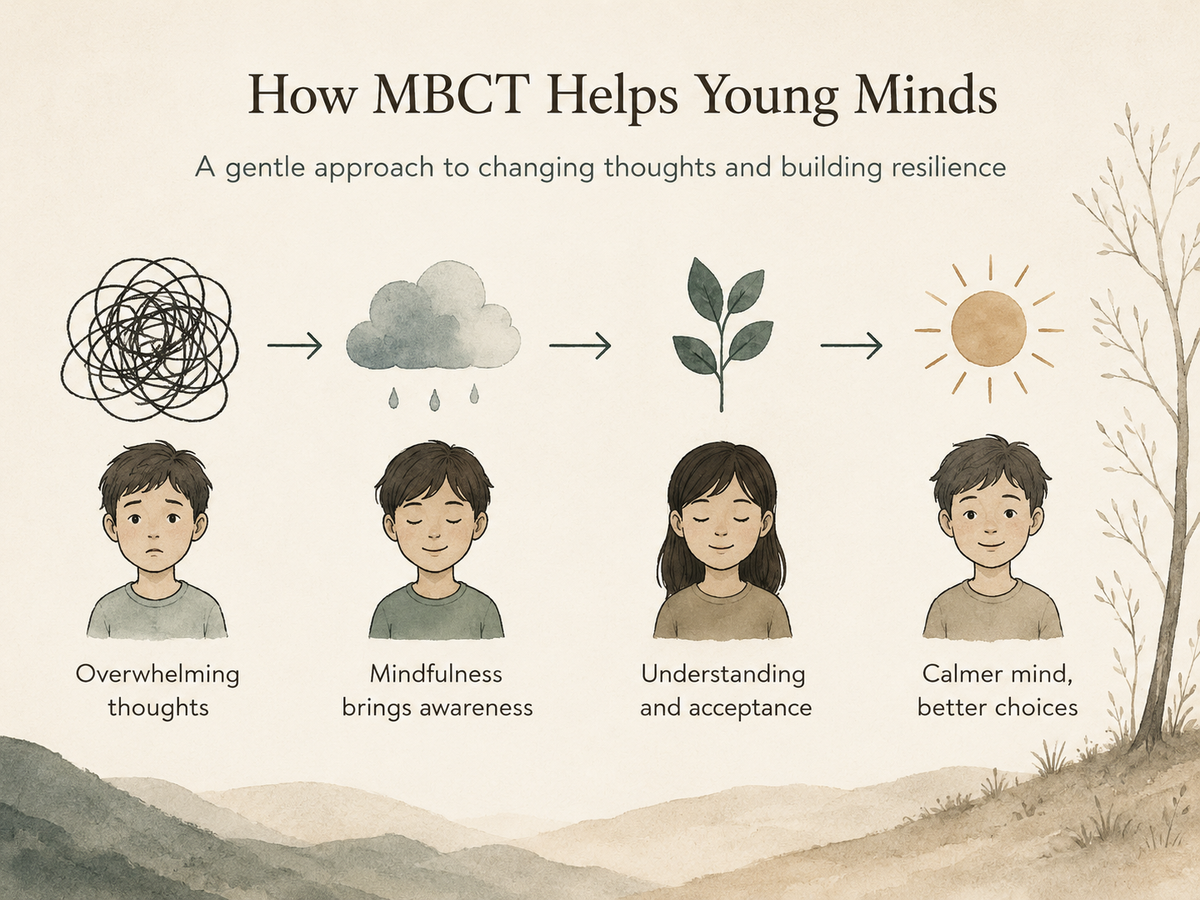
- The "weather in the body" metaphor: emotions are like weather — they arise, change, and pass, without defining who you are
- Mindful movement: yoga-inspired stretches, mindful walking, sensory activities that anchor attention in present experience
Home practice at this age is minimal and informal — "notice three things you can see on your walk to school today" rather than formal sitting meditation. Parental involvement is encouraged, with guidance sheets for parents who want to practise alongside their children.
Young adolescents (ages 11–14): the .b curriculum
The .b curriculum (pronounced "dot-be," standing for "stop, breathe, be") is the Mindfulness in Schools Project's programme for secondary school students aged 11–18. It is MBCT-influenced and has been evaluated in multiple research studies. Sessions are 50–60 minutes and cover:
- The science of mindfulness — what is happening in the brain and body during practice
- Thoughts are like traffic — you do not have to jump in front of every thought that passes
- Mindful movement and breathing practices, including formal sitting meditation
- Working with stress and difficulty — approaching rather than avoiding
- Mindfulness in everyday life — eating, walking, using devices
The key insight for this age group: thoughts about yourself are not necessarily true. "I'm boring," "I don't fit in," "I'm going to fail" — these thoughts are real (they arise, they feel real), but they are not facts. The .b curriculum teaches this through age-appropriate metaphors and, crucially, humour — which is essential for maintaining engagement with secondary-school students.
Older adolescents (ages 15–18): MBCT-A
MBCT-A is the formally structured adolescent adaptation of MBCT, typically delivered over 8 sessions of 60–90 minutes. It follows the same arc as the adult programme — awareness, mind-wandering, thoughts are not facts, relapse prevention — but with developmentally appropriate modifications:
- Language that resonates with adolescent experience — identity, belonging, future anxiety — rather than clinical relapse prevention
- Shorter home practice (15–20 minutes daily)
- More discussion and less formal instruction — adolescents respond better to inquiry than to teaching
- Technology-informed examples — social media comparison, online conflict, digital distraction
- Optional "booster" sessions at 1 and 3 months post-programme
| Age group | Programme | Session length | Home practice | Core skill |
|---|---|---|---|---|
| 4–7 | General mindfulness (no MBCT) | 15–20 min | Informal only | Body awareness, breath |
| 7–11 | Paws b (MiSP) | 30–40 min | 10 min, informal | Emotion recognition, body scan |
| 11–15 | .b (MiSP) | 45–60 min | 10–15 min | Thoughts as events, decentring |
| 15–18 | MBCT-A | 60–90 min | 15–20 min | Full MBCT arc, relapse prevention |
What the research shows
The evidence base for mindfulness-based interventions with children and young people has grown substantially since 2010. While fewer randomised controlled trials exist compared to adult MBCT, the findings are broadly consistent and warrant confidence.
Key research findings
Cotton et al. (2016) — Randomised controlled trial
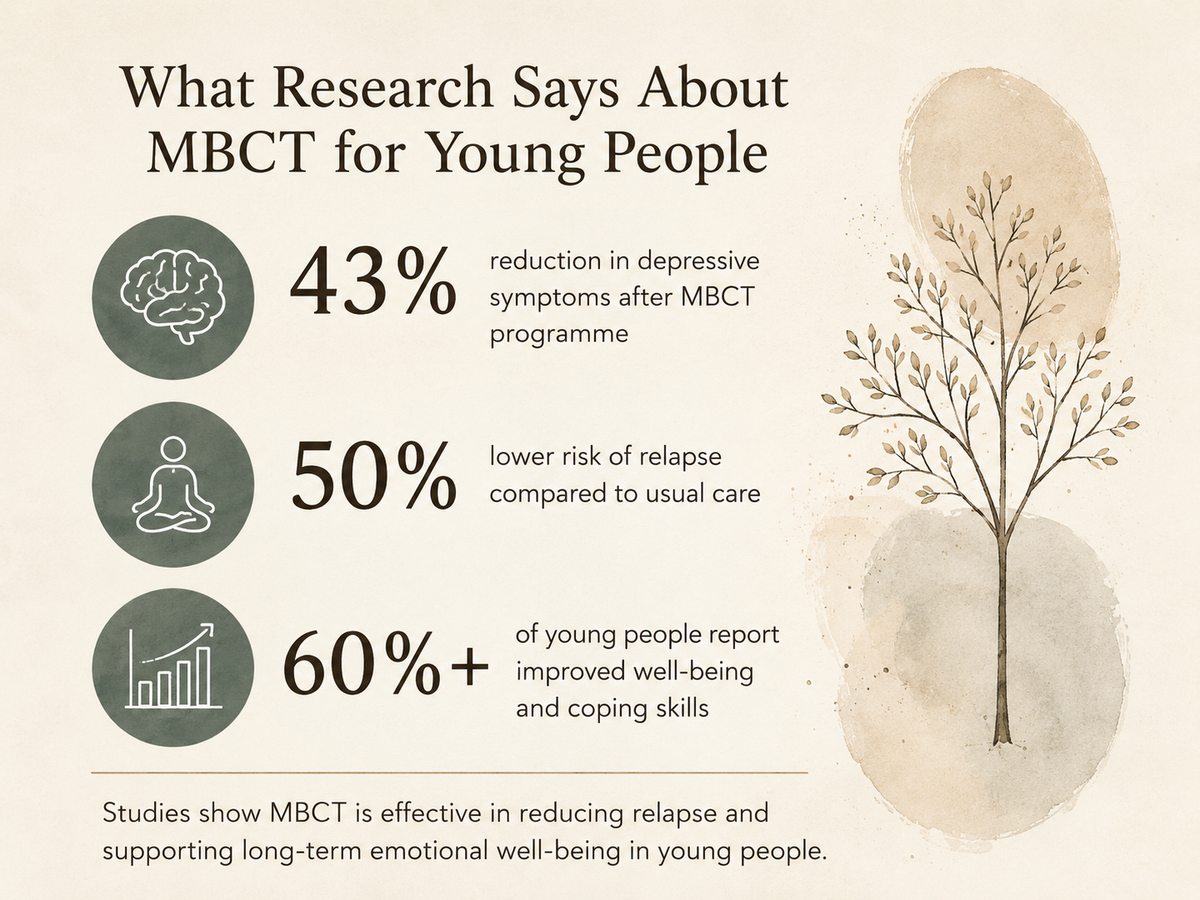
MBCT significantly reduced both anxiety and depressive symptoms in adolescents with elevated mood disturbance. Effects were maintained at 3-month follow-up. This was one of the first RCTs specifically evaluating MBCT (rather than general mindfulness) in a youth population.
Ames et al. (2014) — MBCT-A clinical trial
MBCT-A (the adolescent adaptation) reduced depressive symptoms and improved quality of life in young people aged 13–17 with a history of depression or anxiety. Effects were significant compared to waitlist control.
Chi et al. (2018) — Systematic review
Mindfulness-based interventions produced significant reductions in anxiety and depression in children and adolescents across multiple studies, with effects maintained at follow-up. The review covered 24 studies and found consistent positive outcomes.
Kuyken et al. (2013) — .b in schools RCT
The MYRIAD study (the largest school-based mindfulness trial to date) found that 9-lesson universal mindfulness training for secondary school students did not significantly improve mental health outcomes compared to usual social and emotional learning. However, targeted programmes for at-risk students showed more consistent effects — suggesting universal delivery needs careful design.
The MYRIAD study findings deserve attention. They do not suggest mindfulness does not work for young people. They suggest that brief universal programmes delivered to all students, regardless of individual need, produce modest average effects when compared against robust existing provision. This aligns with the adult MBCT literature: MBCT works best for people who have experienced difficulty (recurrent depression, significant anxiety) rather than as a universal preventive measure for people without elevated risk.
The practical implication: targeted programmes for children and young people showing signs of anxiety, low mood, or emotional dysregulation are better evidenced than brief universal interventions for all students. Schools with robust general social-emotional learning already in place may see smaller effects from adding mindfulness on top.
What parents need to know: a practical guide
How do I know if my child would benefit from MBCT-informed support?
Children who are likely to benefit tend to show some combination of the following:
- Persistent worry or anxiety that interferes with daily life — school refusal, avoidance, somatic complaints (stomach aches, headaches) with no clear physical cause
- Low mood lasting more than two weeks — reduced interest in previously enjoyed activities, increased irritability, withdrawal from friends
- Intense self-criticism — frequent self-referential negative statements, perfectionism combined with low self-worth
- Difficulty with transitions or change — heightened reactivity when routines change, inability to let go of perceived failures or embarrassments
- A family history of depression or anxiety — children of parents with recurrent depression are at elevated risk and may particularly benefit from early intervention
When to seek professional help urgently
Mindfulness-based approaches are not a substitute for urgent clinical care. Seek your GP or CAMHS immediately if your child is: expressing thoughts of self-harm or suicide · showing significant inability to function at school or home · experiencing symptoms suggestive of psychosis · showing signs of an eating disorder · withdrawing completely from all social contact.
How do I talk to my child about mindfulness?
Many children — particularly adolescents — are resistant to anything that sounds like therapy or "breathing exercises." The most effective framing is usually practical and non-pathologising.
For younger children (7–11): "We're going to do some activities that help you notice what you're feeling before it gets too big to handle. Some people find it helps with butterflies in their tummy or when they feel worried before something big." This framing is concrete, familiar, and non-clinical.
For adolescents: the science framing often works best. "This is stuff about how the brain works — why we get stuck on thoughts, why worry feels so automatic, and how to get a bit of distance from it. Lots of athletes and musicians use it." Connecting mindfulness to performance rather than illness reduces resistance significantly.
Practising together — even briefly — is more effective than telling a child to practise alone. A parent who does five minutes of mindful breathing with a child at bedtime models the practice more powerfully than any instruction.
What to expect from a school-based programme
School-based mindfulness programmes vary enormously in quality, length, and theoretical grounding. Questions worth asking a school before enrolling a child:
- What training does the teacher have? (Minimum: attendance at a validated teacher training programme; ideally BAMBA-accredited or MiSP-trained)
- Does the teacher have their own personal mindfulness practice? (This is one of the strongest predictors of quality delivery)
- What curriculum is being used? (Paws b, .b, and MindUP have the strongest research bases)
- How are students with existing mental health difficulties supported? (Good programmes have protocols for managing disclosure and supporting students who find practice distressing)
- Is there a way for parents to learn what children are practising? (Parent-accessible resources significantly improve home practice)
A guide for teachers: introducing mindfulness in the classroom
Teachers introducing mindfulness face a specific challenge: many of the children who would most benefit are also the ones most resistant to trying. Building a classroom culture of mindfulness requires a different approach from direct instruction.
Start with yourself
The most important determinant of mindfulness programme quality is the facilitating teacher's own practice. Research by Roeser et al. (2013) found that teachers who had participated in their own mindfulness training produced significantly better student outcomes than those who taught from a manual without personal practice. Before introducing mindfulness to students, teachers should attend a Mindfulness-Based Stress Reduction course or a dedicated teacher training programme.
Use micro-practices first
Formal 30-minute mindfulness sessions can be introduced once a culture of brief practice is established. Starting with one-minute "arrivals" at the beginning of lessons — a moment to settle, notice breath, set intention — normalises the practice without requiring sustained attention. Over weeks, the duration can be extended. Students who resist five-minute practices rarely resist thirty seconds.
Normalise difficulty
When introducing mindfulness to a class, teachers should explicitly say: "Your mind will wander. That is not a problem. Noticing that your mind has wandered is the practice." The tendency to evaluate one's own mindfulness practice as "good" or "bad" is the biggest barrier to consistent engagement. Removing the idea of failure from the practice — repeatedly and genuinely — significantly improves sustained engagement.
Handle disclosure carefully
Mindfulness practice occasionally surfaces difficult material. A student doing a body scan might notice physical sensations associated with past trauma. A student sitting in silence might find overwhelming thoughts arising. Teachers should:
- Always give students explicit permission to stop a practice at any point without explanation
- Keep eyes open during initial practices — this reduces the intensity for students with trauma histories
- Have a pre-agreed plan with the school counsellor or SENCO for students who become distressed
- Never force participation — mindfulness delivered under pressure produces the opposite of its intended effect
The Holistic Care approach: beyond clinical MBCT
The Holistic Care programmes for children aged 4–18 draw on both the clinical research tradition of MBCT and the deeper wisdom of the Advaita Vedanta tradition. This is a meaningful distinction.
MBCT teaches children to observe thoughts without fusing with them — a skill that is genuinely valuable and clinically effective. But our programmes go further. We teach children that the awareness in which thoughts arise is not itself disturbed by those thoughts. The sky is not troubled by the clouds passing through it. The screen is not changed by the images projected onto it. There is a quality of awareness that is already whole — and which cannot be depleted by anxiety, depression, or the relentless self-evaluation of adolescent life.
This is not religious instruction. It is contemplative inquiry that sits comfortably alongside secular mindfulness science. The I AM: The Heart of Being programme for ages 13–18 combines mindfulness practices with self-inquiry exercises drawn from the Advaita tradition, delivered in language appropriate for school contexts. Facilitator guides are provided for teachers and school counsellors. Five further programmes cover ages 4–12 through story, art, movement, and guided practice.
Ages 4–6
Calm the Storm
Story-based emotional literacy and body awareness for early years
Ages 7–12
The Awareness Chronicles
Five-book series with eLearning courses integrating mindfulness, self-inquiry, and emotional intelligence
Ages 13–18
I AM: The Heart of Being
Contemplative inquiry programme for teens, combining MBCT-informed skills with nondual awareness practices. Includes school facilitator guide.
Featured Course · Ages 13–18
I AM: The Heart of Being
A 7-week nondual mindfulness course for teens combining MBCT-inspired practices with self-inquiry from the Advaita Vedanta tradition. Available as a self-paced eLearning course with school facilitator guide.
Explore the I AM Course →Where to find MBCT for children and young people
Through schools
The Mindfulness in Schools Project (MiSP) is the leading UK provider of school-based mindfulness teacher training. Schools trained by MiSP deliver Paws b (ages 7–11) or .b (ages 11–18). Visit mindfulnessinschools.org to find a trained school or enquire about teacher training. In Australia, Smiling Mind's school curriculum (smilingmind.com.au) is the most widely available free-to-use programme, with over 6 million users. In the United States, Mindful Schools (mindfulschools.org) and Learning to BREATHE are the most common school-based options.
Through CAMHS and clinical services
In the UK, Child and Adolescent Mental Health Services (CAMHS) can provide MBCT-A for young people with significant anxiety or depressive symptoms. Referrals are through your GP. Due to high demand and stretched provision, waiting times are often substantial — typically 6–18 months in England outside specialist services. If your child needs support now, private or third-sector options are likely faster.
Through private therapists
Look for therapists accredited by BAMBA (bamba.org.uk) who have specific experience with children or adolescents. Not all MBCT practitioners work with children — verify this explicitly before booking. In Australia, the Psychology Foundation of Australia and Australian Association of Psychologists Inc (AAPi) maintain directories of child and adolescent specialists.
Through The Holistic Care
The Holistic Care offers eLearning courses for children aged 4–18, combining mindfulness-based practices with nondual awareness inquiry. Courses are self-paced and can be completed at home with parental involvement or delivered in school settings with the facilitator guides provided.
Also on The Holistic Care
- → What Is MBCT? The Complete Expert Guide for Adults
- → Anxiety in Children: Signs, Causes & Mindfulness Solutions
- → Mindfulness in Schools: Evidence, Benefits & How to Introduce It
- → Breathing Exercises for Anxious Children
- → Free Mindfulness Games for Children
- → All Courses for Children and Young People
- → School Mindfulness Programmes
Frequently asked questions
Can children do MBCT?
Yes. Adapted versions of MBCT are used with children from around age 7–8 upwards. Programmes for children are shorter (30–45 minutes for primary age, 50–60 minutes for secondary), use age-appropriate language, include more movement-based practices, and reduce home practice expectations. For children under 7, general mindfulness practices — body awareness, mindful breathing, sensory activities — are more developmentally appropriate than MBCT specifically.
What is MBCT-A?
MBCT-A is the formally developed adolescent adaptation of Mindfulness-Based Cognitive Therapy, designed for young people aged approximately 13–17. It follows the same 8-session structure as adult MBCT but with sessions of 60–90 minutes (rather than 2 hours), developmentally appropriate language, more discussion and less formal instruction, and a reduced home practice expectation of 15–20 minutes daily rather than 30–45. MBCT-A is typically delivered in clinical settings — CAMHS or private therapy — rather than schools.
Is mindfulness effective for children with ADHD?
Research on mindfulness for children with ADHD shows promising but mixed results. Mindfulness practice requires sustained attention — the very capacity that ADHD affects — which creates a particular challenge. However, several studies have found that adapted mindfulness interventions can reduce ADHD symptoms, including hyperactivity and impulsivity, and improve emotional regulation. Movement-based practices tend to work better than formal sitting meditation for children with ADHD. Parent-child mindfulness programmes (where parents also practise) show particularly strong effects.
What age is mindfulness appropriate for?
Simple mindfulness practices — body awareness, mindful breathing, mindful eating — are appropriate from age 4–5 and can be introduced playfully even earlier. Practices involving observing thoughts as thoughts (the core MBCT skill) are accessible from around age 8–9 with age-appropriate framing. Formal MBCT-informed groups are typically for ages 11 and above. Adolescents aged 13–18 can engage with the full depth of MBCT including self-inquiry practices. Developmental appropriateness matters more than a strict age threshold.
How do I know if a mindfulness programme is good quality?
Key quality indicators for children's mindfulness programmes include: the facilitating teacher has their own personal mindfulness practice (most important factor); the teacher has completed a validated teacher training programme; the curriculum is evidence-based (Paws b, .b, MBCT-A, MindUP, or Learning to BREATHE); the programme includes protocols for managing student distress; and there are parent communication resources to support home practice. Programmes with none of these elements should be approached with caution, regardless of how mindfulness is marketed.
Can mindfulness make anxiety worse in children?
For most children, mindfulness reduces anxiety over time. However, some children — particularly those with significant trauma histories or high levels of current distress — can find the initial phase of sitting with thoughts and feelings activating rather than calming. This is a recognised phenomenon in the mindfulness literature and not cause for alarm in itself. Supportive practices (keeping eyes open, movement-based practices, very short sitting durations) are usually sufficient adjustments. If a child consistently finds practice distressing despite adjustments, refer to a trauma-trained therapist before continuing.
Is mindfulness available in Australian schools?
Yes. Smiling Mind (smilingmind.com.au) provides a free, research-backed mindfulness curriculum for Australian schools, with teacher training and student resources for all year levels. The Wellbeing Framework for Schools in New South Wales incorporates mindfulness-based approaches. Queensland, Victoria, and South Australia each have state-level wellbeing initiatives that include mindfulness components.
What is the difference between mindfulness and meditation for children?
Meditation typically refers to formal seated practice — sitting still, focusing on breath or an object of attention. Mindfulness is broader: it includes formal seated meditation but also informal practices — mindful eating, mindful walking, noticing without judging. For children, informal mindfulness practices are usually more accessible and more transferable to daily life than formal meditation. Most children's programmes lead with informal practice and gradually introduce shorter formal sitting practices as engagement builds.
How does The Holistic Care's approach differ from standard MBCT for children?
Standard MBCT adaptations for children teach the decentring skill: noticing thoughts as thoughts rather than facts. The Holistic Care's approach goes further, introducing children to the awareness in which thoughts arise — the undisturbed presence that contemplative traditions describe as the ground of being. This draws on Advaita Vedanta, a non-dual philosophical tradition, combined with contemporary mindfulness science. The practical effect is that children who engage with The Holistic Care's programmes do not just manage their thoughts more skillfully — they begin to recognise a quality of awareness in themselves that is not disturbed by any thought or feeling. This can be a profound source of stability, particularly for adolescents navigating identity questions.

Written by
Mohan ChuteHead of Marketing & AI Strategy | Digital Transformation Leader | Nonduality Mindfulness Teacher | Author | Explorer of Consciousness
Mohan Chute is a rare blend of technology strategist and mindfulness teacher. With over 23 years of experience in digital marketing, AI strategy, and growth leadership, he has guided organizations through automation, analytics, branding, and digital transformation. Alongside this professional expertise, Mohan has devoted his life to exploring meditation, yoga, and nondual awareness—helping people discover balance, presence, and authenticity in a fast‑paced world.
💻 AI & Digital Expertise
As a strategist and innovator, Mohan empowers businesses to harness AI, automation, and analytics to drive growth. His leadership in go‑to‑market strategy, branding, and digital transformation positions him at the forefront of innovation—while keeping human wellbeing at the center.
🧘♂️ The Journey Within
At 17, Mohan discovered meditation on his own—a spark that ignited a lifelong journey into yoga, mindfulness, and nondual inquiry. Today, he integrates this wisdom into both personal and professional domains, showing that technology and consciousness can coexist to create meaningful impact.
🌍 Founder & Teacher
Through The Holistic Care Foundation, Mohan leads transformative programs worldwide. His Nonduality & Mindfulness‑based education initiatives support schools, colleges, and communities in cultivating calm, connected, and compassionate learning environments. For corporate teams, his programs position mindfulness as a competitive edge—enhancing creativity, reducing burnout, and fostering resilient workplace cultures.
📚 Author of Inspiring Works
Mohan’s books span audiences from children to spiritual seekers, weaving story, metaphor, and practice into accessible journeys of awareness. His published works include:
Mindful Adventures for Little Minds
In the Garden of Kindred Spirits
The Wondrous Quest: Journey to the Knower Within
I Am – The Heart of Being
Seeds of Kindness
Mindful Computing: Embracing Presence in a Digital World
The Awareness Chronicles series:
Book 1: The Magic Sketchbook
Book 2: The Movie Projector
Book 3: The Mask Maker
Book 4: The Listening River
Book 5: The True Compass
🎓 Interactive eLearning Courses
Each of these books has been transformed into interactive eLearning programs available on The Holistic Care. These courses combine storytelling, reflection prompts, creative activities, and mindfulness practices—making awareness accessible to children, teens, educators, families, and professionals.
🌈 A Guiding Light
Whether you are a student, educator, professional, or seeker, Mohan’s voice offers clarity and compassion. His mission is simple yet profound: to help people live with balance, presence, and purpose—reminding us that awareness is not the end, but the beginning.