Nonduality (Advaita) is the recognition that awareness itself is undivided. A clear guide to what it means, key teachers like Ramana and Nisargadatta, and how it applies to daily life.
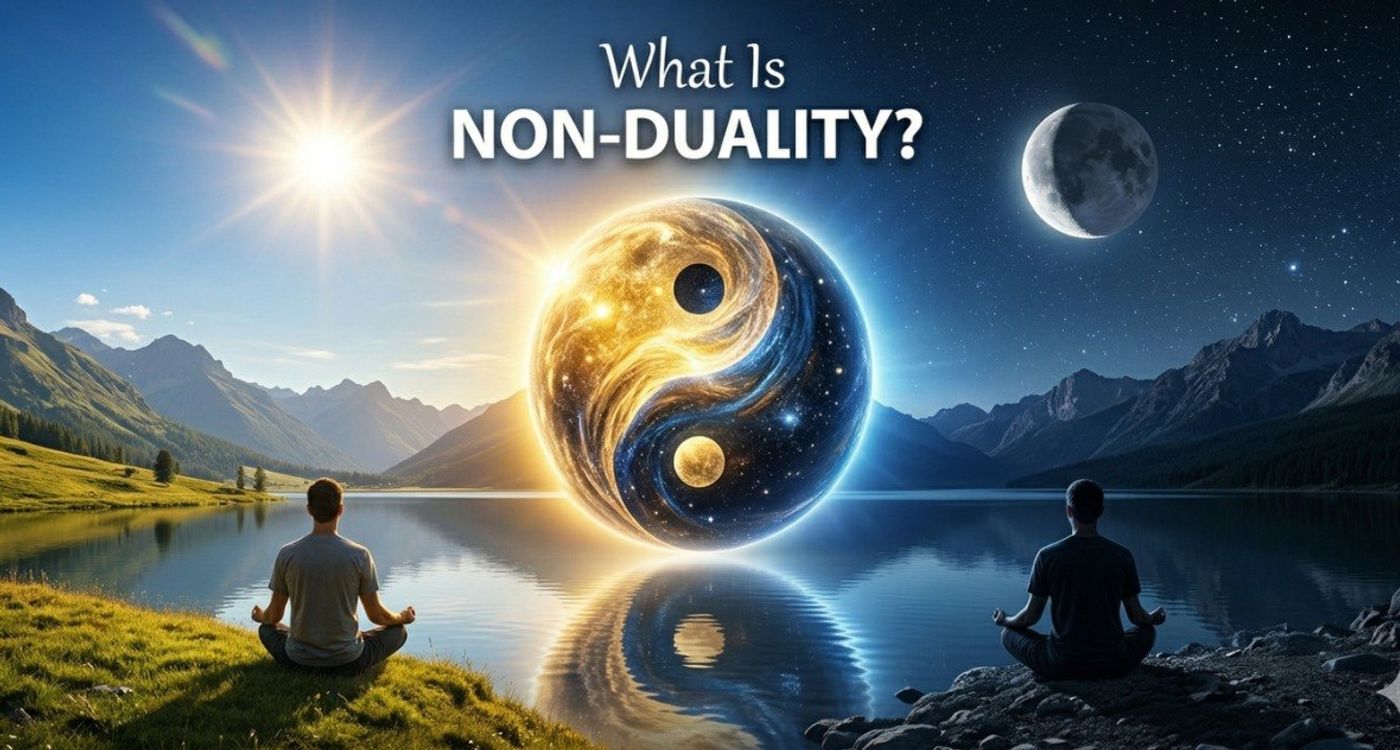
Nonduality is the recognition that the aware presence in which all experience appears — thoughts, feelings, perceptions, the sense of being a separate person — is itself undivided, unchanging, and already at peace. The word comes from the Sanskrit advaita, meaning "not two." It is not a belief system or philosophy in the usual sense. It is a direct pointing toward something that cannot be argued for or against: the simple fact of being aware, right now, before any thought about it.
Nonduality has been taught in various forms for thousands of years, most precisely in the Advaita Vedanta tradition of India, and has appeared in Zen Buddhism, Taoism, Sufism, and the Christian mystical tradition. In recent decades it has become increasingly accessible in the West through teachers like Ramana Maharshi, Nisargadatta Maharaj, and Rupert Spira.
What does nonduality mean?
The word nonduality means "not two." In practice, it points to the recognition that the subject who seems to be experiencing life — the "me" looking out from behind the eyes — and the world of objects being experienced are not fundamentally separate. There is one aware reality appearing as both the experiencer and the experienced.
This is not a metaphysical theory to be believed. The nondual teachers consistently point to direct investigation: look for yourself. Where is the boundary between awareness and what appears in it? When you look for the one who is looking, what do you find? Most people, on close inspection, find that what they take to be "me" — a bounded, independent self — does not hold up to scrutiny. What remains is bare aware presence: awake, open, undisturbed.
Where does nonduality come from?
Nonduality is most precisely articulated in Advaita Vedanta, one of the six classical schools of Hindu philosophy. Vedanta means "the end of the Vedas" — referring to the Upanishads, the concluding portions of the ancient Vedic scriptures. Advaita means non-dual. The systematic form of Advaita Vedanta was established by the philosopher Adi Shankaracharya in the 8th century CE.
Adi Shankaracharya (c. 788–820 CE)
Shankaracharya's central argument: Brahman — the one reality, pure awareness — is all there is. The apparent multiplicity of the world arises within it, like waves on an ocean, without being separate from it. The individual self (atman) is not separate from Brahman — expressed in the mahavakya (great saying): Tat tvam asi — "That thou art." Shankaracharya also established four monasteries at the four compass points of India which continue to transmit Advaita Vedanta to this day.
The same recognition appears in Zen Buddhism (pointing to "original nature" prior to thought), Taoism (the Tao as the undivided ground from which all arising flows), and Christian mysticism (Meister Eckhart: "The eye through which I see God is the same eye through which God sees me").
Key nondual teachers
Ramana Maharshi (1879–1950)
Ramana Maharshi is arguably the most widely recognised modern Advaita teacher. At the age of sixteen, he had a spontaneous recognition of his own true nature that never left. He spent the rest of his life at Arunachala in Tamil Nadu, South India, teaching through silence and through a single practice: self-inquiry. "Who am I?" — not as a philosophical question, but as a direct looking. What is the sense of "I" that underlies all experience? What is here before the thought "I am"?
Nisargadatta Maharaj (1897–1981)
Nisargadatta Maharaj was a tobacco seller in Mumbai who pointed, with remarkable directness, to the bare sense of "I AM" — existence-awareness prior to all description. His teachings were collected in I Am That (translated by Maurice Frydman), which has become one of the most widely read nonduality texts in the Western world. His instruction: "Go back to the sense I AM. Abide there. Find out what it is." Before "I am a person," "I am suffering," "I am happy" — just: I AM.
Rupert Spira (b. 1960)
Rupert Spira is a British teacher of Advaita Vedanta and perhaps the most influential contemporary voice making nondual understanding accessible to Western audiences. A former ceramics artist, he studied under Francis Lucille. His books — including Presence: The Art of Peace and Happiness, Being Aware of Being Aware, and The Nature of Consciousness — are considered among the clearest contemporary presentations of Advaita teaching.
How is nonduality different from mindfulness?
Standard mindfulness, as taught in MBSR and most school-based programmes, teaches you to observe the contents of the mind — thoughts, feelings, sensations — without getting caught in them. The meditator and what is being observed remain distinct: "I am observing my thoughts."
Nondual inquiry asks a different question: who is the observer? Rather than remaining as the one who watches thoughts, you turn attention back on the watching itself. What is the aware presence in which thoughts arise? Is it disturbed by them? Can it be found to be limited or bounded in any way?
Mindfulness is enormously valuable — it builds attention, emotional regulation, and present-moment awareness. Nondual inquiry adds a dimension that mindfulness typically does not address: the recognition that the awareness doing the noticing is already still, already undisturbed, already free of the content it contains.
"You need not get rid of thought. You need only recognise what you are — the awareness in which thought appears — and you will find that thought no longer disturbs you." — Rupert Spira
How is nonduality different from Buddhism?
Buddhist teaching (particularly in the Theravada tradition) emphasises anatta (no-self): the self is not a fixed entity but a constantly changing process of aggregates. Advaita Vedanta makes a related but distinct claim: the self as usually conceived — the separate "me" — is not what we actually are. But what we are is not "no-self." What we are is pure awareness: that which remains when the apparent self is seen through. In Advaita, awareness itself is not denied — it is recognised as the only real thing.
Nonduality and mental wellbeing
One of the most significant contemporary developments in nondual teaching is its application to mental health and emotional wellbeing. When it becomes clear — even briefly — that the aware presence you are is not disturbed by whatever arises in it, the implications for anxiety, depression, and self-criticism are profound.
Anxiety, at its root, involves the belief that a vulnerable self is threatened. Depression often involves complete identification with a story about being inadequate, hopeless, or unlovable. Nondual inquiry does not try to fix these stories. It asks: who is suffering? And in the looking, something is discovered that was already there — a presence that is not the story, not the feeling, not the difficulty, but the quiet space in which all of it arises.
Nonduality for children and young people
Children ask nondual questions naturally. "Who is the one who is noticing?" "What is here before I start thinking?" "Am I the same me I was when I was a baby?" These are not unusual questions for a curious eight-year-old. At The Holistic Care, our courses for children aged 4 to 18 are built around exactly this natural capacity. Rather than asking children to manage their thoughts, we invite them to explore what is here before thought — the aware, still presence that is already present regardless of what they are feeling or thinking.
For adolescents, this has particular relevance. The developmental pressure of adolescence — identity formation, social comparison, the urgent need to know who you are — is precisely the territory that nondual inquiry addresses. The recognition that there is something stable in you that no experience can touch, not as a belief but as a direct discovery, is genuinely transformative for a young person navigating that terrain.
Explore our courses: The I AM: The Heart of Being course for ages 13–18 is built entirely on Ramana Maharshi's self-inquiry practice, adapted for young people. The full course library covers ages 4–18 across six structured programmes.
Frequently asked questions

Written by
Mohan ChuteHead of Marketing & AI Strategy | Digital Transformation Leader | Nonduality Mindfulness Teacher | Author | Explorer of Consciousness
Mohan Chute is a rare blend of technology strategist and mindfulness teacher. With over 23 years of experience in digital marketing, AI strategy, and growth leadership, he has guided organizations through automation, analytics, branding, and digital transformation. Alongside this professional expertise, Mohan has devoted his life to exploring meditation, yoga, and nondual awareness—helping people discover balance, presence, and authenticity in a fast‑paced world.
💻 AI & Digital Expertise
As a strategist and innovator, Mohan empowers businesses to harness AI, automation, and analytics to drive growth. His leadership in go‑to‑market strategy, branding, and digital transformation positions him at the forefront of innovation—while keeping human wellbeing at the center.
🧘♂️ The Journey Within
At 17, Mohan discovered meditation on his own—a spark that ignited a lifelong journey into yoga, mindfulness, and nondual inquiry. Today, he integrates this wisdom into both personal and professional domains, showing that technology and consciousness can coexist to create meaningful impact.
🌍 Founder & Teacher
Through The Holistic Care Foundation, Mohan leads transformative programs worldwide. His Nonduality & Mindfulness‑based education initiatives support schools, colleges, and communities in cultivating calm, connected, and compassionate learning environments. For corporate teams, his programs position mindfulness as a competitive edge—enhancing creativity, reducing burnout, and fostering resilient workplace cultures.
📚 Author of Inspiring Works
Mohan’s books span audiences from children to spiritual seekers, weaving story, metaphor, and practice into accessible journeys of awareness. His published works include:
Mindful Adventures for Little Minds
In the Garden of Kindred Spirits
The Wondrous Quest: Journey to the Knower Within
I Am – The Heart of Being
Seeds of Kindness
Mindful Computing: Embracing Presence in a Digital World
The Awareness Chronicles series:
Book 1: The Magic Sketchbook
Book 2: The Movie Projector
Book 3: The Mask Maker
Book 4: The Listening River
Book 5: The True Compass
🎓 Interactive eLearning Courses
Each of these books has been transformed into interactive eLearning programs available on The Holistic Care. These courses combine storytelling, reflection prompts, creative activities, and mindfulness practices—making awareness accessible to children, teens, educators, families, and professionals.
🌈 A Guiding Light
Whether you are a student, educator, professional, or seeker, Mohan’s voice offers clarity and compassion. His mission is simple yet profound: to help people live with balance, presence, and purpose—reminding us that awareness is not the end, but the beginning.