Eight foundational yoga poses that build strength, clarity and stillness for a fresh start, from Mountain Pose through Savasana.
Eight foundational yoga poses can create a balanced, repeatable New Year practice: Tadasana, Uttanasana, Warrior I, Warrior II, Tree Pose, Downward-Facing Dog, Bridge Pose, and Savasana. They train attention, balance, strength, mobility, and rest, but they do not automatically produce willpower or guarantee success outside yoga.
The real value is behavioural. A short sequence gives you a concrete action that can be scheduled, repeated, adapted, and reviewed. Choose a version you can do on an ordinary day, not only when motivation is high. Your goal is to build a relationship with practice, not complete an annual fitness test on 1 January.
Safety note: This guide is educational and not individual medical advice. Consult a qualified healthcare professional for symptoms, pregnancy, recent surgery, balance changes, cardiovascular or eye conditions, osteoporosis, or other concerns affecting exercise.
Key Takeaways
- These eight poses form an adaptable sequence, not a promise that yoga creates motivation or guarantees a goal.
- Consistency improves when the practice is small, specific, personally meaningful, and linked to a reliable cue.
- Props, bent knees, shorter holds, and wall or chair support are normal practice choices.
- Progress can mean better confidence, comfort, attention, or adherence, not deeper shapes.
- If-then planning and obstacle planning can help turn intention into action, but flexibility protects the habit during difficult weeks.
The eight-pose sequence at a glance
Why New Year Yoga Goals Often Fade
A resolution names a desired future, but often leaves the behaviour vague. Practise more yoga does not specify when, where, how long, what sequence, or what happens when time is short. Ambitious starting doses also create soreness and scheduling friction before the routine has become familiar.
Goals can also be borrowed from social pressure. A personally meaningful aim such as feeling steadier during a demanding workday is easier to sustain than trying to look like a teacher online. Progress improves when the reason, action, and environment support one another.
Turn a Resolution Into an If-Then Plan
An implementation intention links a situation to an action: if it is 7:00 on Monday, Wednesday, or Friday and I have finished brushing my teeth, then I will practise the ten-minute version beside my bed. The cue reduces the need to renegotiate every session.
A meta-analysis of mental contrasting with implementation intentions found a small to moderate positive effect on goal attainment across 21 studies, while noting possible publication bias and the need for more research. This supports specific planning, not the claim that one formula works for every person.
Research on self-concordant goals and implementation intentions suggests that goals aligned with personal interests and values work better with concrete planning than goals pursued mainly through pressure. Ask both: why does this matter to me, and what will I actually do?
Before You Begin: A Two-Minute Readiness Check
Notice energy, pain, dizziness, breathlessness, recent illness, sleep, and whether your environment is safe. New or severe symptoms need medical attention, not a test sequence. If you are pregnant, recovering from surgery, managing osteoporosis, glaucoma, uncontrolled blood pressure, a neurological condition, or significant joint pain, obtain individual guidance.
Clear enough space, place a stable chair near the mat, and keep the practice free of candles, pets, or furniture you could fall into. A mat improves traction but is not mandatory. Avoid practising on a soft bed for standing balance. Bare feet may help grip, but supportive footwear can be appropriate.
Pose 1: Tadasana, Mountain Pose
Stand with feet at a comfortable width and arms easy. Let weight spread across both feet without forcing identical pressure at every point. Soften the knees, allow the pelvis and ribs to settle into a sustainable position, and look forward. Take four natural breaths.
Tadasana trains attentive standing, but it does not reveal one perfect posture. Feet may be together, apart, turned slightly, or supported according to anatomy and balance. If standing is not available, practise seated orientation: feel both feet or the chair, notice the vertical relationship of pelvis, ribs, and head, and breathe.
Goal cue
Name the smallest useful action for today. For example: I will practise for ten minutes, then stop even if enthusiasm says to double it. Keeping a modest promise builds evidence that the routine is trustworthy.
Pose 2: Uttanasana, Standing Forward Bend
From standing, bend the knees and hinge at the hips. Place hands on thighs, blocks, a chair, or the floor. Let the head remain aligned if dropping it causes pressure, dizziness, reflux, or neck discomfort. Stay for two to four breaths, then rise slowly with support.
The aim is not straight legs or touching toes. A bent-knee fold can reduce hamstring and back load while preserving the hip hinge. People with glaucoma or retinal concerns, uncontrolled blood pressure, significant dizziness, or conditions affected by head-down positions should use an upright chair version after medical advice.
Goal cue
Practise flexible thinking. If the planned version does not suit today, choose the chair version. Adaptation protects continuity; it is not cheating.
Pose 3: Warrior I, Virabhadrasana I
Step one foot back into a comfortable split stance. Keep the feet wide enough for balance. Bend the front knee only as far as you can maintain steady pressure through both feet. Let the back heel lift or turn the foot outward. Keep hands on hips, reach forward, or raise the arms if shoulders and balance allow.
The pelvis does not need to face perfectly forward. Forcing it can twist the knee or compress the lower back. Shorten the stance and reduce depth until breathing is normal. Hold for three breaths on each side.
Goal cue
Distinguish effort from strain. Goals require tolerable challenge, but pain, breath holding, and panic do not prove commitment. Choose an effort you can repeat later in the week.
Pose 4: Warrior II, Virabhadrasana II
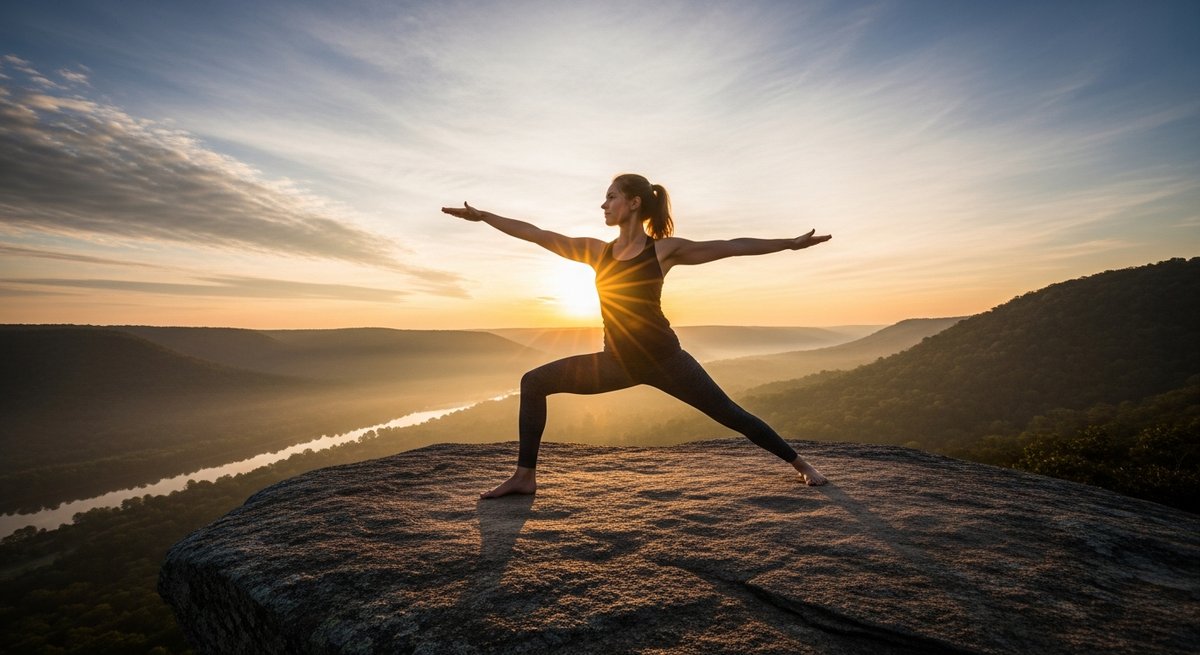
Take a wide stance and turn the front foot toward the short end of the mat. Bend the front knee in a direction that feels compatible with the foot, while the back foot remains grounded. Extend arms comfortably or place hands on hips. Look forward or over the front hand without forcing the neck.
Heel-to-arch alignment is one convention, not an anatomical law. Adjust stance width, foot angle, knee depth, arm height, and gaze. A chair beneath the front thigh can reduce effort. Build from ten seconds rather than treating a long hold as a test.
Goal cue
Direct attention to one chosen task while remaining aware of the whole situation. Narrow focus can support action, but rigid tunnel vision can hide fatigue and changing needs.
Pose 5: Tree Pose, Vrikshasana
Stand beside a wall or chair. Shift weight toward one foot and place the other toes on the floor like a kickstand. If steady, move the foot to the inner calf or thigh without pressing directly on the knee. Keep one hand supported and gaze at a stable point.
Wobbling is information, not failure. Balance changes with sleep, stress, vision, inner-ear function, medication, fatigue, and the surface beneath you. Use support before you need it. People with unexplained falls or new balance changes should seek assessment.
Goal cue
When attention wanders, return without commentary. This simple reset is more transferable than demanding perfect concentration. The habit is the return.
Pose 6: Downward-Facing Dog, Adho Mukha Svanasana
For a wall version, place hands around shoulder height, step back, bend knees, and hinge until the trunk lengthens comfortably. For the floor version, begin on hands and knees, spread the hands, lift the knees, and move the hips back. Keep knees bent and heels free.
Downward Dog is a weight-bearing shoulder pose and a head-down position, not automatic rest. Choose the wall or chair with wrist pain, shoulder load concerns, reflux, dizziness, or pressure-related eye restrictions. Come out if breathing becomes strained or arms lose stable support.
Goal cue
Build the environment around the behaviour. Leaving a stable chair ready may make the sequence easier to start and safer to complete. Good systems reduce unnecessary friction.
Pose 7: Bridge Pose, Setu Bandha Sarvangasana
Lie on the back with knees bent and feet comfortable. Press through the feet and lift the pelvis only as high as the back, hips, and knees tolerate. Keep the head still. Hands can rest beside the body. Lower slowly after two to four breaths and repeat once if comfortable.
Bridge trains hip extension and can load the legs and back body. It has not been shown to stimulate the thyroid or reproduce every benefit of deeper backbends. Use a low lift, place support under the pelvis for a restorative version, or substitute a standing hip extension if floor transitions are unsuitable.
Goal cue
Use progressive overload modestly. Add one repetition, a few seconds, or a slightly larger range, not all three at once. Small visible progress can be motivating without sacrificing recovery.
Pose 8: Savasana, Deliberate Rest
Lie on the back with support under the knees and head if comfortable. You may also rest side-lying, sit in a chair, or elevate the torso. Let breathing be natural for two to five minutes. Keep eyes open if closing them increases anxiety or disorientation.
Savasana supports a deliberate transition out of practice, but it is not mandatory in one fixed shape and the benefits of earlier poses are not lost if it is shortened. People with reflux, pregnancy, breathlessness while flat, trauma, or back pain often need a different resting position.
Goal cue
Review without judgement. What made starting easier? Which pose needed adaptation? What is the smallest change that improves the next session? Reflection turns experience into a practical plan.
A 20-Minute Sequence Using All Eight Poses
Begin with two minutes in Tadasana. Move into two supported Uttanasana holds. Practise Warrior I and Warrior II for two short rounds on each side. Spend two minutes with supported Tree Pose, then take Downward Dog at a wall, chair, or floor for two rounds. Complete two low Bridges and rest in Savasana for four minutes.
Transitions count as part of the practice. Move slowly between standing and floor positions. Rest whenever the talk test fails or form becomes difficult to control. The total time is a template, not a target that overrides symptoms.
The Five-Minute Minimum Version
On a difficult day, practise one minute of Tadasana, one minute of supported Warrior II split between sides, one minute of wall Downward Dog, one minute of chair or low Bridge alternative, and one minute of supported rest. Mark the session complete.
A minimum version prevents all-or-nothing thinking. It should remain genuinely small. Do not turn it into a hidden twenty-minute workout. If illness or medical advice calls for rest, the appropriate minimum is no practice.
A Four-Week Habit Plan
Week 1: make starting easy
Schedule three ten-minute sessions. Use wall and chair options even if you might manage more. Finish while you still feel capable. Record only whether you started, what version you used, and how you felt later.
Week 2: stabilise the cue
Keep the same days, time window, and location. Prepare props the night before. Add the five-minute minimum as a backup plan. Do not increase difficulty if the schedule itself is not yet reliable.
Week 3: add one progression
Choose one change: an extra round of Bridge, five more seconds in a supported Warrior, or the twenty-minute sequence once that week. Maintain easy versions elsewhere. Progress should not create pain or make the next planned session less likely.
Week 4: review the system
Compare your planned and completed sessions without moral judgement. Identify helpful cues, predictable obstacles, and preferred adaptations. Decide whether the next month needs more consistency, more variety, a class, or a clinical consultation.
Plan for Obstacles Before They Arrive
Write three if-then backups. If the morning meeting starts early, then I will use the five-minute version at lunch. If my wrist is sore, then I will use wall Downward Dog. If I miss a session, then I will resume at the next scheduled cue without adding a punishment workout.
Some barriers are structural rather than motivational: caregiving, shift work, disability, unsafe space, pain, fatigue, or limited privacy. A realistic plan may use seated practice, audio guidance, family participation, or fewer sessions. Compassionate design is more effective than shame.
Measure What Actually Matters
Depth of pose and body weight are not the only metrics. Track attendance, confidence using adaptations, balance support, comfortable range, perceived effort, recovery, sleep, pain response, or the ability to pause before another task. Choose one or two measures tied to your reason for practising.
Expect variation. A lower-capacity day does not erase adaptation, and a missed week does not reset the body to zero. If symptoms worsen over several sessions, pause and obtain guidance rather than using consistency as a reason to continue an unsuitable dose.
When to Learn With a Teacher or Clinician
A skilled yoga teacher can offer props, sequencing, and movement alternatives. A physiotherapist or qualified healthcare professional is more appropriate for diagnosis, rehabilitation, progressive neurological symptoms, unexplained dizziness, significant joint pain, or return after surgery. Some people benefit from both professionals communicating.
Choose a teacher who asks permission before touch, welcomes rest, avoids guaranteed benefits, and can explain why an option may help. Leave a class that treats pain as weakness, insists every body should look identical, or tells you to stop medical care.
Make the Practice Evergreen
Although this sequence is framed around the New Year, any week can be a beginning. Waiting for a perfect date can become another delay. Start with the next reliable cue, use the smallest appropriate version, and review after enough repetitions to learn something.
Yoga can become a laboratory for goal skills: choosing a value, translating it into action, noticing obstacles, adjusting without self-attack, and returning. The transferable skill is not the pose. It is responsive, repeated participation.
Recovery Is Part of the Plan
Training changes during recovery, not only during effort. Leave at least a day between demanding beginner sessions when needed, sleep adequately, eat and hydrate according to your health needs, and keep ordinary walking or movement comfortable. More yoga is not automatically more progress.
If a session causes pain that changes movement, fatigue that disrupts responsibilities, or symptoms that accumulate through the week, reduce duration, range, or frequency. A rest day is a planned training decision. Persistent symptoms deserve qualified assessment.
When the Goal Itself Needs to Change
A goal is a tool, not a moral contract. Illness, injury, caregiving, work, pregnancy, grief, or changed values can make the original target inappropriate. Revise it explicitly rather than labelling adaptation as failure. The new goal may be two chair-based sessions, rehabilitation exercises, or full rest.
Ask whether the goal still matters, whether the action still supports it, and whether the cost remains acceptable. Then keep, modify, pause, or replace it. This review preserves agency and prevents a January intention from controlling circumstances it could not predict.
Build Community Without Comparison
A class, friend, or shared calendar can provide accountability and encouragement. Agree on supportive check-ins rather than surveillance. Celebrate showing up and adapting, not only advanced shapes or uninterrupted streaks.
Comparison becomes unhelpful when another person’s range, body, schedule, or progress sets your dose. Practise beside others while measuring against your own reason, safety, and recovery. Community should widen access and belonging, not create a new performance test.
At the end of the month, thank the people who supported the routine and decide what kind of accountability you want next. A shared weekly message, a paid class, or quiet independent practice may each be right. Support should make the habit more humane and practical.
Featured Programme
The I AM Programme
A structured programme in mindfulness and self-inquiry for adults developing clarity, presence, and a sustainable contemplative practice.
Explore the I AM ProgrammeTeaching Note from Shital Chute
The pattern I see most often is not lack of enthusiasm. It is a starting plan built for an unusually energetic day. The sequence becomes useful when readers give themselves a chair, a five-minute fallback, and permission to stop on time. Consistency grows from a practice that can survive ordinary life.
Frequently Asked Questions
Do I need to do all eight poses every session?
No. Use the full sequence when it fits and the five-minute or selected-pose version when it does not. A smaller appropriate practice still counts.
How often should a beginner practise this sequence?
Three short sessions per week is a reasonable experiment for many beginners. Your health, recovery, schedule, and professional guidance may support a different dose.
Will these poses make me more motivated?
Not automatically. The sequence can create a repeatable behaviour and attentional reset. Personally meaningful goals, specific cues, obstacle plans, and a manageable dose support adherence.
What if I cannot get down to the floor?
Use standing, wall, and chair versions. Bridge and Savasana can be replaced with supported standing hip extension and seated rest. Floor access is not a requirement for yoga.
Is soreness a sign the habit is working?
No. Mild unfamiliar muscle sensation can occur, but soreness is not the goal. Reduce the dose if discomfort affects daily activity or the next session, and seek advice for persistent or concerning pain.
What should I do after missing a week?
Resume with the easiest planned version at the next practical cue. Do not compensate with an extra-long session. Review what disrupted the routine and adjust the system.
Free Guide for Parents & Educators
Mini Mindfulness Masters
Simple practices to help children slow down, feel calm, and become more present. A free download, straight to your inbox.
No spam, ever. Unsubscribe at any time.

Written by
Shital ChuteMarketing Lead, The Holistic Care | Mindfulness & Behavioral Health Educator
Shital Chute leads Marketing at The Holistic Care, where she shapes how the platform's mindfulness courses, books and free resources reach the families, schools and workplaces who need them. Alongside this role, she is a passionate advocate and educator for mindfulness and behavioral health, drawing on that perspective to help shape content that is genuinely useful, not just promotional.
Her work at The Holistic Care sits at the intersection of communication and care: translating research-backed mindfulness practices into clear, practical guidance for parents, teachers and adults navigating everyday stress.


