Explore Ananda marga : bliss path with a clearer holistic overview, practical takeaways, and thoughtful next steps for deeper learning.
Quick Answer: Ananda Marga, meaning Path of Bliss, is a yoga and meditation organisation founded in India in 1955 by Prabhat Ranjan Sarkar, known to followers as Shrii Shrii Anandamurti. It combines an eight-limb yoga system with social service as an inseparable part of practice. Meditation is taught through a personalised six-lesson system. The organisation operates in over 130 countries and runs schools, food relief programmes and disaster response projects.
Origins: Shrii Shrii Anandamurti and the Founding of Ananda Marga
Ananda Marga was founded on 5 January 1955 in Jamalpur, Bihar, India. Its founder, Prabhat Ranjan Sarkar (1921-1990), was a railway clerk who began teaching a system of yoga and meditation to a small group of students. He took the spiritual name Shrii Shrii Anandamurti, meaning one who is the embodiment of bliss, a name used by his students. Publicly and in his extensive writings on socioeconomic theory he used the pen name P. R. Sarkar.
Sarkar taught that the purpose of human life is to move toward the infinite, toward Brahma, the absolute consciousness. He framed this not as a withdrawal from the world but as an expansion: the individual consciousness expands through practice until it recognises its identity with universal consciousness. Social service, Seva, was not an optional addition to this path but its necessary expression: love of the infinite naturally manifests as love of all beings.
Sarkar was prolific as a writer and teacher across many fields. He developed a socioeconomic theory called Prout (Progressive Utilization Theory), wrote extensively on linguistics, literature, history, and science, and composed thousands of songs in a devotional style called Prabhat Samgiita. His followers consider him a mahaguru, a great teacher; critics have noted the controversies surrounding the organisation during his lifetime, including allegations of political violence and misuse of power.
The Yoga System: Ashtanga with Social Service
Ananda Marga follows Patanjali's eight-limbed path of yoga (ashtanga) but interprets and applies each limb within a specific framework. The yamas (ethical restraints) and niyamas (observances) are given particular elaboration, with each of the ten principles of the yamas and niyamas specified in detail and understood as both personal disciplines and social ethics.
The physical practice (asana) is adapted to support the meditation practice rather than taught as an independent discipline. Pranayama is taught in connection with specific meditation techniques. Pratyahara (sense withdrawal), dharana (concentration), dhyana (meditation), and samadhi (absorption) form the inner sequence toward which the entire system points.
What distinguishes Ananda Marga from most yoga organisations is the formal integration of social service into the system. Seva is not optional or supplementary but structurally necessary: spiritual practice without service is understood as incomplete, and service without spiritual foundation tends toward burnout and ego reinforcement. The organisation's relief and development projects, including schools in underserved communities, food programmes, and disaster response, are understood as part of the collective practice of members.
The Six-Lesson Meditation System
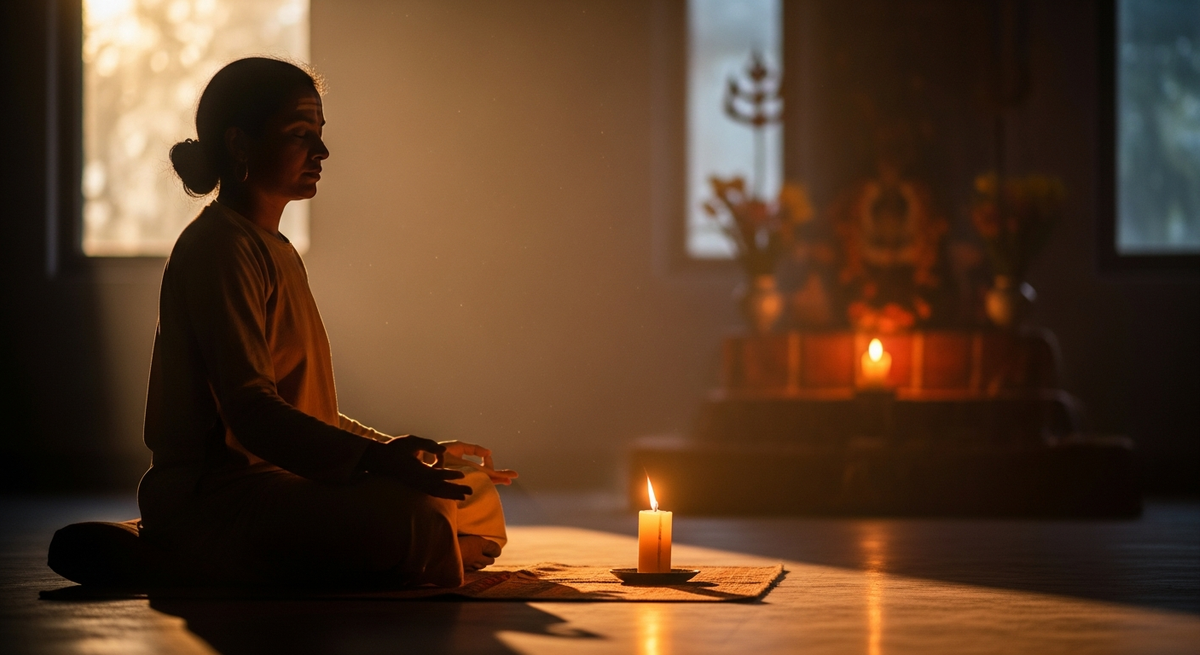
Ananda Marga teaches meditation through a structured six-lesson system given individually by trained teachers called acaryas (also spelled acharyas). Each lesson introduces a specific practice in a sequence designed to progressively deepen the meditator's capacity for inner absorption.
The first lesson introduces a personalised mantra and the basic technique of mantra meditation. The mantra is chosen individually by the acarya for each student based on their assessment of the student's mental and spiritual condition. This personal transmission is considered important: the same mantra given to all would not serve each individual equally. The second and third lessons introduce pranayama and further refinements of the meditation technique. Later lessons work with more subtle levels of practice and with the systematic withdrawal of awareness from the senses.
Students are expected to meditate twice daily, morning and evening, ideally for a minimum of thirty minutes per session. The twice-daily commitment is understood not as rigidity but as recognition that the mind needs consistent recalibration: a single long session once a week is less effective than shorter regular practice. Members also observe a period of retreat four times per year aligned with the lunar calendar.
Seva and Social Projects: Service as Practice
Ananda Marga operates one of the larger decentralised networks of social service projects in the world, run primarily by volunteers and renunciant members. Projects include primary and secondary schools in India, Africa, Asia, and South America; relief operations during natural disasters; food distribution programmes; and community development work in rural areas.
The theological basis for this service is the principle of universal love: the divine is present in all beings, so service to any being is service to the divine. This is not sentimentality but a structural teaching. Members are not encouraged to feel personally responsible for all suffering or to burn themselves out in service, but to act with care, skill, and the recognition that the work is an expression of their practice rather than a substitute for it.
Ananda Marga in Relation to Mainstream Yoga
Ananda Marga occupies a distinctive position in the landscape of yoga organisations. It is less visible in the Western yoga studio world than systems like Iyengar, Ashtanga, or Kundalini yoga because it does not teach drop-in yoga classes as its primary offering. The emphasis on personalised initiation, twice-daily practice commitment, and social service means that engagement tends to be deeper and longer-term than typical yoga studio participation.
At the same time, many of Sarkar's teachings on yoga philosophy, meditation, and the nature of mind are applicable regardless of organisational affiliation. His writings on the chakras, on the stages of meditation, and on the relationship between individual consciousness and the absolute draw on the same classical sources as other nondual and yoga traditions and can be read with benefit by practitioners of any background.
For those drawn to a yoga system that integrates practice with a broader ethical and social framework, Ananda Marga offers one of the more coherent available models: a systematic meditation practice, a clearly articulated philosophy, and an active expression of that philosophy in the world. Its controversies and the complexity of its history are part of the honest picture, and engaging with the teachings does not require uncritical acceptance of all claims made about or by its founder.
Featured Programme
The I AM Programme
A structured course in nondual mindfulness for adults exploring awareness, stillness and inner clarity
Explore the ProgrammeTeaching Note from Shital Chute
Ananda Marga was new to me before I started working on this piece, and I suspect that is true for most people reading it. What I found genuinely interesting, from a communications standpoint, is how deliberately the name translates to path of bliss, and how that framing shapes everything else about the movement, the meditation practice, the social service work, the way it presents itself as more than a personal wellness routine. I have noticed that readers researching lesser known spiritual movements like this one are usually trying to understand context and history before deciding whether to look further, not looking for a sales pitch. My aim with this note is simple, to encourage that same curiosity. Read this as an introduction to Shrii Shrii Anandamurti's teachings and the organization he founded, then decide for yourself what, if anything, to explore next.
Frequently Asked Questions
What is Ananda Marga?
Ananda Marga, meaning path of bliss, is a spiritual and social movement founded by Shrii Shrii Anandamurti, born Prabhat Ranjan Sarkar, in India in 1955. It combines a meditation and yoga practice with an emphasis on social service and social reform.
Who founded Ananda Marga?
The organization was founded by Shrii Shrii Anandamurti, also known as Prabhat Ranjan Sarkar, who developed both its spiritual practices and its broader socio-economic philosophy, referred to as Prout, or Progressive Utilization Theory.
What kind of meditation does Ananda Marga teach?
Ananda Marga teaches a form of meditation involving mantra and specific yogic techniques, typically taught to members through initiation by a trained teacher rather than from written instructions alone. Practice is usually paired with ethical guidelines similar to the yamas and niyamas found in classical yoga.
Is Ananda Marga only a spiritual practice, or is it something more?
It presents itself as more than a personal wellness practice, incorporating social service projects, disaster relief work, and educational initiatives alongside its spiritual teachings. This combination of inward practice and outward social action is a defining feature of the movement.
Is Ananda Marga connected to mainstream yoga schools?
It shares roots with broader tantric and yogic traditions but operates as its own distinct organization with its own teachers, practices, and structure, rather than being affiliated with schools like Iyengar or Ashtanga yoga. Anyone curious about joining or learning more should look into a local Ananda Marga center directly.
Free Guide for Parents & Educators
Mini Mindfulness Masters
Simple practices to help children slow down, feel calm, and become more present. A free download, straight to your inbox.
No spam, ever. Unsubscribe at any time.

Written by
Shital ChuteMarketing Lead, The Holistic Care | Mindfulness & Behavioral Health Educator
Shital Chute leads Marketing at The Holistic Care, where she shapes how the platform's mindfulness courses, books and free resources reach the families, schools and workplaces who need them. Alongside this role, she is a passionate advocate and educator for mindfulness and behavioral health, drawing on that perspective to help shape content that is genuinely useful, not just promotional.
Her work at The Holistic Care sits at the intersection of communication and care: translating research-backed mindfulness practices into clear, practical guidance for parents, teachers and adults navigating everyday stress.


