Bhramari, the humming bee breath, is a gentle pranayama technique that calms the nervous system through vagus-nerve stimulation, easing anxiety, improving sleep, and settling a busy mind in minutes.
Bhramari Pranayama: The Humming Bee Breath
Bhramari pranayama takes its name from the Indian black bee, bhramara, whose gentle humming sound the practice imitates. Of all the classical pranayama techniques, bhramari is perhaps the most immediately soothing. The humming tone produced on the exhale creates a continuous vibration that resonates through the skull, the throat and the chest, settling the nervous system within just a few breaths.
Unlike techniques that depend on complex hand positions or precise ratios, bhramari is simple enough to learn in minutes and safe enough to practise during anxiety, before sleep, or even during periods of mild illness. It is one of the most accessible tools in the pranayama repertoire and, for many practitioners, the one they return to most reliably when life becomes overwhelming.
The Technique: How to Practise Bhramari
Basic Bhramari: The Simplest Form
Sit comfortably with the spine upright. Close the eyes and take a few natural breaths to settle. Inhale slowly and fully through both nostrils. On the exhale, close the lips gently and produce a continuous humming sound, like the drone of a bee. The lips are closed but not pressed tightly together; the teeth are slightly parted. Feel the vibration in the lips, the skull, the roof of the mouth and the throat. Allow the entire exhalation to become the hum. When the breath is fully spent, inhale again through the nostrils and repeat.
Begin with five to seven rounds and notice the shift in the quality of the mind. Most people find that the mental chatter reduces noticeably within two or three rounds. The focus required to sustain the hum naturally draws attention inward, creating a mild pratyahara effect, a withdrawal of the senses that bridges breathwork and meditation.
Shanmukhi Mudra: Closing the Six Gates
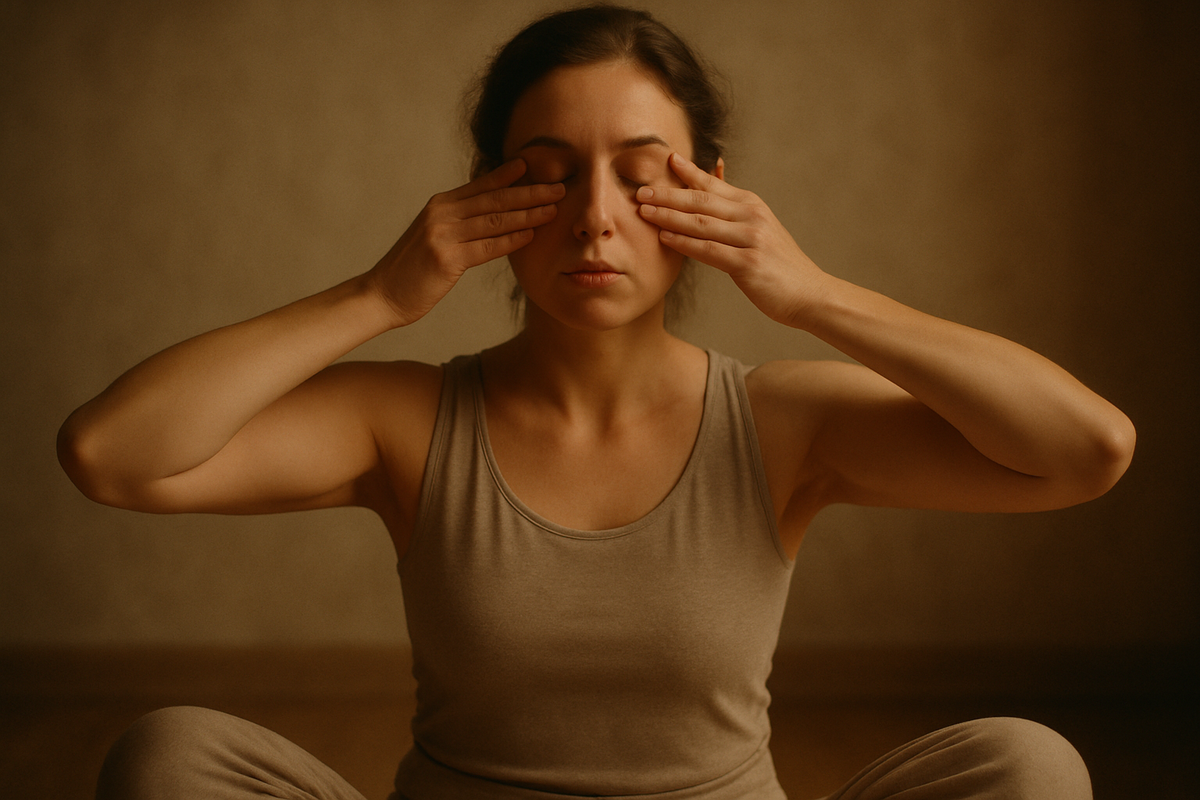
A classical variation of bhramari involves the addition of shanmukhi mudra, also called yoni mudra, in which the fingers gently close the eyes, ears and nose. The thumbs press lightly over the ear openings to block external sound. The index fingers rest over the closed eyelids without pressing on the eyeballs. The middle fingers lightly press the sides of the nose without fully closing the nostrils. The ring and little fingers rest on the upper and lower lips respectively.
In this configuration, the practitioner is almost entirely cut off from external sensory input. The humming vibration becomes the only thing filling awareness. This variation is particularly powerful for inducing pratyahara and preparing the mind for deeper meditation. It is best introduced once the basic technique is well established.
Related Pranayama and Breathwork Practices
Why Humming Stimulates the Vagus Nerve
The vagus nerve is the longest cranial nerve in the body, running from the brainstem through the throat, heart and abdomen. It is the primary pathway of the parasympathetic nervous system, the system responsible for rest, digestion and recovery. Stimulating the vagus nerve shifts the body out of the stress response and into a state of calm, regulated functioning.
Humming activates the vagus nerve through two mechanisms. First, the vibration of the vocal cords directly stimulates the vagal branches that pass through the throat. Second, the extended exhalation involved in producing the hum activates the baroreceptors in the lungs, which signal the vagus nerve to slow the heart rate. Research has confirmed that vagal tone, a measure of how effectively the vagus nerve moderates the stress response, improves with consistent practice of extended exhalation techniques including humming.
Studies examining bhramari specifically have found significant reductions in heart rate, blood pressure and self-reported anxiety following even brief sessions of five to ten minutes. One study found that bhramari produced greater reductions in anxiety scores than slow breathing alone, suggesting that the humming vibration adds a specific benefit beyond the extended exhale. Another line of research has explored how the nasal nitric oxide released during humming exceeds that produced during normal breathing by as much as fifteen fold, with implications for cardiovascular and immune function.
Benefits for Sleep, Stress and Emotional Regulation
For people struggling with sleep, bhramari practised for five to ten minutes before bed is one of the most effective non-pharmaceutical tools available. The vagal activation it produces lowers cortisol, slows the heart rate and reduces the mental activity that typically prevents the mind from settling into sleep. Many practitioners report falling asleep within minutes of completing a bhramari session.
For stress and anxiety, bhramari works differently from distraction or cognitive reframing. Rather than changing the content of anxious thoughts, it changes the physiological state that produces them. When the nervous system is calm, thoughts naturally lose their urgency. This is why bhramari can be effective even when someone feels too anxious to meditate or focus on anything cognitive.
Emotional regulation is another area where bhramari offers particular value. The humming tone has a self-soothing quality that activates the same neural pathways engaged when a parent hums to a distressed child. This is not metaphorical: research in developmental neuroscience suggests that the prosodic, melodic qualities of sound are processed in brain regions closely linked to emotional memory and self-regulation. Bhramari taps directly into this system.
Mindfulness and Yoga for Children and Adults
Teaching Bhramari to Children
Bhramari is one of the pranayama techniques most readily accessible to children. The humming sound is immediately engaging, and children tend to enjoy producing it and feeling the vibration in their skulls. For younger children, it can be introduced as a game: "Let us pretend to be bees. Make a big humming sound when you breathe out." Even three and four year olds can participate in this form.
For older children and teenagers, bhramari can be introduced more directly as a tool for managing exam stress, social anxiety or sleep difficulties. The key is framing it in concrete, physiological terms: "When you hum, you are actually sending a calming signal to your nervous system." This matters because the technique works regardless of whether the practitioner believes in it or understands the mechanism, but children engage more willingly when they understand why something works.
In classroom settings, a brief two or three minute bhramari session at the start of a lesson can noticeably improve attention and reduce background agitation. Teachers who have incorporated it into their morning routines report that it takes only a week or two for children to request the practice themselves.
Featured Programme
I Am: The Heart of Being
A nondual mindfulness course for teenagers aged 13 to 18, integrating breathwork, self-inquiry and inner awareness.
Explore This CourseHow to Build Bhramari Into Your Daily Practice
Bhramari sits comfortably at any point in a pranayama or meditation session. Many teachers recommend it near the end of a pranayama sequence, after more stimulating techniques such as kapalbhati, as it helps to settle the nervous system before entering meditation. It can also be used as a standalone practice at any time of day.
There are almost no contraindications to bhramari. People with ear infections should avoid the version with thumb-plugged ears, but the basic practice with hands resting on the knees is suitable for virtually everyone. It is one of the safest and most reliably beneficial techniques in the pranayama tradition, and for many practitioners, it becomes the practice they return to first whenever life becomes difficult.
Teaching Note from Shital Chute
Bhramari is one of my favorite techniques to recommend to people who tell me they cannot sit still for silent meditation, because the humming sound gives the mind something immediate to focus on. I have noticed that readers respond really well to the simple explanation that the name comes from the black Indian bee, since the low humming exhale is meant to resemble its sound. What I want people to know before trying it is that this is a gentle practice meant to be done in a relaxed, unforced way, not something to perform loudly or for as long as possible. It is also worth being upfront that anyone with an active ear infection or ear condition should skip it until that clears up, and that pregnant readers should keep the practice gentle and check with their doctor first.
Frequently Asked Questions
What is Bhramari pranayama and where does the name come from?
Bhramari, sometimes called the humming bee breath, is a pranayama technique where you exhale slowly while making a continuous humming sound in your throat, with your ears typically closed using your fingers. The name comes from the Sanskrit word for the black Indian bee, since the sound is meant to resemble a bee's soft humming.
What are the benefits people usually mention with Bhramari?
People commonly describe Bhramari as calming and useful for settling a busy mind before sleep or during stressful moments, largely because the humming vibration and slow exhale naturally encourage a slower breathing rate. It is a traditional relaxation practice rather than a clinically proven treatment, so it is best thought of as a calming tool alongside other healthy habits.
Is Bhramari safe for someone with ear problems?
No, you should avoid Bhramari if you have an active ear infection, recent ear surgery, or a perforated eardrum, since closing the ears and creating internal vibration can aggravate these conditions. If you have any ongoing ear issues, check with your doctor before practicing.
Can I practice Bhramari while pregnant?
Gentle, quiet Bhramari without straining the breath is generally considered acceptable during pregnancy by many teachers, but any forceful or prolonged breath control should be avoided. As with any breathing practice during pregnancy, it is best to check with your doctor first, especially if you have a high risk pregnancy.
How long and how often should a beginner practice Bhramari?
Most beginners start with five to ten rounds, done gently and without straining the voice or the breath. It can be practiced daily, often in the evening or before bed, since many people find the humming sound and long exhale naturally winding down.
Free Guide for Parents & Educators
Mini Mindfulness Masters
Simple practices to help children slow down, feel calm, and become more present. A free download, straight to your inbox.
No spam, ever. Unsubscribe at any time.

Written by
Shital ChuteMarketing Lead, The Holistic Care | Mindfulness & Behavioral Health Educator
Shital Chute leads Marketing at The Holistic Care, where she shapes how the platform's mindfulness courses, books and free resources reach the families, schools and workplaces who need them. Alongside this role, she is a passionate advocate and educator for mindfulness and behavioral health, drawing on that perspective to help shape content that is genuinely useful, not just promotional.
Her work at The Holistic Care sits at the intersection of communication and care: translating research-backed mindfulness practices into clear, practical guidance for parents, teachers and adults navigating everyday stress.


