
A practical step-by-step guide to meditation for absolute beginners — covering posture, breath, technique, how long to practise and how to handle a wandering mind.
Meditation is one of the oldest and most thoroughly researched mind-training practices on the planet. Across more than 6,000 peer-reviewed studies, it has been shown to reduce stress, sharpen attention, ease anxiety and depression, improve sleep, and — for those who go deeper — point toward something far more profound than relaxation: an unmediated recognition of the awareness that you already are.
Yet for most beginners, meditation feels bewilderingly elusive. You sit down, close your eyes, and within seconds the mind is composing shopping lists, replaying yesterday's argument, or wondering whether you are doing it right. The good news is that this is not a failure. It is, in fact, exactly what meditation is designed to work with.
This guide gives you everything you need to start meditating today: from posture and timing to neuroscience and the most common pitfalls. Whether you have never sat still for five minutes or you have dabbled and given up, these steps will meet you exactly where you are.
The Short Answer
Meditation is the practice of deliberately directing attention: usually to the breath, body or a chosen anchor: and gently returning whenever the mind wanders. That returning, done without self-criticism, is the practice. Everything else is detail.
What Actually Happens When You Meditate
Modern neuroscience has mapped what contemplatives described for millennia. When you meditate, three changes are particularly well-documented. First, activity in the Default Mode Network (DMN): the brain's "wandering mind" circuitry responsible for rumination, self-referential chatter, and worry: quietens measurably. Second, the prefrontal cortex, which governs attention, decision-making and emotional regulation, strengthens its connections to the rest of the brain. Third, the amygdala — your threat-detection alarm system: becomes less reactive, generating fewer fight-or-flight surges in response to everyday stressors.
These are not subtle effects visible only in long-term meditators. Research by Harvard Medical School's Sara Lazar found measurable cortical thickening after just eight weeks of daily practice. A 2014 meta-analysis by Goyal et al. in JAMA Internal Medicine found mindfulness meditation programmes as effective as antidepressants for mild-to-moderate depression — without side effects.
What the Research Shows
43%
reduction in perceived stress after an 8-week MBSR programme (Kabat-Zinn et al.)
58%
decrease in anxiety symptoms after 8 weeks of mindfulness meditation (Hofmann et al., 2010)
23%
reduction in cortisol (the primary stress hormone) measured in regular meditators vs controls
5–10 min
daily practice is sufficient to produce measurable neural changes within 4–6 weeks (Tang et al., 2015)

Before You Begin: 5 Myths About Meditation
More people abandon meditation because of misconceptions than because of any genuine difficulty. Let's clear the most persistent ones before you sit down for the first time.
-
Myth 1: "You have to empty your mind."
The goal of meditation is not to stop thinking: that is impossible. It is to notice thoughts as they arise without being swept away by them. Thinking during meditation is not a failure; it is an opportunity to practise the act of returning.
-
Myth 2: "You have to sit cross-legged on the floor."
You can meditate on a chair, on a sofa, standing, walking, or lying down. The only requirement is a posture that keeps you alert enough not to fall asleep and comfortable enough not to be distracted by pain.
-
Myth 3: "You need 30+ minutes a day."
Research consistently shows that 5–10 minutes of daily practice produces real neurological change. Consistency matters far more than duration, especially at the start.
-
Myth 4: "Meditation is religious."
While meditation has roots in Buddhist, Hindu, Christian and other traditions, the techniques themselves are entirely secular. The world's leading hospitals, militaries, and corporations teach mindfulness meditation as a cognitive and physical health tool.
-
Myth 5: "If your mind wanders, you're doing it wrong."
Mind-wandering is not a bug: it is the mechanism by which meditation trains the brain. Each time you notice the mind has wandered and gently return your attention, you are performing a "mental rep." The more you do it, the stronger attention becomes.
How to Meditate: Step-by-Step for Beginners
Follow these nine steps for your first session. With practice, steps 1–5 will compress into a single minute of settling, and the heart of the practice — steps 6–8 — will deepen naturally over weeks and months.
Step 1: Choose Your Time and Place
Meditation is most effective when it becomes a daily ritual anchored to a fixed time and location. Morning — before checking your phone: is widely recommended because the mind has not yet accumulated the day's momentum of thought. Choose a spot where you will not be interrupted: a corner of your bedroom, a garden chair, or even a parked car if that is the quietest place available. Consistency of location primes the nervous system: over time, simply sitting in "your spot" begins to induce a settling.
Step 2: Set a Timer
Beginners typically oscillate between two extremes: either watching the clock every thirty seconds or completely losing track of time. A timer solves both problems. Start with five minutes for the first week, and extend by two or three minutes each successive week. Many dedicated apps (Insight Timer, Calm, Headspace) offer guided sessions with gentle closing bells; alternatively, a simple phone timer with a soft alarm tone works perfectly well.
Step 3: Take Your Seat
Meditation Postures
The classical instruction is a posture that is "alert and relaxed" — not so tense that discomfort distracts you, not so comfortable that you drift into sleep. Below are the main options:
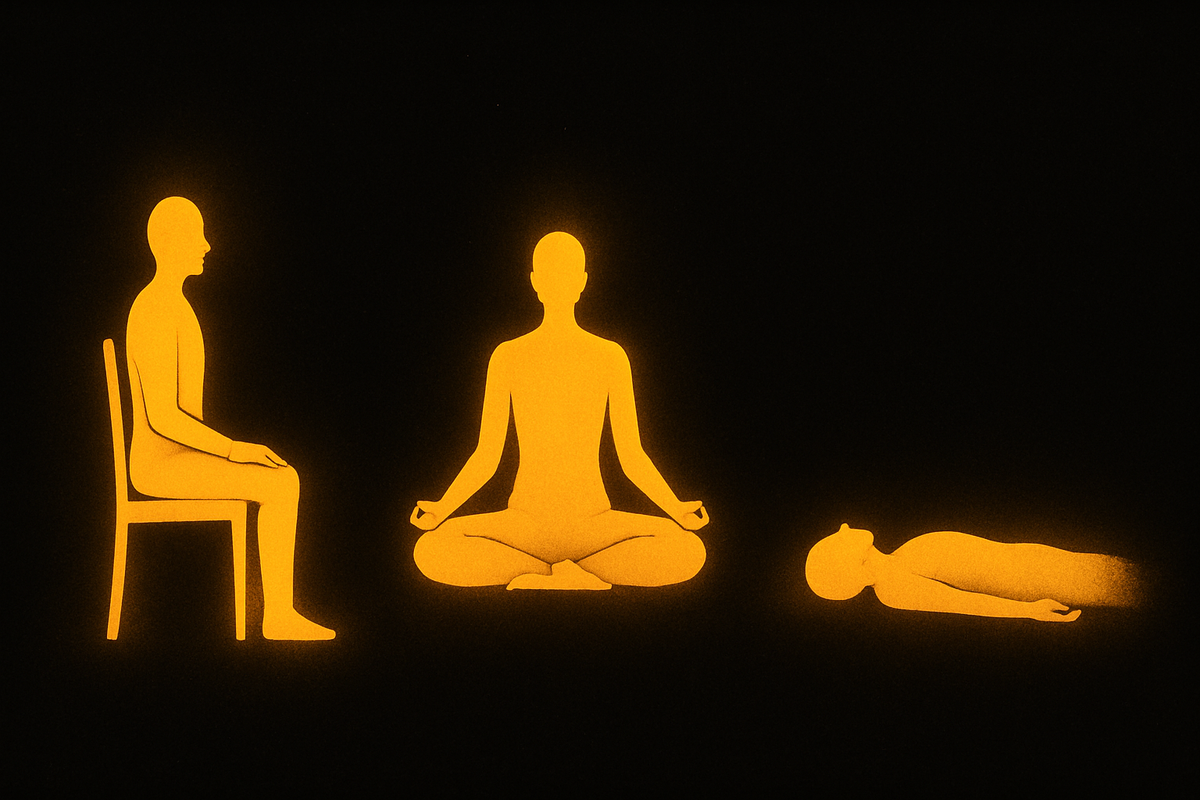
- Seated on a chair — feet flat on the floor, back away from the chair back, hands resting on thighs. Ideal for most beginners.
- Cross-legged on the floor : on a cushion or folded blanket to tilt the pelvis forward and protect the lower back. Hands on knees or in lap.
- Kneeling (seiza) : knees on the floor, hips resting on the heels or a meditation bench. Keeps the spine naturally upright.
- Lying down (savasana) : valid for body scan and Yoga Nidra, but prone to sleep. Place a rolled blanket under the knees to keep the position slightly active.
Step 4: Close Your Eyes
Gently close your eyes, or if you prefer, lower your gaze to the floor at a 45-degree angle with a soft, unfocused look. Either is correct. Closing the eyes reduces visual stimulation and makes it easier to turn attention inward; a soft downward gaze is useful if you feel very drowsy, as it introduces a mild degree of wakefulness.
Step 5: Arrive in the Body
Before finding your anchor, take three deliberate, conscious breaths: slightly deeper than normal, breathing in through the nose and out through the mouth. Feel the weight of the body on the seat. Conduct a brief top-to-bottom scan: notice the crown of the head, the face, the jaw (unclenching if it is tight), the shoulders, the hands, the belly, the legs, the feet. This thirty-second arrival process signals to the nervous system that the period of doing is over and a period of being is beginning.
Step 6: Find Your Anchor
The anchor is the object to which you return your attention every time the mind wanders. The most common and most thoroughly researched anchor is the physical sensation of the breath: not the idea of breathing, but the raw felt sense: the coolness of air entering the nostrils, the rise and fall of the chest or belly, the brief pause at the top and bottom of each cycle. If the breath is uncomfortable (anxiety, trauma, respiratory conditions), the body as a whole — the weight and pressure of the body on the seat — is an excellent alternative. Sound is another valid option: simply receiving whatever arises in the soundscape without naming or judging it.
Step 7: Simply Notice
This is the heart of meditation. You are not trying to make the breath interesting, to slow the mind, to achieve a special state, or to feel anything in particular. You are simply resting attention on the anchor, receiving each moment of sensory experience with quiet, non-judgmental awareness. If calm arises, good. If restlessness arises, good. Neither is the goal; both are just weather passing through the same open sky of awareness.
Step 8: When the Mind Wanders, Return
At some point — probably within seconds: you will realise that your attention has drifted from the breath to a thought, a plan, a worry, a memory, or a fantasy. This realisation is the most important moment in meditation. Without self-criticism, without sigh or internal eye-roll, simply and gently redirect attention back to the anchor. Each return is a single repetition of the mental workout. Twenty returns in one five-minute session is twenty reps. That is a productive session, not a failed one.
"Begin again" is, in many traditions, the whole instruction. Meditation is not the absence of mind-wandering; it is the practice of beginning again, indefinitely, with patience and without cruelty to oneself.
Step 9: Close Gently
When your timer sounds, resist the impulse to immediately reach for your phone. Spend thirty seconds in transition: let awareness expand back outward, wiggle fingers and toes, take one conscious breath, and open your eyes slowly. Notice the quality of awareness before re-entering the day. That noticing — brief as it is — reinforces the perceptual shift that accumulates over weeks of practice.
Types of Meditation for Beginners
Meditation is not a single technique — it is a family of practices. The table below offers a starting map. Most beginners do best choosing one and staying with it for at least four weeks before exploring others.
| Type | What you focus on | Best for | Difficulty |
|---|---|---|---|
| Breath Awareness | Physical sensation of each breath | All beginners; stress & focus | ★☆☆☆☆ |
| Body Scan | Systematic attention through body regions | Physical tension, insomnia, trauma recovery | ★★☆☆☆ |
| Loving-Kindness (Metta) | Phrases of goodwill toward self and others | Anxiety, self-criticism, relationship stress | ★★☆☆☆ |
| Mantra / Sound | A repeated word, phrase or sacred syllable (e.g. So-Hum) | Active minds; those who respond well to sound | ★★☆☆☆ |
| Open Awareness | Awareness itself — the space in which all experience arises | Intermediate+ practitioners; nondual inquiry | ★★★★☆ |
| Yoga Nidra | Guided rotation of awareness through body & layers of experience | Deep rest, sleep disorders, emotional processing | ★☆☆☆☆ |
How Long Should You Meditate?
The research answer may surprise you: consistency of daily practice matters far more than the length of individual sessions. A 2015 study by Tang et al. demonstrated structural brain changes in participants who meditated just 11 minutes per day for 28 days. A 2014 Carnegie Mellon study showed that 25 minutes of mindfulness meditation on three consecutive days meaningfully reduced psychological stress. The ancient traditions were ahead of this: Patanjali does not specify a duration — he specifies a quality of sustained, uninterrupted attention.
For most adults beginning today, a simple progression works well:
Beginner Progression Guide
| Phase | Duration | Goal |
|---|---|---|
| Weeks 1–2 | 5 minutes daily | Establish the habit; learn the basics of returning |
| Weeks 3–4 | 10 minutes daily | Deepen concentration; begin noticing gaps between thoughts |
| Weeks 5–8 | 15–20 minutes daily | Sustained periods of stillness; emotional regulation improving |
| Ongoing | 20–45 minutes daily | The territory of genuine transformation opens up here |
Often attributed to St Francis de Sales
"Half an hour's meditation each day is essential, except when you are busy. Then a full hour is needed."
How to Build a Consistent Practice
The largest obstacle to meditation is not the practice itself but the practice of showing up for the practice. Research on habit formation offers several reliable strategies.
-
Stack it onto an existing habit
James Clear's "habit stacking" principle: attach meditation to something you already do every day: after you make your morning coffee, before you step into the shower, or immediately after brushing your teeth.
-
Same time, same place
Environmental cues are powerful triggers. A dedicated cushion, a particular corner, a specific candle: these become conditioned prompts that make it easier to drop into a meditative state more quickly over time.
-
Use an app for accountability and guidance
Insight Timer — free, the largest library of guided meditations globally. Headspace — excellent for beginners; structured courses. Calm: strong on sleep meditations and body scans. All three track streaks, which leverages loss-aversion to support consistency.
-
Keep a brief journal
Three sentences after each session — what you noticed, what was hard, what shifted: accelerates self-knowledge and keeps the inquiry alive between sessions.
-
Adopt the "two-day rule"
Missing one day is a human moment. Missing two days in a row is the beginning of a break. Commit to never skipping twice. This single rule, popularised by Matt D'Avella and backed by habit research, saves more long-term practices than any other strategy.
Common Meditation Challenges (and What to Do)
Restlessness
You sit down and an irresistible urge to move, check your phone, or do something productive floods in. This is the nervous system's conditioned momentum: and it is extremely common in the first few weeks. The practice instruction is to treat restlessness as the object of meditation itself: notice it, feel it in the body (usually as a buzzing or tightening in the chest), and observe it without feeding it. Most restlessness dissolves within ninety seconds when met with direct, non-reactive awareness.
Sleepiness
Sitting still in a quiet environment signals the nervous system to power down: especially if you are chronically under-slept. Remedies include: meditating earlier in the day, sitting upright (not lying down), opening the eyes slightly, or taking three conscious deep breaths whenever drowsiness arrives. If you repeatedly fall asleep, consider addressing sleep debt before extending sessions, or switching to a walking meditation practice.
Physical Discomfort
Mild discomfort in the lower back, hips or knees is normal and can itself be an object of meditation, observing pain with curiosity rather than aversion often reduces its subjective intensity. Moderate or sharp pain is a signal to adjust your posture, add a cushion, or switch to a chair. There is no virtue in sitting through genuine pain, and no posture is more "meditative" than another.
Emotional Overwhelm
Meditation can occasionally surface emotions: grief, anxiety, or an inexplicable sadness: that have been kept at bay by the busyness of daily life. This is not a sign that something has gone wrong; it is often a sign that the practice is working. If emotions feel manageable, stay present and observe them as sensations. If they feel destabilising, shorten your session, open your eyes, ground yourself in the immediate environment, and — if the pattern persists — consider working with a mindfulness-informed therapist.
Feeling Like "Nothing Is Happening"
Many beginners expect a dramatic experience — waves of peace, bursts of light, a profound silence. Most sessions feel ordinary. The absence of fireworks is not absence of progress. The neurological changes unfold beneath the level of conscious experience; the benefits tend to be noticed indirectly: in how you respond to a difficult email, how quickly you fall asleep, how readily you snap at your children. Trust the process and resist the temptation to measure each session against a peak experience.
Boredom
Boredom is one of the most underrated objects of meditation practice. When you stop feeding the mind with stimulation, it initially protests loudly — boredom is that protest. The instruction is identical to restlessness: meet it with curiosity. What does boredom actually feel like in the body? Where is it located? Is it static or does it shift? Investigating boredom directly is excellent training in the foundational meditative skill of non-reactivity.
The Deeper Dimension: From Technique to Being
Most Western presentations of meditation stop at the level of technique: stress reduction, focus enhancement, emotional regulation. These benefits are real and worth pursuing. But the contemplative traditions from which these techniques were drawn point to something larger: the recognition that the awareness in which all experience arises — all thoughts, sensations, emotions, perceptions — is not a product of the mind, but its ground.
At The Holistic Care, meditation is taught not merely as a tool for wellbeing but as a doorway to what the Indian philosophical tradition calls svaroopa: one's own essential nature. This is not a religious claim; it is an invitation to direct investigation. What remains when the next thought has not yet arisen? What is aware of the breath? These questions do not require years of preparation; they can be asked in the very next sit. The I AM Programme explores this territory in depth, over seven weeks, through both classical nondual teaching and contemporary mindfulness science.
Featured Programme
The I AM Programme
A 7-week nondual mindfulness course for adults — takes meditation from technique to the direct recognition of your essential nature.
Explore the I AM Programme →Deepen Your Practice
- → Meditation: The Complete Resource
- → 25 Mindfulness Techniques That Actually Work
- → Mindfulness Exercises: 20 Practices for Every Day
- → 35 Evidence-Based Benefits of Meditation
- → Mindfulness for Anxiety: A Research-Backed Guide
- → Yoga Nidra: A Complete Guided Script
- → What Is MBCT? The Complete Guide
- → The I AM Programme (Adults)
Frequently Asked Questions
How long should a beginner meditate for?
Start with 5 minutes daily for the first two weeks. This is long enough to feel the practice and short enough to be non-threatening to a busy schedule. Extend gradually — 10 minutes by week three, 15–20 minutes by week five. Research shows that daily 5–10 minute sessions produce measurable neurological and psychological benefits within four to six weeks.
What should I think about when meditating?
Nothing intentionally. Meditation is not a thinking practice: it is an attention practice. You are not trying to generate good thoughts or suppress bad ones; you are learning to rest awareness on a chosen anchor (the breath, the body, a sound) and to notice when it has drifted. Thoughts will arise: that is unavoidable. The practice is to observe them without following them, and to return to the anchor without drama when you have followed them.
Why is my mind so busy when I meditate?
It almost certainly is not busier than usual — it is simply that for once you are paying attention to it. Most of us spend the entire day inside our thoughts without noticing. Meditation is the first time many people actually observe their mental activity, so the volume seems startling. This is a sign of growing awareness, not a malfunctioning practice.
Can I meditate lying down?
Yes, with a caveat: lying down strongly promotes sleep, which is a different state from meditation. If you are using a lying-down position for Yoga Nidra or a body scan, that is appropriate — the practice is designed for the hypnagogic (pre-sleep) threshold. For general meditation, a seated position that keeps you comfortably alert is preferable.
What is the best time of day to meditate?
The research does not conclusively favour one time, but practitioners across traditions almost unanimously recommend morning: specifically, before engaging with screens, news, or the demands of others. The mind is relatively fresh, conditioned momentum is lower, and a morning practice sets a tone of intentionality for the rest of the day. That said, the best time is whichever time you will consistently show up for. A lunchtime meditator who never misses will progress faster than a morning meditator who skips every third day.
How do I know if I'm meditating correctly?
There is no experiential checklist for "correct" meditation. If you are sitting, directing attention to an anchor, noticing when the mind has wandered, and returning: you are doing it correctly. Calmness, stillness or special states are not the measure of a good session. The quality of your attention and the kindness with which you return it are the only metrics that matter.
What is the difference between mindfulness and meditation?
Meditation generally refers to a formal, dedicated practice period, sitting down with intention to train attention. Mindfulness is the quality of open, present-moment, non-judgmental awareness that meditation cultivates: and which can then be applied informally throughout the day: while washing dishes, walking, listening to a colleague. All formal meditation produces mindfulness; not all mindfulness is formal meditation.
Can meditation replace therapy or medication?
Meditation is a powerful complement to professional mental health support: not a replacement for it. For mild-to-moderate depression and anxiety, research shows it can be as effective as antidepressant medication, and it is an evidence-based component of NHS-recommended MBCT for recurrent depression. However, for moderate-to-severe conditions, suicidal ideation, trauma, or psychotic disorders, professional care is the primary intervention. Always consult a qualified healthcare provider before making decisions about medications.
Is it normal to feel worse after meditating?
Occasionally, yes. Meditation can surface suppressed emotions, temporarily increase sensitivity to physical sensations, or — in rare cases in people with certain mental health histories: induce disorientation or heightened anxiety. This is known in the literature as "meditation-induced adverse effects" and is more common at longer session durations or in intensive retreat settings. For most beginners meditating for 5–20 minutes daily, the most common experience is a mild increase in noticing, noticing stress you had been running from, noticing tiredness you had been overriding. This noticing is healthy and generally self-resolving.
What is the best meditation app for beginners?
Insight Timer is free, has the largest library of guided meditations available, and includes structured beginner courses. Headspace is excellent for those who want a linear, well-designed curriculum with animated explanations. Calm is particularly strong for sleep meditations and nature soundscapes. All three offer reminders, streak tracking, and a variety of durations. Try the free tier of each and choose the one whose teaching voice resonates with you — that subjective fit matters more than any feature comparison.
How long until I see results from meditation?
Measurable neurological changes have been documented after as few as four weeks of daily practice. Most beginners report noticing something earlier than that, a slightly greater ease in returning to calm after being stressed, a new ability to notice an emotion arising before being swept away by it, or simply a more reliable quality of sleep. The deepest benefits, a stable shift in the sense of who and what you fundamentally are — tend to emerge over months and years of sustained practice.
Can meditation help with sleep?
Yes: and the research is robust. Meditation activates the parasympathetic nervous system (rest-and-digest mode), lowers cortisol and arousal, and trains the metacognitive skill of not engaging with the content of thoughts — precisely what is needed to fall asleep when a busy mind is the obstacle. Yoga Nidra (yogic sleep) is specifically designed to guide practitioners to the hypnagogic threshold and has been used clinically for insomnia. Regular body scan practice before bed is one of the most evidence-backed non-pharmacological sleep interventions available.
Free Guide for Parents & Educators
Mini Mindfulness Masters
Simple practices to help children slow down, feel calm, and become more present. A free download, straight to your inbox.
No spam, ever. Unsubscribe at any time.

Written by
Mohan ChuteHead of Marketing & AI Strategy | Digital Transformation Leader | Nonduality Mindfulness Teacher | Author | Explorer of Consciousness
Mohan Chute is a rare blend of technology strategist and mindfulness teacher. With over 23 years of experience in digital marketing, AI strategy, and growth leadership, he has guided organizations through automation, analytics, branding, and digital transformation. Alongside this professional expertise, Mohan has devoted his life to exploring meditation, yoga, and nondual awareness—helping people discover balance, presence, and authenticity in a fast‑paced world.
💻 AI & Digital Expertise
As a strategist and innovator, Mohan empowers businesses to harness AI, automation, and analytics to drive growth. His leadership in go‑to‑market strategy, branding, and digital transformation positions him at the forefront of innovation—while keeping human wellbeing at the center.
🧘♂️ The Journey Within
At 17, Mohan discovered meditation on his own—a spark that ignited a lifelong journey into yoga, mindfulness, and nondual inquiry. Today, he integrates this wisdom into both personal and professional domains, showing that technology and consciousness can coexist to create meaningful impact.
🌍 Founder & Teacher
Through The Holistic Care Foundation, Mohan leads transformative programs worldwide. His Nonduality & Mindfulness‑based education initiatives support schools, colleges, and communities in cultivating calm, connected, and compassionate learning environments. For corporate teams, his programs position mindfulness as a competitive edge—enhancing creativity, reducing burnout, and fostering resilient workplace cultures.
📚 Author of Inspiring Works
Mohan’s books span audiences from children to spiritual seekers, weaving story, metaphor, and practice into accessible journeys of awareness. His published works include:
Mindful Adventures for Little Minds
In the Garden of Kindred Spirits
The Wondrous Quest: Journey to the Knower Within
I Am – The Heart of Being
Seeds of Kindness
Mindful Computing: Embracing Presence in a Digital World
The Awareness Chronicles series:
Book 1: The Magic Sketchbook
Book 2: The Movie Projector
Book 3: The Mask Maker
Book 4: The Listening River
Book 5: The True Compass
🎓 Interactive eLearning Courses
Each of these books has been transformed into interactive eLearning programs available on The Holistic Care. These courses combine storytelling, reflection prompts, creative activities, and mindfulness practices—making awareness accessible to children, teens, educators, families, and professionals.
🌈 A Guiding Light
Whether you are a student, educator, professional, or seeker, Mohan’s voice offers clarity and compassion. His mission is simple yet profound: to help people live with balance, presence, and purpose—reminding us that awareness is not the end, but the beginning.


