Understand Know-your-Dosha in a clearer holistic context, including what it explores, how it is commonly used, and when thoughtful guidance matters.
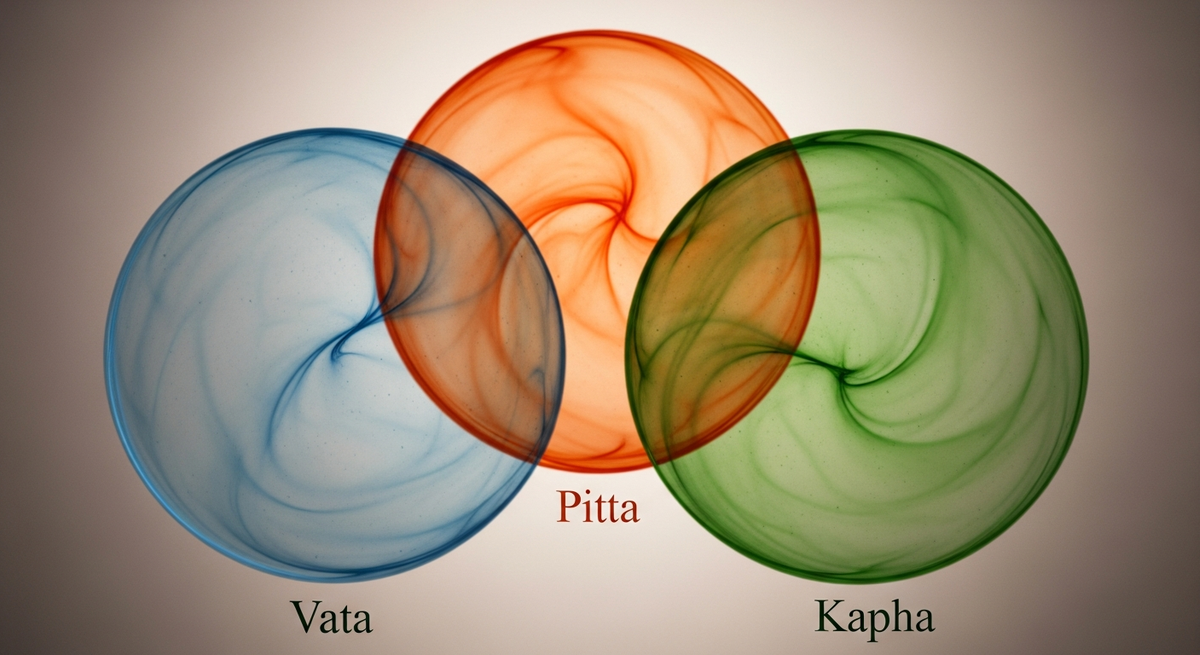
Quick Answer: In Ayurveda, your dosha is your constitutional type, a unique combination of Vata (air and space), Pitta (fire and water), and Kapha (earth and water). Most people have one or two dominant doshas. Knowing your primary dosha helps you choose foods, sleep patterns, exercise, and stress management strategies that work with your nature rather than against it.
The Three Doshas: Plain-Language Descriptions
The doshas are not personality types in the pop-psychology sense. They describe the underlying biological and psychological tendencies that shape how your body processes food, how your mind responds to stress, and how you naturally relate to sleep, temperature, activity, and emotion. They are constitutional patterns, present from birth, that can be supported or disturbed depending on how you live.
Vata is the energy of movement. Its qualities are dry, light, cold, rough, subtle, and mobile. A Vata-dominant person tends to think quickly, move quickly, and communicate with enthusiasm. The body is often lean, with variable appetite and a tendency toward dry skin, cold hands, and light or interrupted sleep. When in balance, Vata brings creativity, adaptability, and spontaneity. When out of balance, it shows as anxiety, scattered attention, insomnia, constipation, or a sense of being ungrounded.
Pitta is the energy of transformation. Its qualities are hot, sharp, light, oily, and mobile. A Pitta-dominant person tends to be focused, driven, and articulate, with a sharp appetite both physically and intellectually. The body is often medium-framed with warm skin, strong digestion, and good stamina. When in balance, Pitta brings clarity, confidence, and purposeful action. When out of balance, it shows as irritability, inflammation, skin flare-ups, acid reflux, or an unrelenting drive toward perfectionism.
Kapha is the energy of structure and cohesion. Its qualities are heavy, slow, cool, oily, smooth, and stable. A Kapha-dominant person tends to be calm, loyal, and methodical, with a strong body, good memory for retained information, and deep, long sleep. When in balance, Kapha brings groundedness, patience, and emotional resilience. When out of balance, it shows as lethargy, weight gain, congestion, attachment, or resistance to change.
Prakriti and Vikriti: Constitution Versus Current State
Prakriti is your birth constitution, the ratio of doshas you were born with. It does not change. Vikriti is your current state, how the doshas are operating right now, which can shift significantly with diet, season, stress, sleep, and age. Ayurvedic assessment reads both: understanding your prakriti tells you what you are working with; understanding your vikriti tells you where things have gone out of balance.
How to Identify Your Primary Dosha
A formal Ayurvedic assessment is done with a qualified practitioner who observes pulse (nadi pariksha), physical characteristics, digestion, sleep patterns, and emotional tendencies together. Online questionnaires can provide a useful starting orientation but should be read as approximations, not clinical findings.
To get a rough sense of your dominant dosha, look at the patterns that have been consistent across your life, not just how you feel today. Vata-dominant people often recall childhood as highly imaginative, mobile, and prone to worry. Pitta-dominant people often recall being competitive, focused, and easily frustrated by inefficiency. Kapha-dominant people often recall steady energy, strong attachments, and difficulty with change.
Most people are bi-doshic, meaning two doshas are roughly co-dominant, with one slightly stronger. A small number are tri-doshic, with all three in relatively equal proportion. Reading your constitution honestly, including the qualities you find less flattering, gives a more accurate picture than selecting only the traits you prefer.
Dosha Imbalance: Signs and Seasonal Patterns
Each dosha has a season in which it naturally increases. Vata increases in autumn and early winter, the dry, cool, windy season. Pitta increases in summer, when heat accumulates. Kapha increases in late winter and spring, the heavy, cool, damp season. Adjusting diet and routine in advance of these seasonal peaks is one of Ayurveda's most practical preventive strategies.
Signs of Vata excess include dry skin, cracking joints, irregular digestion, poor sleep, racing thoughts, and feeling cold. Signs of Pitta excess include skin inflammation, acid reflux, impatience, overheating, and sharp or critical mental states. Signs of Kapha excess include sluggish digestion, weight gain, excessive sleep, congestion, emotional clinging, and lack of motivation.
Using Your Dosha to Guide Daily Life
Knowing your dosha becomes practically useful when it informs specific daily decisions. For Vata types, the most stabilising practices are warm cooked food, consistent mealtimes, oil massage (abhyanga) before bathing, early to bed, and calming movement practices such as slow Hatha or Yin yoga. Irregular schedules, raw food, cold environments, and excessive stimulation all increase Vata.
For Pitta types, the most stabilising practices are cooling foods, moderate exercise at cooler times of day, time in nature, avoiding overwork and competitive environments, and practices that cultivate patience and spaciousness. Spicy food, alcohol, overheating, and situations that trigger frustration all increase Pitta.
For Kapha types, the most stabilising practices are lighter meals, vigorous morning exercise, variety and stimulation, early rising, and reducing heavy, sweet, and oily food. Oversleeping, sedentary routines, and excess comfort eating all increase Kapha.
These are tendencies, not rigid rules. A Kapha person with a current Vata imbalance may need grounding practices typically associated with Vata management until the imbalance resolves. The goal is always to read the current state and respond to what is actually present, not to apply constitutional rules mechanically. This is what makes Ayurveda a living system rather than a fixed prescription.
Featured Programme
The I AM Programme
A structured course in nondual mindfulness for adults seeking clarity, stillness, and inner balance
Explore the ProgrammeTeaching Note from Shital Chute
Learning the three doshas, Vata, Pitta, and Kapha, felt at first like being handed three vague personality types, but what won me over was how specific Ayurveda gets once you look past the labels, sleep patterns, digestion, temperament under stress, all mapped to a particular constitution. I think that specificity is why readers keep coming back to dosha content rather than treating it as a one time quiz result. In my experience helping shape content around this topic, people use their dosha less as a fixed identity and more as a lens for noticing why the same routine, diet, or pace of life works beautifully for one person and poorly for another. That practical, comparative use, rather than any strict medical claim, is what I think makes Ayurvedic typing worth understanding, even for someone encountering it for the very first time.
Frequently Asked Questions
What are the three doshas in Ayurveda?
The three doshas are Vata, associated with air and space and qualities like movement and creativity, Pitta, associated with fire and water and qualities like intensity and digestion, and Kapha, associated with earth and water and qualities like stability and calm. Ayurveda holds that everyone has a unique combination of all three.
How do I find out my dosha?
Many Ayurvedic practitioners and wellness sites offer questionnaires covering physical traits, digestion, sleep patterns, and temperament to estimate a person's dominant dosha or combination of doshas. A consultation with a trained Ayurvedic practitioner will generally give a more thorough assessment than a short online quiz.
Can your dosha change over time?
Ayurveda distinguishes between your constitutional dosha, considered relatively fixed from birth, and your current state, which can shift due to season, stress, diet, and lifestyle. Balancing practices are typically aimed at addressing this current state rather than trying to change someone's fundamental constitution.
Is dosha typing scientifically validated?
Dosha typing comes from the traditional Ayurvedic medical system rather than modern biomedical science, and it has not been validated in the way conventional physiological classifications have. Many people still find it a useful, practical lens for thinking about diet, routine, and lifestyle choices.
Can someone have more than one dominant dosha?
Yes, many people are considered dual-dosha types, showing a fairly even balance between two of the three doshas rather than one clearly dominant type. Ayurvedic recommendations for dual types typically draw guidance from both relevant doshas rather than forcing a single category.
Free Guide for Parents & Educators
Mini Mindfulness Masters
Simple practices to help children slow down, feel calm, and become more present. A free download, straight to your inbox.
No spam, ever. Unsubscribe at any time.

Written by
Shital ChuteMarketing Lead, The Holistic Care | Mindfulness & Behavioral Health Educator
Shital Chute leads Marketing at The Holistic Care, where she shapes how the platform's mindfulness courses, books and free resources reach the families, schools and workplaces who need them. Alongside this role, she is a passionate advocate and educator for mindfulness and behavioral health, drawing on that perspective to help shape content that is genuinely useful, not just promotional.
Her work at The Holistic Care sits at the intersection of communication and care: translating research-backed mindfulness practices into clear, practical guidance for parents, teachers and adults navigating everyday stress.


