
Learn what Reiki is, how a session works, what benefits people seek, what research says, and why Reiki is best approached as complementary support rather than a medical replacement.
Reiki is a Japanese complementary practice in which a practitioner places their hands lightly on, or a short distance above, a clothed recipient with the intention of supporting relaxation and wellbeing. Practitioners describe working with universal life energy, often called ki. That energy model is central to Reiki tradition, but science has not established the existence of a Reiki-specific energy field or shown that practitioners can direct one to treat disease.
People may still find a quiet Reiki session comforting. Time set aside to rest, attentive presence, expectations, gentle or no-touch ritual, and a supportive relationship can all influence subjective experience. The responsible position is therefore neither to mock personal benefit nor to turn it into medical proof. Reiki is best approached as optional complementary support, not a diagnosis, cure, or replacement for evidence-based care.
Key Takeaways
- Reiki is a Japanese complementary practice in which a practitioner places hands lightly on or just above a clothed person, with consent.
- People often use Reiki for relaxation, comfort, or spiritual practice, but it has not been clearly shown to treat any medical condition.
- Research on pain, stress, and anxiety is mixed, with small samples, varied methods, and challenges creating convincing sham-Reiki controls.
- Reiki should complement, never replace, diagnosis, medication, psychotherapy, surgery, cancer care, emergency treatment, or veterinary care.
- A responsible practitioner welcomes questions, explains touch and fees, makes no cure promises, and supports ongoing medical care.
What Is Reiki?
Reiki is usually described as a hands-on or hands-near-body practice developed in Japan by Mikao Usui in the early twentieth century. The word is commonly explained through rei, associated with a spiritual or universal dimension, and ki, associated with vital energy. English translations vary, and the compound should not be treated as a precise biomedical term.
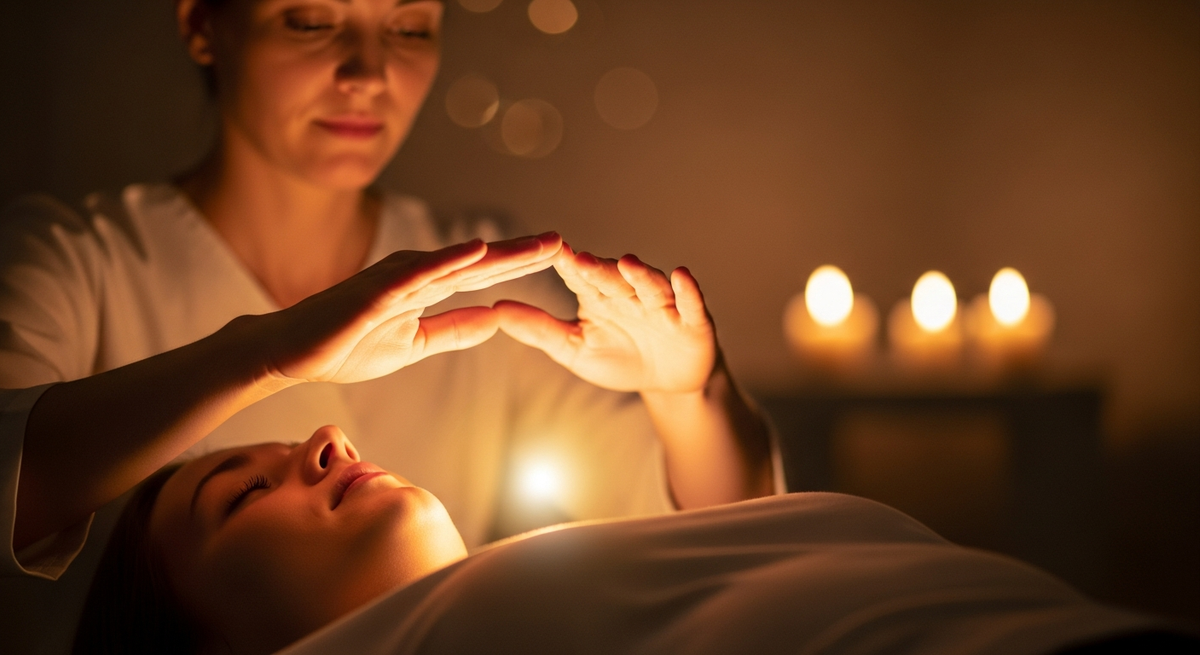
In a session, the recipient normally remains fully clothed while sitting or lying down. The practitioner may hold their hands above the body or make light contact at agreed areas. There is no massage, manipulation, needle, medication, or requirement to adopt a religion.
Reiki can also refer to a spiritual system that includes meditation, precepts, self-treatment, hands-on practice, and initiation or attunement from a teacher. Some modern presentations focus mostly on relaxation sessions. Others emphasise personal cultivation and lineage. These approaches share a name but may differ considerably in training and claims.
Reiki in One Sentence
Reiki is a consent-based complementary practice using light or no touch and a traditional energy-healing framework to support rest and subjective wellbeing, without established evidence that it cures disease or manipulates a scientifically detected energy field.
That definition makes room for tradition, personal experience, and scientific limits at the same time.
The History of Reiki and the Usui System
The modern system is associated with Mikao Usui, who established the Usui Reiki Ryoho Gakkai in Tokyo in 1922. Reiki organisations commonly connect the system's formation with a period of fasting, meditation, or spiritual practice by Usui on Mount Kurama. Details of the story vary across lineages, and some popular Western accounts included claims later questioned by historical researchers.
Usui taught a method for personal and spiritual development as well as hands-on care. Chujiro Hayashi, a naval officer and one of Usui's students, helped organise clinical-style hand positions and training. Hawayo Takata, a Japanese American born in Hawaii, learned through Hayashi's lineage and played a major role in bringing Reiki to Hawaii, the continental United States, and a wider Western audience.
Modern Reiki includes Usui Shiki Ryoho, Usui Reiki Ryoho, Japanese Reiki approaches, and many later systems. Lineage names do not guarantee skill, ethics, or therapeutic effectiveness. They show how a teacher describes the transmission of their method.
The International Center for Reiki Training's history of Reiki is useful as an institutional account from within the Reiki community. It should be read as a lineage source, not as independent clinical evidence.
The Five Reiki Principles
The Reiki precepts, or gokai, are often presented in English as intentions for today:
- Just for today, do not anger.
- Just for today, do not worry.
- Be grateful.
- Work diligently or honestly.
- Be kind to others.
Wording and grouping differ among translations. The principles are not commands to suppress anger, deny anxiety, accept injustice, or remain pleasant during harm. A mature reading treats them as prompts for awareness and conduct.
"Do not anger" can mean noticing anger before it becomes harmful action. It does not mean that anger is spiritually impure. "Do not worry" can point away from repetitive mental struggle while leaving practical planning intact. Gratitude should not erase grief or unequal circumstances. Diligence can mean sincere practice without turning exhaustion into virtue. Kindness includes boundaries and self-respect.
These principles distinguish Reiki as more than a passive wellness treatment. In many lineages, how a practitioner lives and relates is as important as hand positions.
Reiki Compared with Similar Practices
These distinctions matter in research. A study comparing Reiki with usual care cannot reveal whether any change came from energy, resting, attention, expectation, gentle touch, or the relationship. Stronger designs may use sham Reiki, but creating a convincing sham is difficult because participants and practitioners can form beliefs about which condition they received.
What Happens During a Reiki Session?
Before the session
A responsible practitioner asks what brings you, explains the format, and states clearly that Reiki is complementary. They should not diagnose by intuition, scan you for hidden disease, or advise stopping medical treatment.
Discuss touch before beginning. You can request hands-off practice, exclude any body area, keep your eyes open, remain seated, bring a support person where appropriate, or end the session at any time. Consent to one session is not permanent consent.
Tell the practitioner about mobility, pain, pregnancy, recent surgery, sensory sensitivity, trauma triggers, hearing needs, allergies, or other factors that affect comfort. You do not need to disclose a detailed medical history to receive a simple relaxation session, but relevant information helps prevent pressure, unsafe positioning, fragrance exposure, or unwanted touch.
During the session
Sessions commonly last between 30 and 90 minutes, although there is no universal standard. You remain clothed on a treatment table, recliner, chair, hospital bed, or other supported surface. The practitioner moves through a sequence of hand positions or responds intuitively, usually holding each position for several minutes.
Contact, if used, should be light and non-manipulative. Areas such as the chest, pelvis, buttocks, or any place experienced as intimate should not be touched without explicit, context-appropriate consent. No-touch practice is a complete option, not a lesser substitute.
The room may include quiet music or low lighting, but neither is essential. Incense, essential oils, crystals, heat, and other additions are not required for Reiki and introduce separate allergy, interaction, burn, or safety considerations.
What Reiki may feel like
People report warmth, coolness, tingling, heaviness, lightness, emotional release, sleepiness, calm, boredom, restlessness, or no noticeable sensation. A practitioner may also feel heat or tingling in their hands. These are subjective experiences. They do not diagnose an energy blockage or prove that tissue, organs, chakras, or disease changed.
Falling asleep is common during quiet rest and is not evidence that a treatment worked or failed. Strong emotion can arise when someone finally pauses or receives attentive care. If you feel panicked, trapped, unreal, or overwhelmed, open your eyes, ask the practitioner to stop, sit up gradually, and orient to the room.
After the session
Take a moment before standing, especially if you are sleepy or prone to dizziness. Notice comfort, pain, mood, and alertness without assuming every change was caused by Reiki. If you plan to drive, wait until fully alert.
There is no scientific basis for routine claims that Reiki releases toxins and therefore causes headache, nausea, fatigue, or emotional distress as a necessary "healing crisis." New or concerning symptoms should be assessed normally rather than reframed automatically as detoxification.
What Benefits Do People Seek from Reiki?
People commonly seek Reiki for relaxation, stress, pain, anxiety, sleep difficulty, emotional comfort, spiritual connection, support during illness, or a caring pause. Those goals range from subjective wellbeing to medical treatment, and they require different standards of evidence.
It is entirely possible for a person to feel calmer after a session. That report is valid as personal experience. It does not establish that Reiki treats an anxiety disorder, changes tumour biology, heals an injury, balances hormones, removes trauma, or improves immune function.
A useful distinction is between three claims:
- "I felt relaxed during Reiki." This is a direct personal report.
- "A trial found lower average anxiety scores in one Reiki group." This is a research result limited by that study's design.
- "Reiki directs energy that cures anxiety." This is a proposed mechanism and medical claim that current evidence does not establish.
Keeping those levels separate protects both personal meaning and health decisions.
What Does Research Say About Reiki?
The overall evidence remains uncertain
The US National Center for Complementary and Integrative Health states that Reiki has not been clearly shown effective for any health-related purpose. It notes that studies of pain, anxiety, and depression have often been low quality or inconsistent, and that no scientific evidence supports the proposed energy field. The NCCIH Reiki overview is a useful baseline because it distinguishes clinical evidence from the energy explanation.
That conclusion does not mean every study is negative or every recipient feels nothing. It means the total evidence does not yet justify using Reiki as an established treatment.
Pain and anxiety studies
A 2014 review located seven randomised studies of Reiki for adult pain or anxiety. Some reported favourable effects, but populations, controls, sample sizes, and outcomes varied. The authors called for larger trials with standardised methods. The review of Reiki for pain and anxiety is promising at the hypothesis-generating level, not a basis for cure claims.
A 2018 meta-analysis of pain included only four randomised studies with 212 participants. Its pooled estimate favoured Reiki, but such a small evidence base is vulnerable to study quality, heterogeneity, publication bias, and imprecision. The Reiki pain meta-analysis cannot establish that Reiki treats the cause of pain or should replace standard pain care.
A 2022 systematic review examined placebo-controlled Reiki trials for mental health symptoms. Fourteen studies met inclusion criteria, and the authors reported possible effects in some clinical groups. They also concluded that the number of studies in each area was small, most had some risk-of-bias concerns, and findings remained inconclusive. See the placebo-controlled mental health review.
Why Reiki research is difficult
Reiki trials face challenges common in non-pharmacological interventions:
- Participants may guess whether they received genuine or sham Reiki.
- Practitioners cannot be blinded to what they intend to provide.
- Training, hand positions, duration, and treatment frequency vary.
- Outcomes such as calm or pain are affected by expectation and context.
- Small studies can produce unstable or exaggerated effects.
- Usual-care controls do not match time, attention, rest, and ritual.
- Selective publication can make positive studies easier to find.
Sham-controlled trials can ask whether Reiki outperforms a credible matched ritual. They still may not isolate every element. A good study states what it can and cannot infer.
How Might a Reiki Session Help Without Proving Energy Transfer?
Several ordinary mechanisms could contribute to a helpful experience:
Protected rest
A scheduled period of stillness interrupts continuous demand. Breathing, muscle tone, and attention may settle without special instruction. Rest is a real experience even when the proposed energy mechanism remains unverified.
Caring attention
Being listened to and treated with patience can reduce isolation. Therapeutic context influences symptoms in many forms of care. This should not be dismissed as "only placebo," nor confused with proof of a biofield.
Expectation and meaning
Ritual, belief, prior experience, and cultural meaning shape perception. Expectancy can influence subjective pain or anxiety. It does not mean the person imagined the experience, and it does not validate every explanatory claim.
Gentle touch or proximity
Welcome, appropriate touch may feel soothing to some people. Others prefer no touch. Effects of consented human contact are not evidence that a unique Reiki energy entered the body.
Attention to bodily experience
Quiet sessions may make tension, warmth, breathing, or emotion easier to notice. This can support self-awareness. It can also intensify discomfort for people with trauma, pain, or sensory sensitivity, which is why choice matters.
These explanations can coexist with a practitioner's spiritual interpretation. What should not happen is presenting spiritual belief as settled physiology.
Is Reiki Safe?
Reiki itself is generally noninvasive. The NCCIH overview reports that Reiki has not been shown to have harmful effects. However, "no harmful effects shown" is not the same as no possible harm in every setting.
Indirect risks include:
- Delaying diagnosis or effective treatment.
- Stopping medication because a practitioner promises healing.
- Financial exploitation through repeated urgent sessions.
- Unwanted or inappropriate touch.
- Trauma activation, panic, or dissociation.
- Unsafe positioning after surgery, during pregnancy, or with disability.
- Burns or allergies from unrelated candles, oils, heat, or incense.
- Shame when a person is told illness reflects blocked energy or insufficient belief.
Reiki should never delay emergency care for chest pain, stroke signs, severe breathing difficulty, major bleeding, poisoning, suicidal crisis, loss of consciousness, or another urgent problem.
Reiki Alongside Medical and Mental Health Care
Pain
Reiki may be used as an optional relaxation practice alongside an evidence-based pain plan. New, severe, unexplained, or changing pain needs medical assessment. A practitioner cannot determine the cause of pain by feeling energy.
Chronic pain care may involve medicine, physiotherapy, psychology, exercise, pacing, procedures, or specialist support. Do not discontinue treatment because a session temporarily changes pain intensity.
Cancer
Some people use Reiki for comfort during cancer care. It does not treat cancer, shrink tumours, remove chemotherapy, or replace oncology. Tell the oncology team about complementary practices, especially when other products, supplements, fasting, or touch near treatment sites are involved.
Avoid pressure over tumours, ports, wounds, radiotherapy skin changes, or painful areas. Follow infection-control and hospital policies.
Surgery
Reiki cannot sterilise a wound, prevent surgical complications, replace anaesthesia, or guarantee faster recovery. If offered before or after surgery, it should occur only with the clinical team's knowledge where required and without interfering with fasting, monitoring, medication, movement restrictions, or wound care.
Anxiety, depression, and trauma
A quiet session may feel supportive, but Reiki is not psychotherapy and does not treat the causes of a psychiatric condition. Persistent anxiety, depression, trauma symptoms, mania, psychosis, eating disorders, addiction, or suicidal thinking requires qualified care.
Trauma-sensitive practice keeps eyes-open options, explains every movement, avoids surprise touch, and stops immediately when requested. Emotional flooding is not proof that energy is clearing.
Pregnancy
Passive hands-off Reiki has no established direct mechanism of harm, but research specific to pregnancy is limited. Positioning, overheating, scent exposure, dizziness, bleeding, pain, reduced fetal movement, or other symptoms require ordinary maternity guidance. Reiki must not replace antenatal care.
Children and vulnerable adults
Consent, assent, safeguarding, caregiver involvement, and professional boundaries are essential. A child should never be told that refusing touch blocks healing. Sessions should be brief, age-appropriate, and secondary to paediatric care.
Animals
Reiki does not replace veterinary diagnosis, vaccination, medication, surgery, behaviour care, or emergency treatment. Animals communicate discomfort through movement and behaviour. Never restrain an animal to receive Reiki, and respect its choice to move away.
How to Choose a Reiki Practitioner
Reiki training and regulation vary widely by country and region. A certificate may show that someone completed a teacher's course, but it does not confer a medical licence or guarantee ethical conduct.
Ask these questions before booking:
- Which Reiki system and level did you train in?
- How long was the training, and did it include supervised practice?
- What happens during a session?
- Do you use touch, and how is consent handled?
- What are the fee, duration, cancellation policy, and suggested frequency?
- How do you respond when a client has a medical or mental health concern?
- Do you carry appropriate insurance or follow relevant local requirements?
- Can I choose hands-off practice and stop at any time?
Positive signs include clear scope, modest claims, clean professional boundaries, transparent fees, respect for healthcare, and willingness to refer.
Red flags include diagnosing disease through energy, promising cures, guaranteeing outcomes, selling fear about blocks or entities, pressuring you into expensive packages, requesting secrecy, crossing sexual boundaries, discouraging medicine, or blaming you when Reiki does not help.
Titles such as Master or Grand Master belong to a training tradition. They are not medical credentials and should not be treated as independent evidence of expertise.
Reiki Levels, Training, and Attunement
Many Western Reiki schools use a level structure, though formats vary.
Reiki Level 1
Level 1 commonly focuses on history, precepts, self-practice, hand positions, and offering Reiki to people nearby. Courses may last a day, a weekend, or longer. Time alone does not determine quality, but very short automated certification deserves careful evaluation.
Reiki Level 2
Level 2 often introduces symbols, mantras, mental or emotional practice, and distance Reiki. Symbols and teaching details may be considered private within some lineages and openly taught in others.
Reiki Master or Teacher level
Advanced levels may teach additional symbols, attunement methods, and how to teach. Some systems combine Master and Teacher; others separate them. There is no single international curriculum or licensing authority.
What is a Reiki attunement?
An attunement, initiation, or reiju is a ritual through which a teacher authorises or prepares a student to practise within a lineage. Practitioners may describe it as opening a channel to Reiki. Science has not established a measurable energy change caused by attunement.
An attunement can still carry educational, relational, spiritual, and ceremonial meaning. Students should receive informed information about what will happen, including any touch, breathing, symbols, cost, and expectations. A ritual never removes consent.
What Is Distance Reiki?
Distance Reiki is the practice of intending to offer Reiki to a person who is not physically present, sometimes using a name, photograph, symbol, or scheduled time. It is part of many Level 2 systems.
There is no established scientific mechanism by which a practitioner can transmit a healing energy across distance, and existing research does not justify using distance Reiki to treat illness. A recipient may still use a scheduled session as a cue to rest, reflect, pray, or feel supported.
Consent remains appropriate. Do not use distance Reiki claims to say you know another person's diagnosis, thoughts, spiritual condition, or outcome. Never imply that remote practice replaces direct medical, mental health, or emergency care.
A Simple 10-Minute Self-Reiki Practice
Self-Reiki can be approached as a personal spiritual ritual and structured pause. It does not require making a health claim.
Step 1: Choose a safe setting
Sit or lie somewhere supported. Do not practise while driving, cooking, bathing, supervising someone who needs attention, or performing a task that requires alertness.
Step 2: State a modest intention
Use language such as, "For ten minutes, I will rest and meet my experience with care." Avoid demanding that symptoms disappear.
Step 3: Orient to the body and room
Feel the support beneath you and notice three visible objects. Let breathing remain natural. If inward attention makes you anxious, keep the eyes open and use external sound.
Step 4: Choose hands-on or hands-off positions
Place hands together, rest them on the thighs, hold one forearm, or position them above the body. Avoid injured, painful, surgical, intimate, or medically restricted areas. No contact is required.
Step 5: Move through three positions
Stay for two or three minutes at each position. Notice warmth, pressure, breath, emotion, and thought without diagnosing them. Adjust immediately if the posture is uncomfortable.
Step 6: Close deliberately
Separate the hands, look around, move gradually, and decide what practical care comes next. That may be water, rest, food, an appointment, prescribed treatment, or returning to the day.
Self-practice should not become compulsive monitoring. If you repeatedly scan for energy problems or delay needed care, step back and speak with a qualified professional.
Common Reiki Claims That Need Caution
"Reiki can never do harm"
The passive practice appears low risk, but context can cause harm. Delayed care, coercion, boundary violations, financial pressure, and false reassurance are real concerns.
"Reiki works whether you believe in it or not"
This statement cannot prove the energy model. Expectations may influence experience, and people who do not believe may still enjoy quiet rest. Others notice no effect.
"The energy goes where it is needed"
This is a traditional belief, not a safety system. A practitioner cannot rely on energy to detect contraindications, set medication doses, or decide whether symptoms are urgent.
"Feeling heat proves Reiki is flowing"
Hands naturally radiate heat, and attention changes how sensation is perceived. Warmth may be meaningful to a participant but does not verify an invisible mechanism.
"Worse symptoms mean a healing crisis"
Do not assume deterioration is detoxification or release. New, severe, persistent, or concerning symptoms need ordinary assessment.
"More sessions guarantee deeper healing"
There is no evidence-based universal schedule. Decide in advance what you want from the experience, review whether it is useful, and protect your budget. A practitioner should not create urgency or dependency.
A Teaching Perspective from Shital Chute and The Holistic Care
In our approach, Reiki begins with presence and respect. The recipient is not a collection of faulty energy centres to be corrected. They are a person with choices, medical needs, history, beliefs, and boundaries. A session should make room for that whole context.
We also separate experience from explanation. If someone reports warmth, calm, or emotion, we listen without immediately declaring what the sensation means. This protects the recipient from suggestion and allows the session to remain honest.
Finally, complementary care should strengthen a person's relationship with appropriate support, not isolate them from it. A Reiki practitioner demonstrates maturity when they say, "This concern needs a doctor," "Please continue your prescribed care," or "I am not qualified to answer that." Clear limits are not a weakness in practice. They are part of care.
Featured Programme
The I AM Programme
A structured adult journey through body awareness, mindfulness, meditation, deep rest, and compassionate self-understanding.
Explore the ProgrammeFrequently Asked Questions
Is Reiki a religion?
No. Reiki developed within a Japanese spiritual and cultural context, and many practitioners use precepts, meditation, or ceremony, but it does not require membership in a religion. People interpret its spiritual language differently.
Is Reiki scientifically proven?
No. Some small trials and reviews report possible changes in pain, stress, anxiety, or other subjective outcomes, but research quality and results are inconsistent. Science has not established the Reiki energy field or shown that Reiki treats a medical condition.
Can Reiki replace medicine, therapy, or surgery?
No. Reiki should be complementary only. It cannot diagnose disease, replace medication, psychotherapy, surgery, cancer treatment, maternity care, emergency care, or veterinary treatment. Discuss complementary practices with the relevant healthcare professional.
Does Reiki require physical touch?
No. Reiki can be offered with hands above the clothed body. Any contact requires consent, and you can exclude areas, remain seated, keep your eyes open, request a support person where appropriate, or stop at any time.
What is the difference between Reiki and massage?
Reiki uses still light contact or no contact within an energy-practice framework. Massage involves physical manipulation of soft tissues and requires different training, screening, and technique. A Reiki certificate does not qualify someone as a massage therapist.
How many Reiki sessions do I need?
There is no evidence-based universal number. One session may be enough to decide whether you find the experience restful or meaningful. Avoid practitioners who guarantee results or pressure you into costly packages. Persistent symptoms need appropriate assessment rather than more sessions by default.
The Essential Point
Reiki can offer a structured pause, caring attention, and a spiritual ritual that some people experience as deeply supportive. Those experiences deserve respect. They do not require claiming that Reiki cures disease or that an undetected energy mechanism has been scientifically confirmed.
Approach Reiki with informed consent and realistic expectations. Choose practitioners who welcome questions, protect boundaries, state evidence honestly, and work alongside healthcare rather than against it. Whether a session feels warm, peaceful, uneventful, or simply restful, let the next decision be guided by both personal experience and the level of evidence the decision requires.
Continue Exploring Reiki and Mind-Body Practice
Free Guide for Parents & Educators
Mini Mindfulness Masters
Simple practices to help children slow down, feel calm, and become more present. A free download, straight to your inbox.
No spam, ever. Unsubscribe at any time.

Written by
Shital ChuteMarketing Lead, The Holistic Care | Mindfulness & Behavioral Health Educator
Shital Chute leads Marketing at The Holistic Care, where she shapes how the platform's mindfulness courses, books and free resources reach the families, schools and workplaces who need them. Alongside this role, she is a passionate advocate and educator for mindfulness and behavioral health, drawing on that perspective to help shape content that is genuinely useful, not just promotional.
Her work at The Holistic Care sits at the intersection of communication and care: translating research-backed mindfulness practices into clear, practical guidance for parents, teachers and adults navigating everyday stress.


