
Build strength and inner fire with Utkatasana — Chair Pose. Discover how this fierce standing squat strengthens the legs, tones the core, and grounds your root chakra energy.
Utkatasana, commonly called Chair Pose or Fierce Pose, is a standing squat-like yoga posture that combines knee and hip flexion with trunk control and an optional overhead arm reach. It trains lower-body endurance and coordination, but the knees do not need to stay behind the toes and the torso need not remain vertical.
Choose a depth that keeps the feet grounded, knees comfortable, breathing responsive, and exit controlled. Hands can stay on the hips or a wall, and lightly sitting toward a real chair is an effective beginner and accessibility variation.
Safety note: This article is educational. Significant knee, hip, ankle, back, balance, cardiovascular, or neurological symptoms require individual medical or rehabilitation guidance.
Key Takeaways
- Knees may move past the toes when the ankles, knees, and load tolerate it.
- Hip depth is optional; a shallow Chair Pose still trains the legs.
- Arm position should not force rib flare, shoulder pain, or neck tension.
- A wall or real chair can improve control and confidence.
- Thigh effort is expected, but pain and breath holding are not goals.
Utkatasana variations by training need
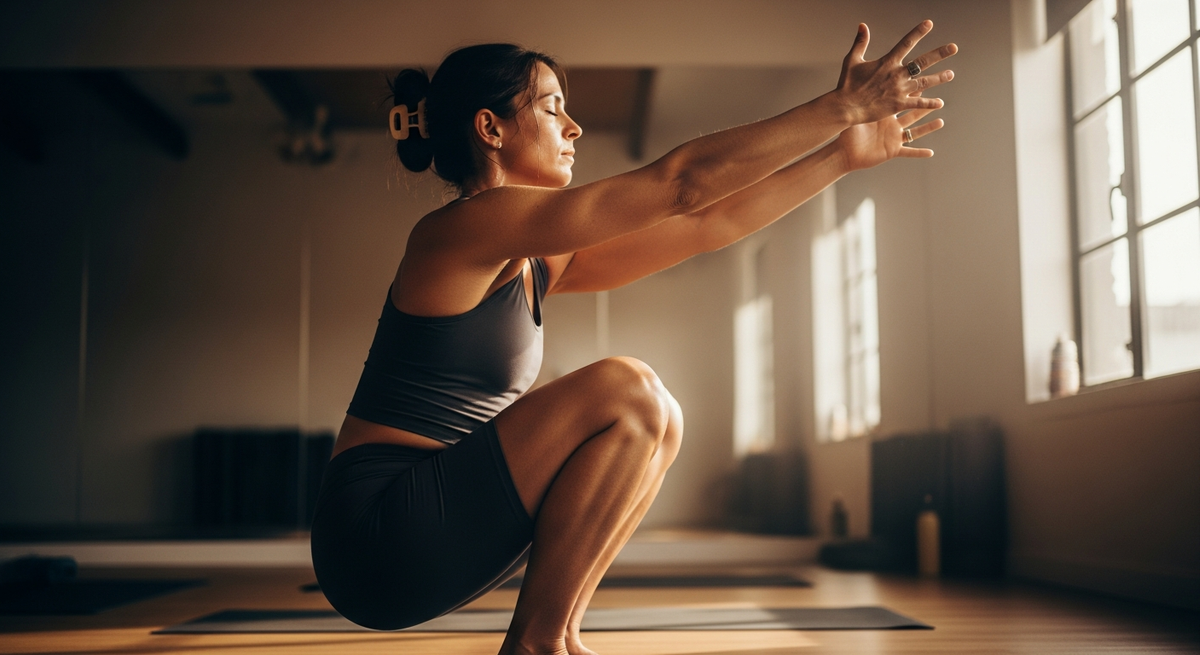
How to Practise Utkatasana Step by Step
Step 1: Choose foot width and support
Stand with feet together or apart according to balance, hip comfort, and teaching context. Place a chair behind you or face a wall for hand support. Confirm that the chair cannot slide.
Step 2: Bend hips and knees together
Let the knees bend while the hips move back and down. Keep pressure through heels and forefeet. The knees can travel forward when comfortable; do not force the shins vertical if it tips the body backward or strains the hips.
Step 3: Select the torso angle
The torso will usually incline. Keep a sustainable spinal position rather than forcing the chest upright or flattening every curve. Reduce depth if the lower back compresses or the pelvis tucks under with discomfort.
Step 4: Add the arms only if useful
Keep hands on hips, reach forward, hold the wall, bring palms together, or raise arms overhead. Overhead arms increase shoulder and trunk demand. Keep a position that permits easy neck movement and breathing.
Step 5: Stand through the whole foot
Press through the feet and extend hips and knees without snapping them backward. Pause upright. For sit-to-stand, touch or sit briefly to the chair and rise with the same controlled foot pressure.
Knees Past Toes: A Context, Not a Prohibition
During squatting, forward knee travel is normal and shifts how load is distributed among ankles, knees, hips, and trunk. Preventing all forward travel may increase hip and trunk demand. The appropriate amount depends on anatomy, symptoms, strength, footwear, and purpose.
Knee pain is a reason to change depth, stance, foot angle, support, speed, or total volume. It is not proof that the knees crossed an imaginary line. A physiotherapist can help assess persistent pain, swelling, locking, instability, or loss of function.
Foot Width, Turnout, and Arch Pressure
Feet do not need to touch. A hip-width or wider stance can improve balance and match hip structure. A small turnout may feel more comfortable. Let the knees move in a compatible direction rather than forcing them straight forward while the feet turn.
Aim for usable pressure through the whole foot without demanding a perfectly static arch. Heels may rise in a deliberate balance variation, but an unplanned heel lift often means the chosen depth or ankle demand is too high.
Spine, Pelvis, and Rib Position
There is no need to draw the tailbone down as hard as possible. Excessive tucking can round the lower back and change hip mechanics, while excessive chest lifting can increase lumbar extension. Choose the middle range that feels strong and breathable.
If overhead arms cause rib flare or back discomfort, lower them. This is a lever adjustment, not a flexibility failure. The leg-training effect remains when hands stay on the wall or hips.
Twisted and Bound Variations
A twist adds rotation and may increase balance and knee asymmetry. Keep knees at comfortable depths and rotate through the trunk without levering the elbow hard against the thigh. Pregnancy and abdominal concerns commonly call for open twists or omission.
A bind adds shoulder range and can distract from the leg base. It is not a necessary progression. Avoid forcing the hands together or using the bind to deepen rotation when shoulders, spine, abdomen, or balance are not prepared.
Manipura and Tapas as Traditional Interpretations
Some modern teachers associate Utkatasana with Manipura chakra, will, and tapas. These can be meaningful traditional or symbolic frames. The pose does not anatomically stimulate a chakra or prove character through endurance.
Staying through manageable thigh effort may teach pacing and attention. Leaving when technique or safety declines may teach equally important discernment. Discipline is not the refusal to respond to the body.
Blood Pressure, Breath Holding, and Heat
A sustained squat can raise cardiovascular demand, especially with overhead arms, heat, breath retention, or repeated rounds. People with cardiovascular disease, uncontrolled blood pressure, fainting, or relevant medicines need individual exercise guidance.
Use a conversational effort, shorten holds, lower the arms, and recover fully. Chest pain, severe breathlessness, faintness, or concerning palpitations require stopping and appropriate medical action.
What Utkatasana Trains and What It Cannot Promise
Utkatasana is a movement task involving a bilateral squat pattern, foot pressure control, knee and hip flexion, trunk positioning, and optional shoulder flexion. Repetition can build familiarity, strength, mobility, balance, or confidence when the load is appropriate. It cannot guarantee corrected posture, detoxification, organ stimulation, emotional release, or treatment of a medical condition.
Its main physical emphasis is quadriceps and hip endurance, ankle and foot coordination, trunk control, and repeated sit-to-stand capacity. The actual effect depends on the chosen variation, starting capacity, frequency, other activity, sleep, nutrition, health, and recovery. One pose is never a complete rehabilitation or fitness programme.
Functional Anatomy of Utkatasana
Joints and movement
The ankles dorsiflex, the knees and hips flex, the spine maintains a chosen angle, and the shoulders may flex when the arms rise. Bone proportions, joint structure, muscle capacity, injury history, pregnancy, disability, and the goal of the session influence the useful version. Alignment should organise load rather than force every body into the same outline.
Muscular work
The quadriceps, gluteal muscles, calves, feet, and trunk share the squat load while shoulder muscles work when arms are raised. Muscles work in coordinated groups, and a felt sensation cannot identify one structure with certainty. Anatomical language is a practical map, not proof that each person should feel an identical location.
Breathing and pressure
Keep the throat and abdomen responsive; reduce depth or arm leverage if breath holding begins. Keep the breath responsive and avoid using retention to endure excessive load. Counting is optional when a prescribed rhythm creates strain, dizziness, anxiety, or loss of control.
Expected Sensations and Stop Signals
Expected sensations can include thigh and buttock effort, foot pressure, mild calf work, and trunk or shoulder effort. They should remain broad, controllable, and compatible with a deliberate exit. Muscular effort differs from sharp, electrical, catching, burning, unstable, or progressively worsening pain.
Leave the pose if you experience sharp knee or hip pain, back compression, foot numbness, loss of balance, chest symptoms, or dizziness. Numbness, tingling, sudden weakness, loss of coordination, chest pain, faintness, severe breathlessness, visual disturbance, or a sudden severe headache require appropriate assessment, not a stronger alignment cue.
Choosing the Right Variation
A variation keeps the useful task while reducing the factor that exceeds current capacity. A practical starting option is a shallow wall-supported squat or controlled sit-to-stand from a stable chair. Props change leverage, load, range, balance demand, or the relationship with the floor. They are training tools, not evidence of failure.
Change one variable at a time. Adjust support before simultaneously changing stance, breath, gaze, and duration. This makes the response easier to interpret and creates a version that can be repeated rather than reinvented each session.
Accessibility belongs inside the definition of yoga
Wall, chair, block, strap, blanket, bolster, seated, standing, and reduced-range options can all express a pose task. The most photographed form is one arrangement, not the standard by which a body earns participation. Agency and a controlled exit matter more than resemblance.
Dose: Holds, Repetitions, and Rest
begin with three holds of ten to twenty seconds or five controlled sit-to-stands with full recovery Rest until breathing, balance, and joint comfort return near baseline. Increase time only when the next-day response is acceptable. Longer holds and deeper range are not automatically more therapeutic.
Isometric effort can accumulate quickly. Stop with some capacity in reserve instead of waiting for shaking, breath holding, or collapsed form. Two or three short, repeatable rounds often provide a better learning dose than one maximum attempt.
Use the later-that-day and next-day tests
Normal training fatigue should settle without reducing ordinary function. Persistent pain, swelling, disturbed sleep, altered gait, reduced grip, new neurological sensations, or symptoms that intensify the next day suggest that the load, range, or volume was too high. Reduce the dose and obtain guidance when the response is significant or recurring.
Where This Pose Fits in a Sequence
Prepare with ankle movement, Tadasana, shallow wall squats, and hip hinges. Follow with upright standing, gentle leg shaking, walking, or a supported rest. These are options rather than mandatory counter-poses. Sequencing should manage total load and preserve enough attention for safe transitions.
Practise a demanding balance, deep range, or strength version while attention is fresh. Avoid adding technical risk at the end of an exhausting class merely because a traditional list or social-media sequence places it there. The order should serve the current goal.
Useful Cues and Their Limits
share pressure through the foot, let knees and hips bend together, and choose an arm position that preserves breath may help organise the task, but every cue is an experiment. Keep it when comfort, control, breath, or the intended action improves. Change it when it produces pain, pressure, instability, or a forced appearance.
Avoid universal commands to square every hip, lock every knee, flatten every curve, pull every shoulder down, or make both sides identical. Alignment distributes load. A teacher cannot determine internal safety from a photograph alone.
Common Mistakes Without Blame
A frequent problem is chasing depth while the heels lift, knees become painful, and the breath locks. This usually means the selected demand exceeds one part of current capacity, not that the practitioner is careless or structurally wrong. Use support, reduce range, slow the transition, or choose a different variation.
Another mistake is treating an instruction as more authoritative than the body response. Traditional language, teacher confidence, and a beautiful demonstration do not cancel pain or a medical restriction. The student remains the primary source for how the pose feels.
Evidence: Whole Yoga Programmes Versus One Pose
Most yoga trials test packages containing many postures, breathing, relaxation, attention, home practice, and teacher contact. Even when the package improves an outcome on average, the research rarely isolates one posture. It is inaccurate to claim that an individual pose treats anxiety, hypertension, diabetes, back pain, or another condition.
A national survey of yoga practitioners found that reported adverse effects were mainly musculoskeletal and were associated with factors including self-study and demanding practices. A systematic review of yoga case reports also identified preventable problems, while case reports cannot estimate ordinary risk. The useful response is gradual progression, not fear.
A Four-Week Learning Plan
Week 1: Build the setup
Use a shallow wall-supported squat or controlled sit-to-stand from a stable chair. Practise entry and exit more often than the hold. Record the prop height, stance, gaze, or support that permits easy breathing and controlled joints. End before fatigue changes the task.
Week 2: Repeat short rounds
Complete two or three short rounds with full recovery. Keep enough consistency to compare days. If one side needs a different range or support, use it instead of forcing visual symmetry.
Week 3: Change one variable
Add a few seconds, one repetition, slightly less support, or a modest range increase. Do not change everything at once. Keep the earlier option available for tired, painful, or lower-capacity days.
Week 4: Integrate without a maximum test
Place the pose in a short sequence with ankle movement, Tadasana, shallow wall squats, and hip hinges before and upright standing, gentle leg shaking, walking, or a supported rest after. Review the response during practice, later that day, and the next morning. Progress is control and choice, not only a more extreme shape.
Teaching, Consent, and Hands-On Assistance
Teachers should explain the task, demonstrate accessible variations, and ask about relevant restrictions without diagnosing them. Consent for touch must be specific, voluntary, and easy to withdraw. An adjustment should never force range, add surprise load, or block the exit.
In Utkatasana, watch transitions as carefully as the final form. Speed, breath holding, fatigue, and loss of orientation often appear during entry or exit first. Use observation and the student’s report rather than assuming deeper means better.
How Often to Practise
Frequency depends on intensity, total training, recovery, symptoms, and which tissues carry the load. A gentle mobility version may suit frequent practice, while a demanding balance or strength form may require more recovery. Do not repeatedly irritate an area to protect a streak.
The WHO physical activity guidelines describe aerobic, strengthening, balance, and mobility needs across a whole week. One pose may contribute, but it cannot provide the full variety needed for health and function.
When Individual Guidance Matters
Seek qualified medical or rehabilitation advice for recent injury, surgery, fracture risk, neurological symptoms, cardiovascular or eye disease, pregnancy complications, unexplained pain, or worsening symptoms. Show the professional the exact variation so they can evaluate the real task.
A yoga teacher and clinician have different roles. The teacher can organise props, pacing, sequencing, and alternatives. The clinician can assess symptoms, diagnose injury or disease, and define restrictions. Safe practice lets each professional stay within scope.
A Pre-Practice Readiness Check
Before Utkatasana, notice pain, fatigue, dizziness, breathlessness, balance, recent illness, and recovery from earlier activity. Confirm that the floor, wall, chair, blocks, and surrounding space are stable. A planned session can become a reduced session or rest day when capacity has changed.
Do not use a pose to test whether a concerning symptom is serious. New severe pain, major trauma, progressive weakness, loss of sensation, fainting, chest symptoms, or other urgent signs require the response advised by a qualified clinician or local emergency service.
A Simple Effort and Recovery Scale
Use a zero-to-ten effort scale, where zero is complete rest and ten is an absolute maximum. Beginners can learn most technique around three to six, with enough reserve to breathe and exit deliberately. The number is personal and should not be compared across bodies.
After each round, ask how quickly breathing, balance, and local sensation settle. Slow or incomplete recovery is information to reduce range, leverage, time, or repetitions. Adaptation comes from an appropriate challenge followed by recovery, not permanent exhaustion.
Pain, Stretch, and Threat Language
Pain is influenced by tissue state, sensitivity, context, expectation, sleep, stress, previous experience, and many other factors. It is real without always mapping directly to damage. A yoga teacher should neither catastrophise every sensation nor insist that pain is harmless.
Use neutral descriptions and choice. Broad muscular effort or stretch may be acceptable when it remains controllable and settles predictably. Sharp, radiating, unstable, or escalating symptoms call for a change. Persistent or function-limiting symptoms deserve clinical assessment.
Practising at Home Versus in Class
Home practice offers convenience but removes immediate feedback and emergency support. Use a simpler version than your maximum, avoid unstable furniture, keep a phone accessible when medically appropriate, and do not attempt a new balance or load because a video continues automatically.
In class, tell the teacher about relevant restrictions and choose a place with access to support. You can decline touch, skip a pose, keep your eyes open, or use a different variation. A competent teacher treats those choices as participation.
Integrating Yoga With Other Movement
Utkatasana may contribute one combination of strength, mobility, or balance, but varied activity is still valuable. Walking, aerobic exercise, progressive resistance, task-specific balance work, and rehabilitation can provide different adaptations. Yoga does not need to replace them to be worthwhile.
Schedule demanding variations around the rest of the week. If the same muscles or joints are already heavily loaded in sport, work, or physiotherapy, choose a gentler yoga version. Total load matters more than whether each activity is labelled exercise, therapy, or spiritual practice.
Reviewing Progress Without Pose Photography
A photograph can document external shape but cannot show pain, pressure, effort, consent, breathing, or recovery. More useful markers include a smoother entry, less support at the same comfort, a steadier exit, better confidence, or the ability to choose an easier version before symptoms escalate.
Review every few weeks rather than every repetition. If the pose remains painful or inaccessible, change the goal. There is no health requirement to master every posture. A complete yoga practice can omit this shape permanently.
Featured Programme
The I AM Programme
A structured mindfulness and self-inquiry programme supporting attention, reflection, and sustainable practice beyond physical pose performance.
Explore the I AM ProgrammeTeaching Note from Mohan Chute
A useful pose guide should leave readers with more choices, not a narrower picture of correct yoga. I encourage people to learn the task, use support early, and judge progress by control, recovery, and confidence. The version that fits today is more valuable than a deeper version borrowed from someone else’s body.
Frequently Asked Questions
Can my knees move past my toes in Chair Pose?
Yes, forward knee travel is normal when tolerated. Depth, ankle mobility, symptoms, and total load matter more than a universal vertical-shin rule.
Should my feet be together?
No. Feet can be together, hip-width, wider, or slightly turned according to balance and hip comfort.
Why does my lower back hurt with arms overhead?
The arm lever may increase rib and spinal extension demand. Lower the arms, reduce depth, and seek guidance if pain persists.
Is thigh burning normal?
Broad muscular effort can be expected. Sharp joint pain, numbness, breath holding, or worsening symptoms are reasons to stop or modify.
Does Utkatasana build willpower?
It can be used as a symbolic practice of attention and effort, but one pose does not measure character or guarantee motivation.
How long should beginners hold Chair Pose?
Ten to twenty seconds for two or three rounds is enough. Sit-to-stand repetitions may be more practical and measurable.
Free Guide for Parents & Educators
Mini Mindfulness Masters
Simple practices to help children slow down, feel calm, and become more present. A free download, straight to your inbox.
No spam, ever. Unsubscribe at any time.
Written by
Editorial Team


