Yoga Chi Gung (YCG) is a synthesis of aspects of Chi Gung and Yoga, drawing on practices from Tibet, Japan, India and China.
Quick Answer: Yoga and Qigong (Chi Gung) are both ancient practices working with life force energy, called prana in Sanskrit and chi or qi in Chinese. Both use breath, slow conscious movement, and inner attention to cultivate, balance and direct this energy. They developed independently in different cultures but share deep structural similarities, and many practitioners find they complement each other well.
Two Traditions, One Principle
Yoga emerged from the Vedic and Tantric traditions of India, developing over at least 5,000 years. Qigong, also written Chi Gung or Chi Kung, emerged from the Taoist and traditional Chinese medical traditions, with documented history spanning at least 2,500 years. They developed in different geographical and cultural contexts, with different metaphysical frameworks, different vocabularies, and different specific techniques.
Yet practitioners who have worked seriously with both consistently note the underlying similarity. Both traditions rest on the recognition that the human body is not merely a physical structure but an energetic system, that life force energy flows through specific channels, that this flow can be cultivated, directed, and balanced through practice, and that the quality of mind and breath is inseparable from the quality of energy flow.
In yoga, the life force is called prana, the channels are called nadis, and the energy centres are called chakras. In Chinese medicine and Qigong, the life force is called chi or qi, the channels are called meridians, and the key energy centres are called dantians, of which there are three: the lower dantian in the lower abdomen, the middle dantian at the heart, and the upper dantian at the forehead. The anatomical maps differ but the underlying function they describe is similar.
Shared Principles: Breath, Movement and Inner Attention
Both yoga and Qigong give central importance to the breath. In yoga, pranayama is a formal practice in its own right, with dozens of specific techniques for energising, calming, and regulating the system. In Qigong, the breath is integrated into movement: every sequence coordinates inhale and exhale with specific physical gestures to direct the flow of chi. In both traditions, the breath is the bridge between the voluntary and autonomic nervous systems, and the most immediate tool for influencing the state of the energy body.
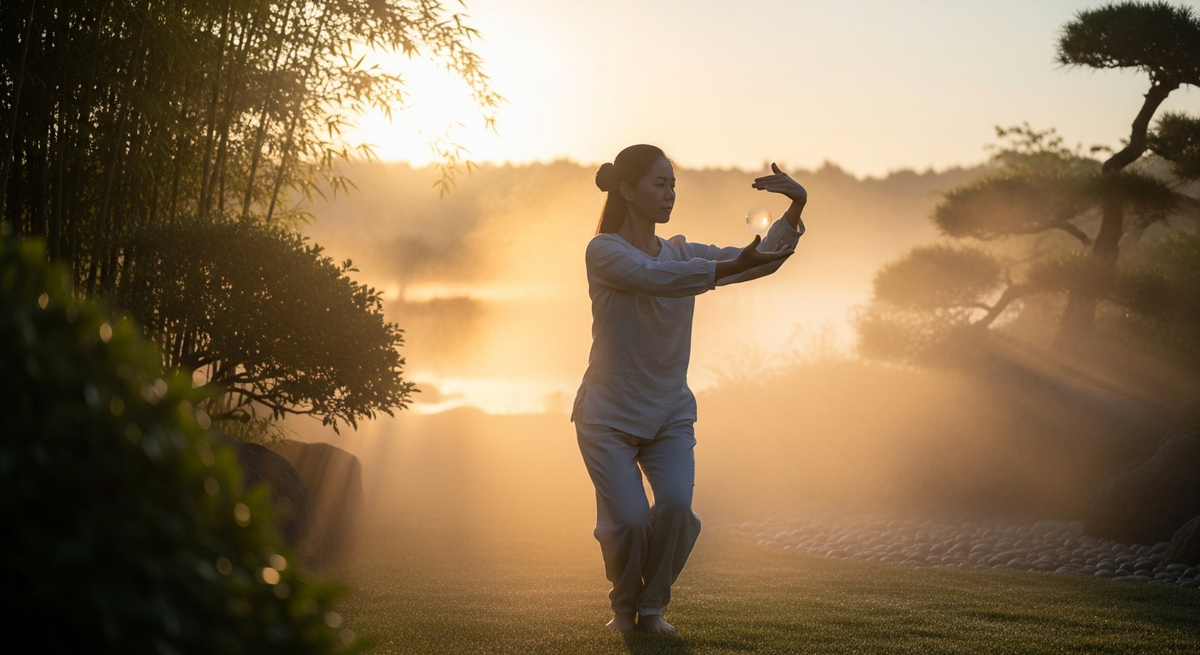
Slow, conscious movement is characteristic of both practices, though this is more pronounced in Qigong than in the broader yoga tradition (which includes both slow and vigorous forms). In Qigong, the slowness is structural: fast movement scatters chi. The emphasis is on moving in a way that can be fully felt from the inside, with attention available for the subtle sensations of energy flowing through the body. This inner attentiveness is also cultivated in yoga practices such as Yin yoga and the slower moving kriyas of Kundalini yoga.
How Practitioners Combine Them
Many practitioners find that yoga and Qigong are more complementary than competitive. Yoga tends to be stronger on the postural and flexibility dimensions, the physical opening of the body through held postures and stretching. Qigong tends to be stronger on the flowing, continuous movement dimension, the cultivation of chi through repetitive sequences that build a kind of inner momentum. A practitioner who uses both can address different aspects of their physical and energetic health more comprehensively than either practice alone might allow.
A common pattern is to practise Qigong as a morning practice for energy cultivation and gentle activation, and yoga in the evening for deeper stretching and nervous system settling. Another pattern is to use Qigong standing practices as a warm-up before yoga asana, building internal awareness and prana before moving into more demanding postures. Some teachers have developed hybrid systems that draw formally on both, though purists in each tradition sometimes view these combinations skeptically.
The shared language of energy, breath, and awareness makes cross-practice learning relatively natural. A yoga practitioner learning Qigong typically finds many familiar principles presented in a different vocabulary. A Qigong practitioner learning yoga typically finds that their existing body awareness gives them a strong foundation, even if the physical demands of some yoga styles are initially challenging.
Complementary Benefits and Different Temperaments
In terms of physiological benefits, research exists for both practices. Studies on yoga have found benefits for flexibility, stress reduction, blood pressure, chronic pain, anxiety, and depression. Studies on Qigong and its close relative Tai Chi have found similar benefits for stress, blood pressure, balance, immune function, and cognitive performance in older adults. Both practices appear to work partly through their effects on the autonomic nervous system, reducing the dominance of the stress response and increasing the responsiveness of the calm-and-restore system.
The differences in character suit different temperaments. Yoga, particularly in its Hatha forms, involves working with physical challenge: holding postures beyond comfort, building strength, and developing specific physical capacities. This suits practitioners who appreciate structure, physical challenge, and clear progression. Qigong is generally more gentle and continuous, less focused on achieving specific physical forms and more focused on the quality of inner attention during flowing movement. This suits practitioners who prefer subtlety, who find held postures uncomfortable, or who are working with injury or age-related limitations.
What Both Practices Point Toward
At their deepest levels, both yoga and Qigong are pointing toward something beyond physical health or energy cultivation. In yoga, the ultimate aim of practice is the recognition of pure awareness, the unchanging conscious presence that underlies all physical, energetic, and mental experience. In Taoism, the context from which Qigong emerged, the aim is alignment with the Tao, the unnameable ground of all existence, and the dissolution of the sense of separateness from it.
These are not identical goals, and the metaphysical frameworks that support them differ significantly. But both involve the cultivation of a quality of inner presence that is different from the ordinary busy mind, a quality of attentiveness, receptivity, and ease that deepens with practice. Both ultimately point the practitioner inward, toward the source of awareness rather than toward external achievement.
For a practitioner engaged with both traditions, this convergence is perhaps the most interesting dimension: each practice opens doors that can be further explored through the other, and both ultimately point toward the same quality of quiet, awake, present awareness.
Featured Programme
The I AM Programme
A structured course in nondual mindfulness for adults exploring awareness, stillness and the source of inner peace
Explore the ProgrammeTeaching Note from Shital Chute
What I like about writing on Yoga Chi Gung, or Qigong, for our readers is that it gives us a chance to show how different movement traditions can share similar underlying goals even though they come from different cultures. From what I have seen in reader interest, people are often looking for something gentler than a vigorous yoga class, and the slow, flowing quality of Qigong paired with yogic breathing tends to appeal to exactly that audience. I think the most useful thing I can offer here as someone on the marketing and education side rather than a longtime practitioner is a clear, respectful explanation of where each tradition comes from and how combining them is typically approached, without collapsing two distinct systems into one generic wellness trend. Readers seem to appreciate that kind of clarity more than a vague blend of buzzwords.
Frequently Asked Questions
What is the difference between yoga and Qigong?
Yoga originates from ancient India and traditionally includes physical postures, breathing practices, and meditation aimed at self realization, while Qigong originates from China and focuses on cultivating and balancing life energy, often called qi, through slow movement, breath, and posture. Combining the two in a single practice draws on techniques from both traditions rather than merging them into one original system.
Is Yoga Chi Gung a traditional, ancient practice or a modern combination?
Yoga Chi Gung as a named, combined practice is generally a more modern approach that blends techniques from the much older individual traditions of yoga and Qigong. Each parent tradition itself has a long, well documented history in its own country of origin.
Is this style of practice physically demanding?
Generally no, most Qigong influenced practices emphasize slow, gentle movement paired with steady breathing rather than intense physical exertion, which makes it approachable for many fitness levels. As with any new physical practice, it is still sensible to move within your own comfortable range and stop if something feels painful.
Do I need any special equipment to try Yoga Chi Gung?
No special equipment is required, comfortable loose clothing and enough open floor space to stand and move your arms freely are generally all you need. A yoga mat can be helpful if part of the session involves floor based stretching or seated breathing work.
Can beginners with no yoga or Qigong experience start with this combined practice?
Yes, this kind of gentle, movement based practice is often considered accessible for complete beginners, since it does not typically require prior flexibility or experience with either tradition. Starting with a short, guided class or video and moving at your own pace is a reasonable way to begin.
Free Guide for Parents & Educators
Mini Mindfulness Masters
Simple practices to help children slow down, feel calm, and become more present. A free download, straight to your inbox.
No spam, ever. Unsubscribe at any time.

Written by
Shital ChuteMarketing Lead, The Holistic Care | Mindfulness & Behavioral Health Educator
Shital Chute leads Marketing at The Holistic Care, where she shapes how the platform's mindfulness courses, books and free resources reach the families, schools and workplaces who need them. Alongside this role, she is a passionate advocate and educator for mindfulness and behavioral health, drawing on that perspective to help shape content that is genuinely useful, not just promotional.
Her work at The Holistic Care sits at the intersection of communication and care: translating research-backed mindfulness practices into clear, practical guidance for parents, teachers and adults navigating everyday stress.


