The nadis are the subtle channels through which prana flows, central to yoga and Ayurveda's map of the body.
The Nadis: Subtle Energy Channels in Yoga and Ayurveda
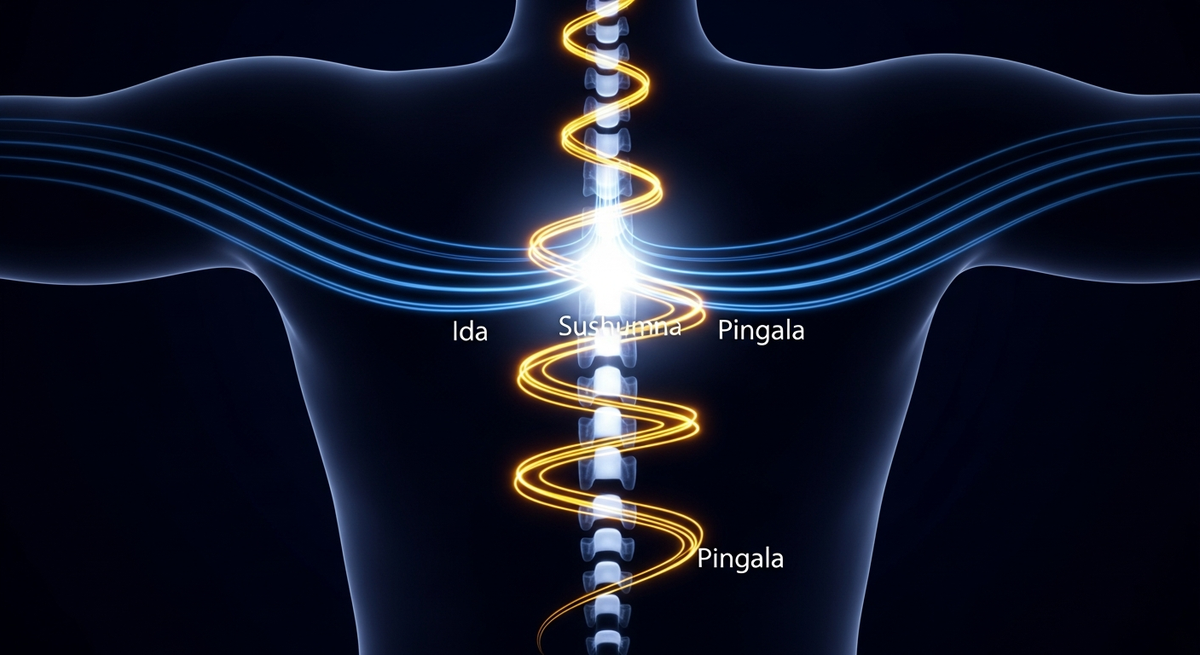
Yoga and Ayurveda share a detailed map of the subtle body, the energetic dimension of the human system that underlies the physical. Central to this map are the nadis, a Sanskrit word that translates approximately as "channels," "tubes," or "flows." The nadis are the pathways through which prana, the vital life force, circulates throughout the body.
Classical texts differ on the exact number, but the most commonly cited figure is 72,000 nadis, a number understood as indicating an extraordinarily complex and interconnected network rather than a precise anatomical count. Of these, three are considered primary and are the focus of almost all pranayama and kundalini yoga practice.
Understanding the nadi system is not merely academic. It provides a functional map for yoga practitioners, helping to explain why certain breathing practices produce certain effects, and what it means when classical texts describe the goal of yoga as the purification and awakening of the subtle body.
Related Yoga and Energy Practices
The Three Main Nadis: Ida, Pingala, and Sushumna
Ida Nadi: The Lunar Channel
Ida nadi originates at the base of the spine, at Muladhara chakra, and spirals upward to terminate at the left nostril. It is associated with the left side of the body, the right hemisphere of the brain, the parasympathetic nervous system, lunar energy, coolness, receptivity, and the mental qualities of introspection and creativity.
When Ida nadi is dominant, breath flows more freely through the left nostril. Practitioners familiar with nadi shodhana (alternate nostril breathing) will have noticed that the dominant nostril shifts roughly every ninety minutes throughout the day, a phenomenon confirmed by modern science as the nasal cycle. During left-nostril dominance, many people naturally feel more reflective and less oriented toward physical activity.
Pingala Nadi: The Solar Channel
Pingala nadi mirrors Ida on the right side, originating at Muladhara and terminating at the right nostril. It is associated with solar energy, heat, activity, the sympathetic nervous system, and the left hemisphere of the brain. When Pingala is dominant, breath flows more strongly through the right nostril, and the individual tends toward greater physical energy, analytical thinking, and outward engagement.
Classical yoga does not judge one nadi as superior to the other. Balance is the goal. Excessive Ida dominance can manifest as lethargy and withdrawal. Excessive Pingala dominance can manifest as agitation, inflammation, and burnout.
Sushumna Nadi: The Central Channel
Sushumna nadi runs through the central axis of the spine, from Muladhara at the base to Sahasrara at the crown. It is the most important nadi in yoga, and the most difficult to activate. Ordinarily, prana flows predominantly through Ida and Pingala, and Sushumna remains relatively dormant. The goal of pranayama and many advanced practices is to bring prana into Sushumna.
When prana enters Sushumna, the mind naturally becomes still. Classical texts describe this as the condition in which deep meditation and samadhi become possible. The experience is often reported as a quality of centredness and clarity that is qualitatively different from ordinary calm.
Deepen Your Prana Practice
Nadis and the Nervous System: A Comparison
Western anatomy does not recognise nadis as discrete structures that can be dissected and observed. However, the functional parallels between the nadi system and the autonomic nervous system are striking. Ida maps closely onto the parasympathetic system, governing rest, repair, and internal processing. Pingala maps onto the sympathetic system, governing action, alertness, and external engagement. Sushumna has been compared to the central nervous system itself.
These parallels do not prove that nadis are simply a pre-scientific description of the nervous system. The nadi model operates at a level of description that is neither purely physical nor purely metaphorical. It describes functional patterns of energy that can be directly experienced through practice, regardless of how they are eventually explained by neuroscience.
Pranayama and the Nadis: How Breathing Practices Create Balance
Nadi Shodhana: Alternate Nostril Breathing
Nadi shodhana is the pranayama practice most directly associated with balancing Ida and Pingala. By alternating the breath between left and right nostrils in a specific ratio, the practice systematically equalises the flow through both channels. When Ida and Pingala are balanced, classical texts say that conditions are created for prana to enter Sushumna spontaneously.
The physical effects of nadi shodhana are well documented. Regular practice reduces resting heart rate, lowers cortisol, and improves heart rate variability, all markers of a well-regulated autonomic nervous system. These effects are entirely consistent with the classical description of what a balanced nadi system produces.
Chakras and Nadis: The Points of Intersection
The seven major chakras are located at the points where the three main nadis cross each other along the spinal axis. Each chakra represents a nexus of energetic activity, a place where the flows of Ida, Pingala, and Sushumna converge. This is why blockages in the nadis are said to manifest as disruptions in specific chakra functions, and why practices that clear the nadis also tend to awaken the chakras.
Featured Programme
Kundalini Yoga at The Holistic Care
Explore the energy body, pranayama, and the subtle architecture of prana through guided kundalini practice.
Explore Kundalini YogaHow to Sense Nadi Energy in Practice
Direct experience of nadi energy is available to any dedicated practitioner. The simplest entry point is through breath awareness. Sit comfortably with eyes closed and place your attention on the sensation of breath moving through each nostril. Notice which side is more open. Spend five minutes simply observing the breath without trying to change anything. This basic practice begins to attune the awareness to the Ida-Pingala dynamic.
As pranayama practice deepens, many practitioners report a sensation of warmth or tingling along the spine during practice, particularly during practices that use breath retention. This is often the first perceptible indication of prana moving in Sushumna. It should not be forced. The classical guidance is to prepare the ground through consistent practice of asana, pranayama, and meditation, and to allow the awakening of Sushumna to occur naturally as a consequence.
The nadi system is one of yoga's most sophisticated contributions to the understanding of human experience. It offers a map that is precise enough to be practically useful, while pointing toward dimensions of the human system that remain beyond the reach of any purely physical account.
Teaching Note from Shital Chute
Subtle body anatomy like the nadi system was, admittedly, the hardest part of this content area for me to get comfortable writing about, because there is nothing to point to under a microscope. What helped was treating Ida, Pingala, and Sushumna the way the yogic tradition itself does, as a functional map of energy, alertness, and calm, rather than as a literal anatomical claim competing with modern physiology. Readers coming to this topic for the first time often ask a version of the same question, is this real, and I think the more useful question is what the framework is used for. People use awareness of these channels, especially through pranayama, to notice shifts between overactive and underactive states of mind. Approached that way, rather than as a scientific fact claim, the nadi system becomes a genuinely practical tool rather than a point of debate.
Frequently Asked Questions
What are nadis in yoga?
Nadis are the subtle energy channels described in yogic anatomy through which prana, or life force, is said to flow through the body. Classical texts describe thousands of nadis, though three, Ida, Pingala, and Sushumna, are considered the most important.
What is the difference between Ida, Pingala, and Sushumna?
Ida is associated with calming, cooling qualities and the left side of the body, Pingala with activating, warming energy and the right side, and Sushumna is the central channel associated with spiritual awakening and balance between the other two. Practices like alternate nostril breathing are said to balance Ida and Pingala.
Are nadis the same as nerves or blood vessels?
No, nadis are a concept from traditional yogic philosophy rather than physical structures identified in anatomy or modern medicine. They are best understood as a functional, energetic map used within yoga and meditation practice rather than a literal anatomical claim.
How can I work with my nadis as a beginner?
Alternate nostril breathing, known as Nadi Shodhana, is the most common beginner practice associated with the nadi system, and it is generally considered gentle and safe for most people. Working with a qualified teacher is a good way to learn proper technique, especially for pranayama practices beyond basic alternate nostril breathing.
Why are Ida and Pingala linked to sun and moon?
Traditional texts associate Pingala with solar, heating qualities and Ida with lunar, cooling qualities, reflecting the yogic idea of balancing opposite energies within the body. This symbolism is meant to describe qualities of energy and temperament rather than a literal connection to celestial bodies.
Free Guide for Parents & Educators
Mini Mindfulness Masters
Simple practices to help children slow down, feel calm, and become more present. A free download, straight to your inbox.
No spam, ever. Unsubscribe at any time.

Written by
Shital ChuteMarketing Lead, The Holistic Care | Mindfulness & Behavioral Health Educator
Shital Chute leads Marketing at The Holistic Care, where she shapes how the platform's mindfulness courses, books and free resources reach the families, schools and workplaces who need them. Alongside this role, she is a passionate advocate and educator for mindfulness and behavioral health, drawing on that perspective to help shape content that is genuinely useful, not just promotional.
Her work at The Holistic Care sits at the intersection of communication and care: translating research-backed mindfulness practices into clear, practical guidance for parents, teachers and adults navigating everyday stress.


