
A complete guide to nondual philosophy, Advaita Vedanta, awareness, self-inquiry, key concepts, misconceptions, benefits, and daily practice.
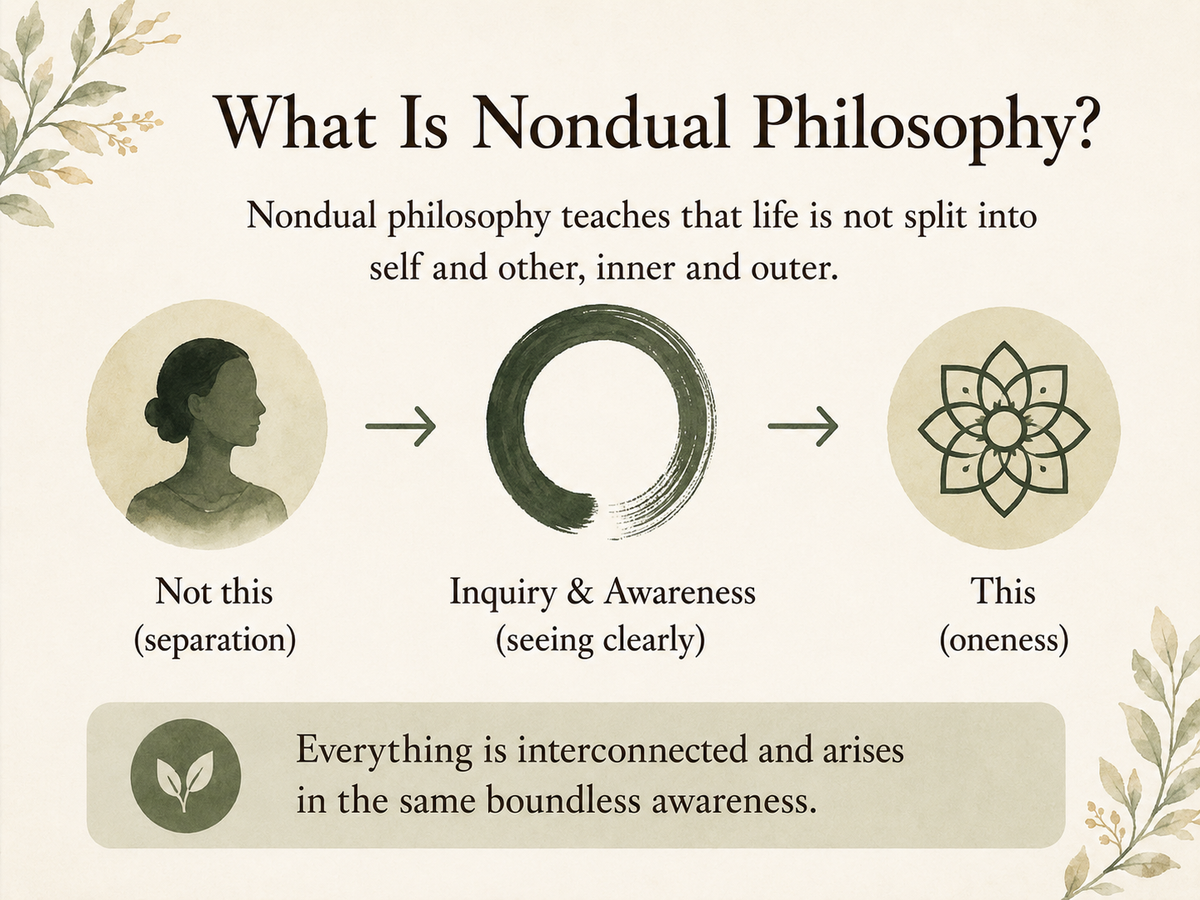
Nondual philosophy is the exploration of one simple but radical possibility: that life is not ultimately divided into a separate self on one side and a separate world on the other. The word "nondual" means "not two." In Advaita Vedanta, this points to the recognition that the true self, the world, and the awareness in which both appear are not separate realities. There is one reality appearing as many names and forms.
This article expands the original guide into a complete introduction to nondual philosophy: its meaning, Advaita Vedanta roots, key Sanskrit concepts, major teachers, self-inquiry practice, common misunderstandings, daily-life application, and recommended next steps through The Holistic Care courses and ebooks.
The short answer
Nondual philosophy teaches that your deepest identity is not the changing body, mind, story, role, or personality. What you are most essentially is awareness itself: the open knowing in which thoughts, emotions, sensations, and the world appear. The apparent boundary between "me" and "life" is useful in everyday functioning, but it is not the final truth of who you are.
Start with these related guides
What is nondual philosophy?
Nondual philosophy is a way of understanding reality that does not begin with separation. Most ordinary thinking assumes a world made of separate things: me here, you there, thoughts inside, objects outside, awareness in the head, life happening somewhere else. Nondual philosophy questions that assumption at its root.
Its central insight is not that the world disappears, or that individuality has no practical function. Rather, it says that the apparent multiplicity of life does not divide reality into truly separate pieces. Just as waves are not separate from the ocean, experiences are not separate from awareness. The mind names and separates; awareness simply knows.
In plain language, nondual philosophy asks: What is aware of this moment? Is that awareness separate from what it knows? Can the one who is looking be found as a separate object? What remains when every changing identity is noticed as a passing appearance?
Why "not two" does not mean "nothing exists"
A common mistake is to hear "not two" as a denial of the world. That is not the mature nondual view. The chair, the body, a conversation, grief, kindness, responsibilities, and relationships all appear. They matter at the human level. Nonduality does not erase them. It changes the way they are understood.
The nondual view is closer to saying this: things are real as appearances, but not separate as independent substances. A movie image appears on a screen. The image can be beautiful, painful, dramatic, funny, or frightening. It is not nothing. But it is never separate from the screen. In the same way, experience is vivid and meaningful while never being separate from awareness.
Nonduality is not the belief that nothing matters. It is the recognition that everything appears in one undivided field of awareness, and therefore everything can be met with more intimacy, clarity, and care.
Advaita Vedanta: the classical home of nondual philosophy
The most systematic expression of nondual philosophy is Advaita Vedanta, one of the great philosophical streams of India. "Advaita" means not-two. "Vedanta" means the end or culmination of the Vedas, especially the wisdom of the Upanishads. Advaita Vedanta teaches that Brahman, pure reality or consciousness, is the ultimate truth, and that Atman, the true self, is not separate from Brahman.
The classical source texts include the Upanishads, the Bhagavad Gita, and the Brahma Sutras. Together they are called the Prasthanatrayi, the three foundational sources of Vedanta. Advaita's philosophical structure was most famously developed by Adi Shankaracharya, traditionally placed in the eighth century CE, whose commentaries shaped the tradition for centuries.
For an easier first step into this tradition, read Advaita Vedanta for Beginners, then return here for the deeper conceptual map.
| School | Main teacher | View of self, world, and Brahman |
|---|---|---|
| Advaita Vedanta | Adi Shankaracharya | Nondual. Atman is Brahman; apparent separation is due to ignorance and superimposition. |
| Vishishtadvaita | Ramanujacharya | Qualified nondualism. The world and souls are real parts or modes of Brahman. |
| Dvaita Vedanta | Madhvacharya | Dualist. God, individual souls, and the world are eternally distinct. |
Key teachings of nondual philosophy
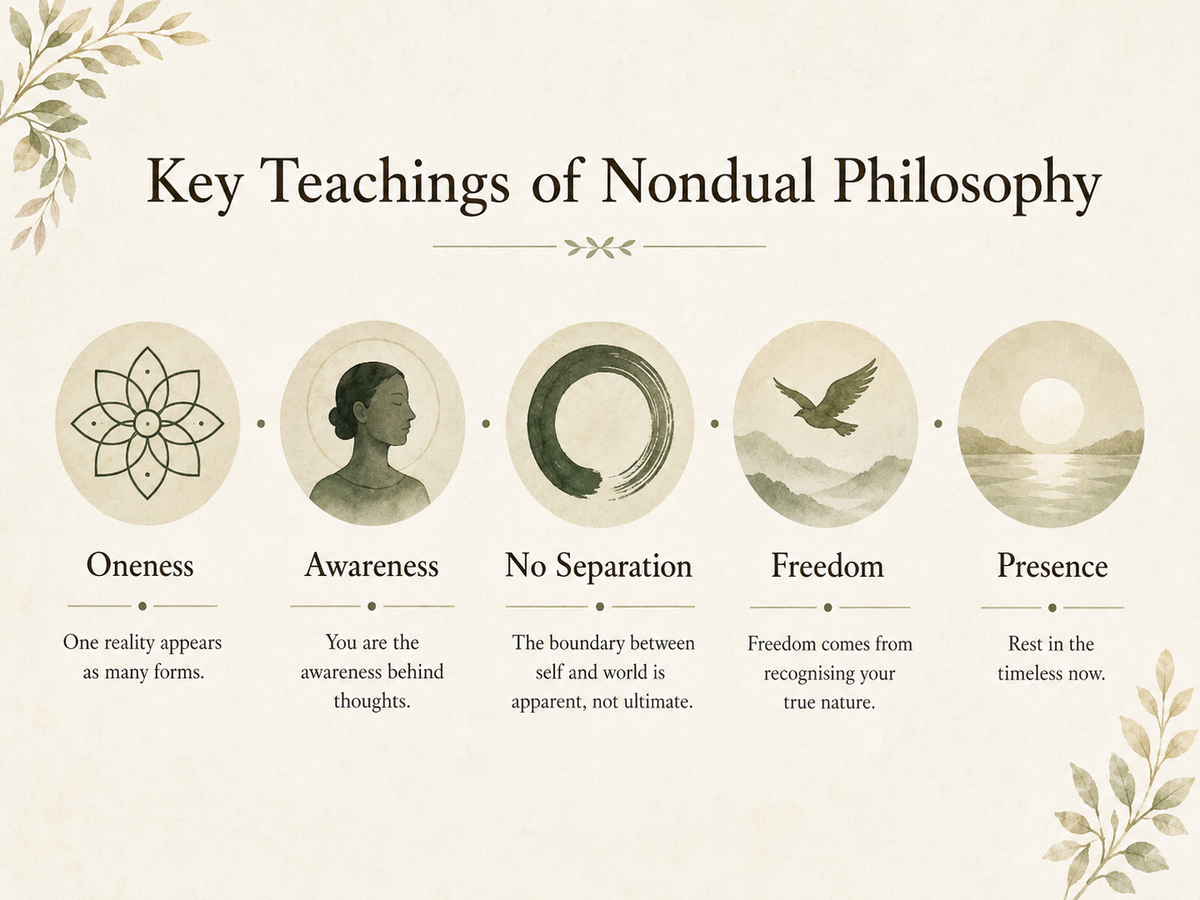
Although nondual teachers use different words, several core teachings appear again and again. You are not merely the body-mind. Awareness is not an object inside the person. The world is not separate from the reality in which it appears. Freedom is not produced by becoming a better ego, but by seeing clearly what the ego actually is. Presence is not something manufactured; it is what remains when the search relaxes.
These teachings are not meant to become new beliefs. They are pointers. A pointer is useful only when it sends attention back to direct experience. The question is not "Do I agree with nonduality?" The real question is "Can I verify, here and now, what is aware of this thought, this sensation, this moment?"
Core concepts: Brahman, Atman, Maya, Avidya and Turiya
Nondual philosophy uses precise language because it is dealing with subtle distinctions. The words can sound abstract at first, but each points to something immediate. Brahman points to reality itself. Atman points to your true self. Maya points to the appearance of separation. Avidya points to mistaken identity. Turiya points to awareness as the constant presence through changing states.
| Term | Plain meaning | Why it matters |
|---|---|---|
| Brahman | The one reality: pure being, consciousness, and limitless awareness. | Nondual philosophy says Brahman is not elsewhere. It is the reality of this moment. |
| Atman | The true self, prior to personality, role, memory, and body-image. | Advaita's central insight is that Atman is not separate from Brahman. |
| Maya | The power by which one reality appears as many separate things. | Maya explains why separation feels real without being ultimately real. |
| Avidya | Ignorance or mistaken identity. | Suffering begins when awareness mistakes itself for the limited mind-body self. |
| Sat-Chit-Ananda | Being, consciousness, and peace/bliss. | A concise description of the nature of Brahman and the true self. |
| Turiya | The fourth: awareness present through waking, dream, and deep sleep. | It points to awareness as constant while all states come and go. |
If Turiya is new to you, the companion article What Is Turiya? explains the fourth state in more detail, while The Four States of Awareness maps waking, dream, deep sleep, and awareness.
The mahavakyas: four great nondual statements
The mahavakyas are the great sayings of the Upanishads. They are among the most concentrated expressions of Advaita Vedanta. They do not ask for blind belief. They invite inquiry into the nature of the one who hears them.
- Prajnanam Brahma - Consciousness is Brahman.
- Aham Brahmasmi - I am Brahman.
- Tat Tvam Asi - That thou art.
- Ayam Atma Brahma - This self is Brahman.
A useful way to approach these sayings is slowly. When you read "I am Brahman," do not let the personal ego claim it as a spiritual achievement. Instead ask: What is the "I" that is present before every thought about me? What knows the body, the story, the memory, and the desire to understand?
How nondual inquiry works
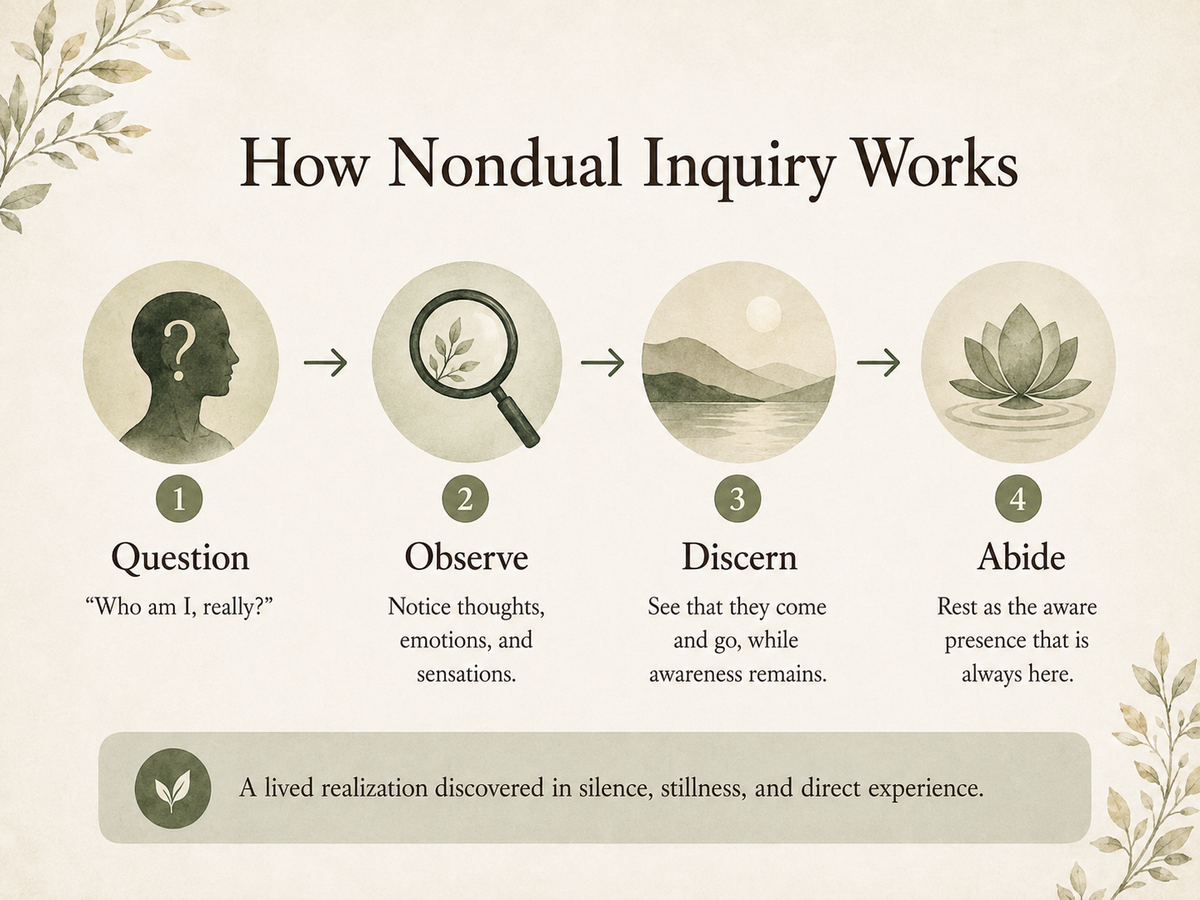
The most direct practice in modern Advaita is self-inquiry, especially as taught by Ramana Maharshi. The question "Who am I?" is not meant to be answered intellectually. It is a way of turning attention back toward the sense of "I" itself. Every answer that appears - name, age, history, gender, profession, emotion, belief - is noticed as an object. If it can be noticed, it cannot be the final subject.
A simple inquiry can unfold like this: first, ask who is aware. Second, observe thoughts, feelings, and sensations without trying to control them. Third, notice that all of them come and go, while awareness remains. Fourth, rest as the aware presence that is already here. This is why nondual inquiry is not a technique for producing a special state. It is a way of recognizing what is already present before, during, and after every state.
The witness, awareness, and the true self
Many people first encounter nonduality through the witness: the felt sense that thoughts, emotions, and sensations are being observed. This is a valuable step. When anger is seen as an arising emotion rather than "me," there is space. When fear is known as sensation plus thought rather than identity, there is freedom to respond.
But nondual philosophy eventually questions even the witness. Is awareness a distant observer standing apart from life, or is it the very field in which life appears? The mature understanding is not detachment in the cold sense. It is intimacy without entanglement. Awareness is not separate from experience; it is the reality of experience.
This distinction is explored further in Nondual Awareness, Nondual Consciousness, and Nondual Experience.
Nondual philosophy and mindfulness
Mindfulness trains the capacity to notice thoughts, feelings, and body sensations without being overwhelmed by them. Nondual inquiry asks a deeper identity question: what is the awareness in which these thoughts, feelings, and sensations are noticed? Mindfulness often begins with the observer watching experience. Nonduality asks whether the observer and experience are truly separate.
For many people, mindfulness is an excellent preparation for nondual understanding. It stabilizes attention and reduces reactivity. Then nondual inquiry points beyond regulation toward recognition. The result is not a rejection of mindfulness, but a fuller understanding of what mindfulness is resting in.
For the full comparison, see Nonduality vs Mindfulness. For a clinical mindfulness pathway, see Mindfulness-Based Cognitive Therapy (MBCT).
Nondual philosophy in everyday life
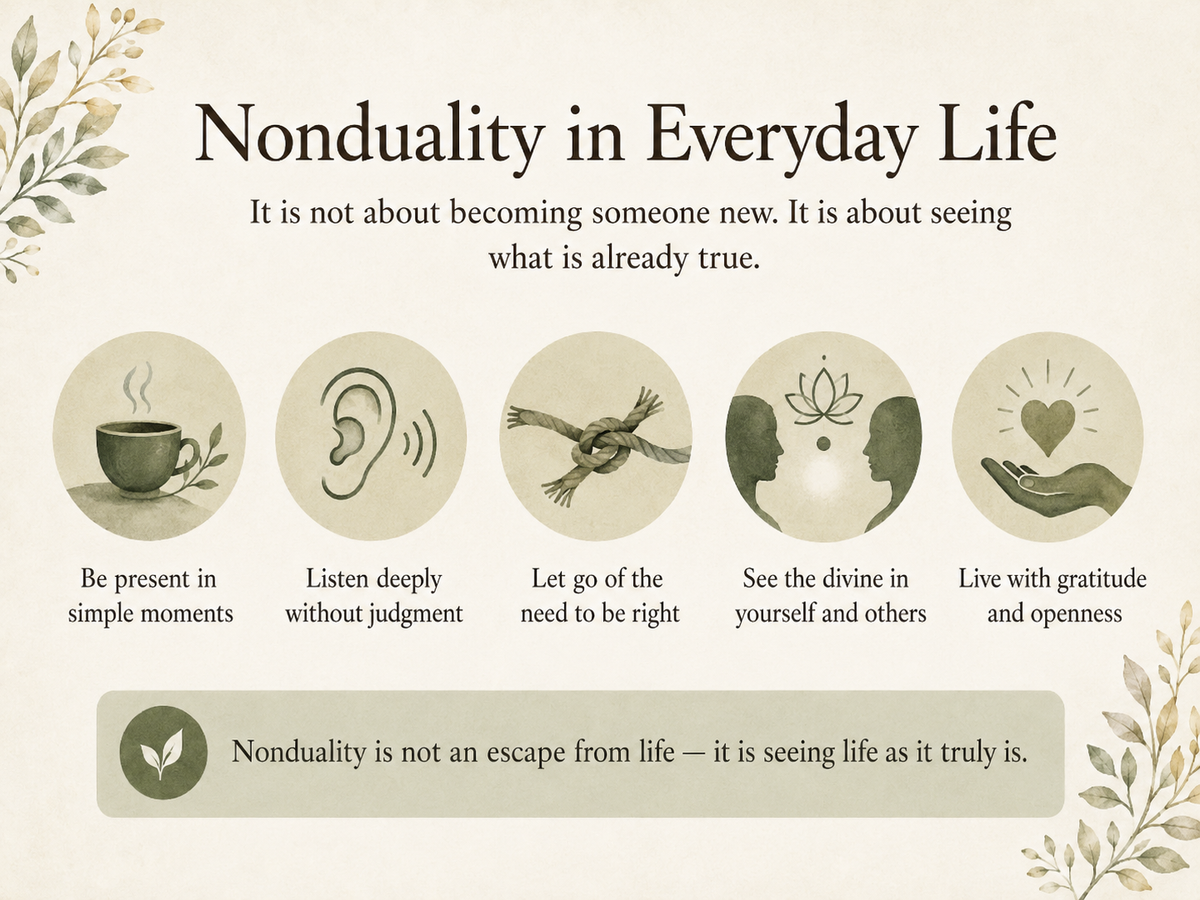
Nonduality is easy to romanticize as a peak experience. But its real test is ordinary life. Can you listen without immediately defending a self-image? Can you feel sadness without becoming the story of sadness? Can you meet another person without reducing them to a role in your private narrative? Can action arise from clarity rather than contraction?
In daily life, nonduality looks surprisingly simple. Drinking tea with full attention. Hearing another person without preparing a reply. Letting go of the need to be right. Seeing the same awareness shining through different temperaments, cultures, ages, and viewpoints. Acting responsibly without turning responsibility into identity.
Benefits of living with nondual understanding
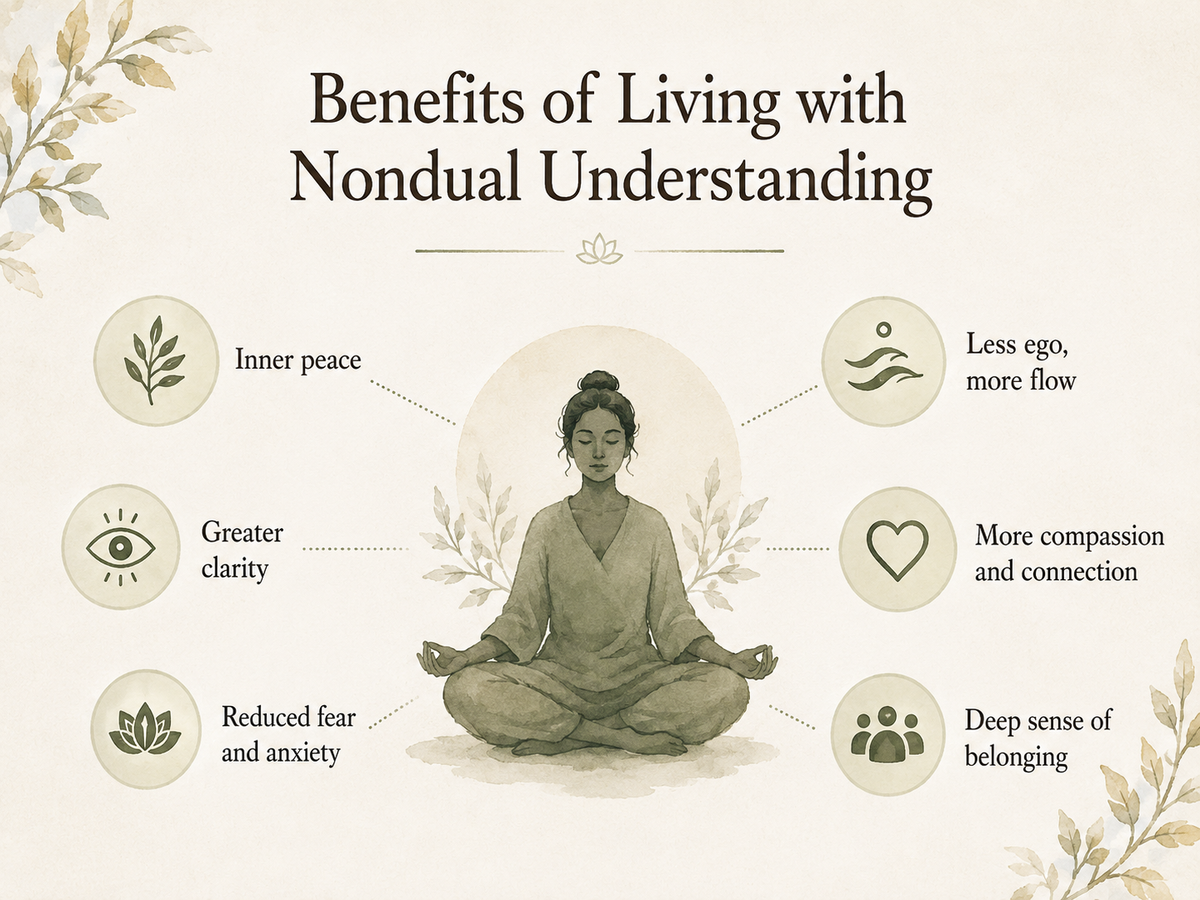
The benefits of nondual understanding are not benefits in the usual self-improvement sense. The point is not to make the ego permanently calm, impressive, or spiritually special. The benefit is that identification softens. The mind may still think. The body may still feel. Life may still bring difficulty. But the sense of being trapped inside a separate, threatened self begins to loosen.
As that loosening deepens, many people report more inner peace, clearer perception, less defensive ego activity, reduced fear, more compassion, and a deeper sense of belonging. These are not manufactured personality traits. They are natural consequences of seeing less separation.
Common misconceptions about nonduality
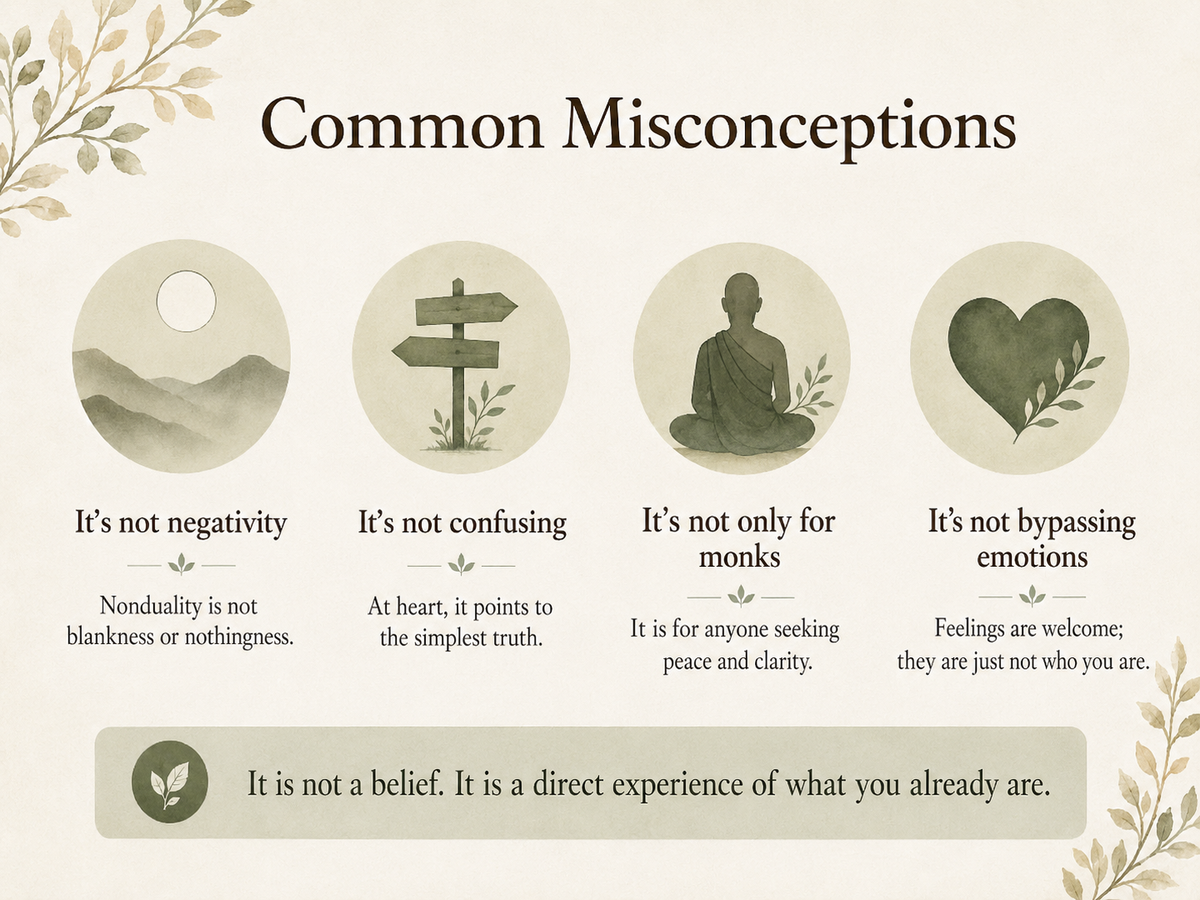
Nonduality is often misunderstood because its language can be subtle. "There is no separate self" can be mistaken for "nothing matters." "You are awareness" can be mistaken for spiritual bypassing. "Everything is one" can be used to avoid boundaries, accountability, or emotional work. These are distortions, not mature nondual understanding.
A grounded nondual approach welcomes emotions, honors the body, respects therapy and trauma work where needed, and remains ethically engaged. If a teaching makes someone less compassionate, less honest, or less responsible, something has gone off course. Clear seeing should make life more intimate, not more avoidant.
Nonduality in Buddhism, Taoism, and other traditions
Advaita Vedanta is not the only nondual tradition. Zen Buddhism points to original nature and direct seeing beyond conceptual mind. Mahayana Buddhism speaks of emptiness: things do not possess separate, independent existence. Kashmir Shaivism sees the world as the self-expression of consciousness. Taoism points to the Tao that cannot be captured by names. Christian mystics such as Meister Eckhart speak in language that often comes very close to nondual recognition.
These traditions are not identical. Buddhism may avoid the language of Atman or Brahman. Advaita may speak more directly of the true self. Taoism may avoid metaphysical certainty and favor naturalness. Yet all of them challenge the assumption that reality is made of fundamentally separate parts.
For the Buddhist angle, read Nonduality in Buddhism. For a broader spiritual context, read Spirituality and Nonduality.
How to start exploring nonduality
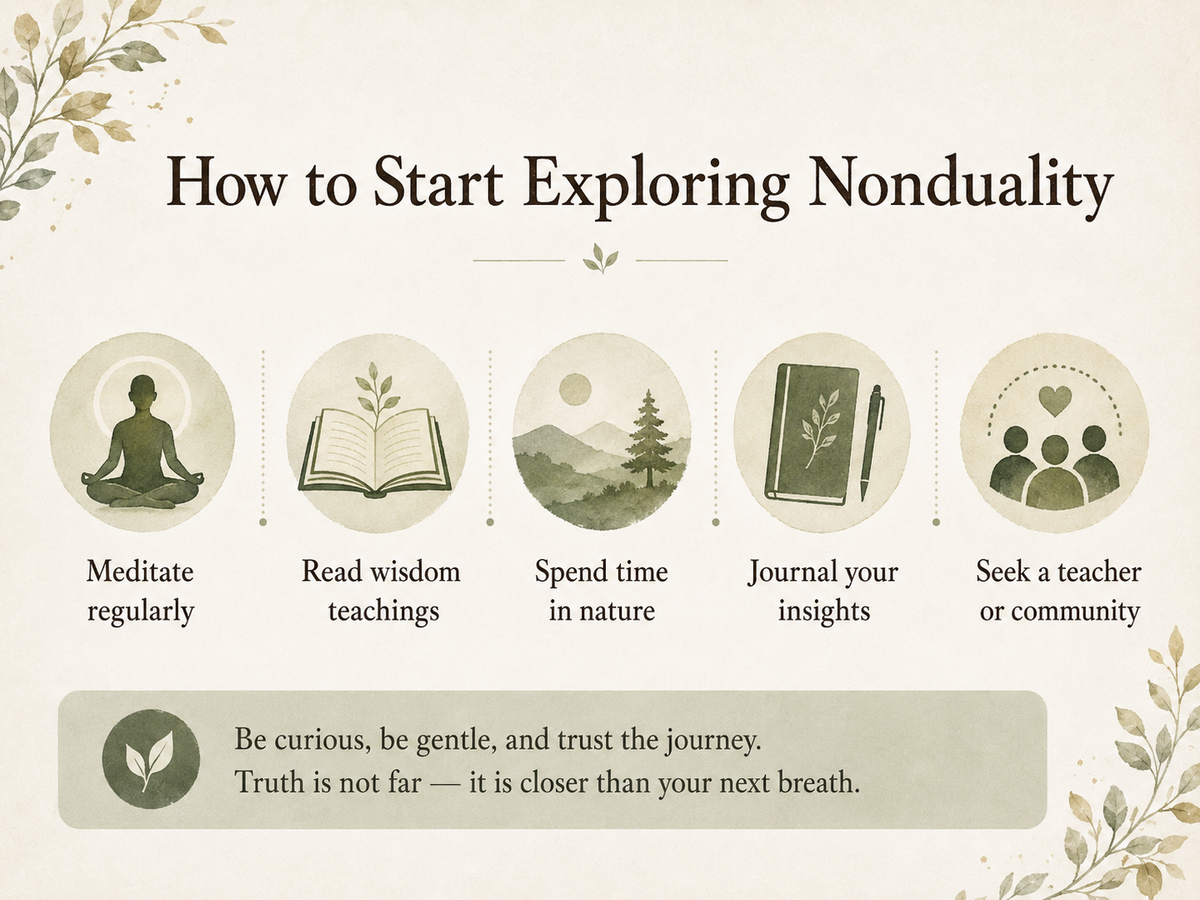
The best way to begin is not to collect more concepts, but to combine clear study with gentle direct investigation. Read slowly. Sit quietly. Notice the sense of being aware. Journal what is actually discovered rather than what you think you should discover. Spend time in nature, where the mind's hard borders often soften. Find teachers and communities that emphasize clarity, humility, and integration.
Start with five minutes. Ask: What is aware of this breath? Do not search for a verbal answer. Notice whatever appears: sensations, thoughts, impatience, silence. Then ask: is awareness itself tense, confused, or lacking? This question is not meant to create a state. It is meant to reveal what is already here.
Featured course
I AM: The Heart of Being
A structured nondual mindfulness course for teens and adults, rooted in self-inquiry and the direct recognition of awareness.
Explore the course →Nonduality ebook
I Am: The Heart of Being
A direct, accessible guide to the I AM recognition and the peace of resting as awareness.
View ebook →Beginner book
The Wonderous Quest
A gentle journey into the knower within, written for readers who want a practical entry into nondual inquiry.
View ebook →Recommended nondual books and teachers
A complete study of nondual philosophy should include both classical sources and modern teachers. Classical Advaita is best approached through the Upanishads, Bhagavad Gita, and selected works attributed to Shankaracharya, supported by a trustworthy commentary. Modern seekers often begin with Ramana Maharshi, Nisargadatta Maharaj, and Rupert Spira because their language is direct and practical.
For a curated reading path, see 25 Best Nonduality Books, Rupert Spira: Nondual Teaching, and I Am That by Nisargadatta Maharaj.
Study tip
Read one paragraph of a nondual text, then pause and verify it in direct experience. Nondual philosophy is not mastered by speed-reading. It becomes alive when every concept returns you to awareness itself.
Living the truth of oneness
The phrase "oneness" can sound poetic, but in nondual philosophy it has practical consequences. When separation softens, compassion becomes less forced. Listening becomes easier. The need to win every argument weakens. The body is cared for without being mistaken for the whole self. Other people are no longer merely characters in the private drama of "me."
The truth of oneness is not a mood. It is not always peaceful on the surface. It includes grief, tenderness, fatigue, joy, work, family, conflict, and silence. The difference is that life is no longer held as an enemy outside awareness. It is known as the movement of the same reality that you are.
Frequently asked questions about nondual philosophy
What is nondual philosophy in simple words?
Nondual philosophy means that reality is not ultimately split into two separate things: a separate self and a separate world. In Advaita Vedanta, it points to the recognition that your true nature is awareness itself, and that awareness is not separate from the life appearing in it.
Is nondual philosophy the same as Advaita Vedanta?
Advaita Vedanta is the most systematic classical form of nondual philosophy, but nondual insights also appear in Zen Buddhism, Mahayana Buddhism, Kashmir Shaivism, Taoism, Christian mysticism, Sufism, and modern consciousness teachings. Advaita Vedanta is a specific tradition; nonduality is the wider recognition of not-two.
What does Advaita mean?
Advaita is a Sanskrit word meaning "not two." In Advaita Vedanta it means that Atman, the true self, is not separate from Brahman, the one reality. The apparent separation between the individual and the whole is due to mistaken identity, not ultimate truth.
Does nonduality mean the world is an illusion?
Not in the simplistic sense that the world is nothing. The world appears and matters at the relative level. Nonduality says that the world's apparent separateness is not ultimately real. The world is like a wave: real as an appearance, but never separate from the ocean.
What is the difference between mindfulness and nonduality?
Mindfulness trains you to observe thoughts, emotions, and sensations without being swept away by them. Nonduality asks what awareness is and whether the observer is truly separate from what is observed. Mindfulness stabilizes attention; nonduality points to the nature of awareness itself.
How do I practise nondual inquiry?
Begin by asking "Who am I?" or "What is aware of this moment?" Let every verbal answer be noticed as another thought. Then rest as the aware presence in which thoughts, sensations, and emotions appear. The practice is not about finding a concept, but recognizing awareness directly.
Who are the most important nondual teachers?
Classical Advaita is associated with the Upanishads and Adi Shankaracharya. Modern nondual teachers include Ramana Maharshi, Nisargadatta Maharaj, J. Krishnamurti, Jean Klein, and Rupert Spira. Each uses different language, but all point attention back toward awareness and the end of mistaken separation.
Can nonduality help with anxiety or fear?
Nondual understanding can soften anxiety by loosening identification with fearful thoughts and the separate self they seem to protect. However, it is not a replacement for medical care, psychotherapy, trauma support, or crisis help. A grounded approach combines clear inquiry with appropriate human support.
Is nonduality only for monks or advanced meditators?
No. Nondual inquiry can be explored by ordinary people in ordinary life. Seriousness, humility, and patience matter more than lifestyle. Meditation, study, and ethical living help, but the recognition itself points to the awareness that is already present in every person.
What should I read after this article?
Good next steps are What Is Nonduality, Advaita Vedanta for Beginners, Core Nondual Teachings, The I AM Practice, and 25 Best Nonduality Books on The Holistic Care blog. For guided study, explore the I AM: The Heart of Being course and the I Am: The Heart of Being ebook.
Free Guide for Parents & Educators
Mini Mindfulness Masters
Simple practices to help children slow down, feel calm, and become more present. A free download, straight to your inbox.
No spam, ever. Unsubscribe at any time.

Written by
Mohan ChuteHead of Marketing & AI Strategy | Digital Transformation Leader | Nonduality Mindfulness Teacher | Author | Explorer of Consciousness
Mohan Chute is a rare blend of technology strategist and mindfulness teacher. With over 23 years of experience in digital marketing, AI strategy, and growth leadership, he has guided organizations through automation, analytics, branding, and digital transformation. Alongside this professional expertise, Mohan has devoted his life to exploring meditation, yoga, and nondual awareness—helping people discover balance, presence, and authenticity in a fast‑paced world.
💻 AI & Digital Expertise
As a strategist and innovator, Mohan empowers businesses to harness AI, automation, and analytics to drive growth. His leadership in go‑to‑market strategy, branding, and digital transformation positions him at the forefront of innovation—while keeping human wellbeing at the center.
🧘♂️ The Journey Within
At 17, Mohan discovered meditation on his own—a spark that ignited a lifelong journey into yoga, mindfulness, and nondual inquiry. Today, he integrates this wisdom into both personal and professional domains, showing that technology and consciousness can coexist to create meaningful impact.
🌍 Founder & Teacher
Through The Holistic Care Foundation, Mohan leads transformative programs worldwide. His Nonduality & Mindfulness‑based education initiatives support schools, colleges, and communities in cultivating calm, connected, and compassionate learning environments. For corporate teams, his programs position mindfulness as a competitive edge—enhancing creativity, reducing burnout, and fostering resilient workplace cultures.
📚 Author of Inspiring Works
Mohan’s books span audiences from children to spiritual seekers, weaving story, metaphor, and practice into accessible journeys of awareness. His published works include:
Mindful Adventures for Little Minds
In the Garden of Kindred Spirits
The Wondrous Quest: Journey to the Knower Within
I Am – The Heart of Being
Seeds of Kindness
Mindful Computing: Embracing Presence in a Digital World
The Awareness Chronicles series:
Book 1: The Magic Sketchbook
Book 2: The Movie Projector
Book 3: The Mask Maker
Book 4: The Listening River
Book 5: The True Compass
🎓 Interactive eLearning Courses
Each of these books has been transformed into interactive eLearning programs available on The Holistic Care. These courses combine storytelling, reflection prompts, creative activities, and mindfulness practices—making awareness accessible to children, teens, educators, families, and professionals.
🌈 A Guiding Light
Whether you are a student, educator, professional, or seeker, Mohan’s voice offers clarity and compassion. His mission is simple yet profound: to help people live with balance, presence, and purpose—reminding us that awareness is not the end, but the beginning.


