
Use these free guided meditation scripts for kids for bedtime, anxiety, focus, breathing and big feelings. Includes short, five-minute, guided imagery and body scan practices.
Children do not always need another explanation when they feel worried, restless, frustrated, overstimulated or unable to sleep. Sometimes they need something simpler: a familiar voice, a few quiet minutes and one clear place to put their attention.
That is where a guided meditation script can help.
A guided meditation script for kids is a short set of spoken instructions that helps a child notice breathing, body sensations, sounds, imagination, feelings or the world around them. Instead of asking a child to "calm down", the adult gives them a gentle path to follow.
The scripts in this guide are designed mainly for children around ages 5 to 12. Parents, caregivers and teachers can read them aloud at bedtime, before school, after a difficult day, before homework, during a classroom transition or whenever a child could benefit from slowing down for a few minutes.
There is no special meditation posture to master. A child can sit on a chair, curl up on a sofa, lie in bed, hold a stuffed animal or keep their eyes open. They do not need to become perfectly still, and they do not need to make their thoughts disappear.
The purpose is more practical: to notice what is happening, create a little space around it and practise returning attention to something steady.
That might be one breath.
A sound.
The feeling of feet on the floor.
A picture in the imagination.
Or simply the recognition, "I am feeling worried right now."
Meditation is not meant to make children suppress emotions. A child who is angry is still allowed to be angry. A child who is worried is still allowed to feel worried. The practice gives them a way to meet those experiences with a little more awareness.
Quick guide: which meditation should you use?
| Situation | Practice to try | Approximate time |
|---|---|---|
| Child is new to meditation | Slow Breath Anchor | 2 minutes |
| Need a short reset | Five-Minute Calm | 5 minutes |
| Bedtime | Sleepy Star Meditation | 5 to 7 minutes |
| Worry or nervousness | Safe Place Guided Imagery | 5 minutes |
| Physical tension | Body Scan Meditation | 5 to 7 minutes |
| Restlessness | Breathing Buddy | 3 to 5 minutes |
| Repetitive thoughts | Worry Clouds | 4 to 5 minutes |
| Anger or frustration | Cooling the Volcano | 4 minutes |
| School or homework focus | Ready to Focus | 3 minutes |
| End of the day | Three Good Things | 3 to 5 minutes |
You do not need to teach all ten practices. In many families, the most useful approach is to find one or two that suit the child and repeat them until they become familiar.
What is guided meditation for kids?
Guided meditation for kids is a short, age-appropriate mindfulness practice in which a parent, teacher, caregiver or recording directs a child's attention toward breathing, body sensations, sounds, imagination or emotions.
Unlike silent meditation, the child does not have to remember what to do next. The voice provides structure.
That matters because instructions such as "relax", "stop worrying" or "clear your mind" are abstract.
"Feel your belly rise under your hand" is concrete.
"Notice three sounds in the room" is concrete.
"Imagine putting your worry on a cloud and watching the cloud move" is concrete.
Children often respond more easily to experiences they can picture, feel or do.
Guided meditation for children also does not need to look like adult meditation. A six-year-old who lies on the carpet with a stuffed animal on their belly while listening to a two-minute breathing story can be practising mindfulness. A child who opens their eyes halfway through has not failed. A child who needs to wiggle their feet may still be paying attention.
The goal is not perfect stillness.
The goal is learning to notice and return.
What does research say about mindfulness for children?
Research on mindfulness with children is promising, but the evidence should be described carefully.
A 2024 meta-analysis of 32 studies involving 3,640 children aged 6 to 12 reported small overall benefits across areas including attention, emotional and behavioural regulation, positive emotion and social competence. The authors also noted important limitations and the need for stronger comparisons with other social and emotional learning approaches. Read the study on PubMed.
A broader updated meta-analysis of 66 randomized controlled trials involving 20,138 young people found modest improvements in anxiety and stress, attention and executive functioning when mindfulness programmes were compared with passive control conditions. Effects were smaller and less consistent when compared with active alternatives, and positive effects were not clearly maintained at follow-up. Read the study on PubMed.
Guided imagery has also been studied in specific settings. In a randomized trial of 60 children aged 6 to 12 who were undergoing minor surgery, relaxation-guided imagery was associated with lower preoperative anxiety and postoperative pain than standard care. That is useful evidence for guided imagery in a particular clinical context, but it should not be stretched into a claim that a home meditation script treats an anxiety disorder. Read the study on PubMed.
For everyday use, a sensible expectation is modest:
Short practice. Simple language. Regular repetition. No pressure.
Meditation can be one supportive skill among many. It is not a cure, a punishment, or a substitute for professional help when a child is struggling significantly.
How to read a meditation script to a child
The way you read the script often matters more than reading every word perfectly.
Slow down more than feels natural
Adults often read relaxation scripts too quickly.
A sentence such as:
"Notice how your belly feels as you breathe in."
needs a pause after it.
The silence gives the child time to actually notice the sensation. Two or three seconds can feel surprisingly long to the person reading, but it often feels completely normal to the listener.
You can also pause after questions such as:
"What sounds can you hear?"
"Where do you feel that emotion in your body?"
"What colour do you imagine?"
Do not rush to fill the silence.
Use your normal voice
You do not need a special meditation voice.
Speak slowly, gently and naturally. A familiar voice is often more reassuring than an exaggerated whisper.
Offer choices
A child can:
- sit
- lie down
- hold a stuffed animal
- keep eyes open
- close eyes
- look softly at one point
- place a hand on the belly
- move slightly if uncomfortable
These choices give children some control over the experience.
Do not correct every interruption
Young children may suddenly ask:
"Is this nearly done?"
"Can my safe place have a dinosaur?"
"My nose is itchy."
"What colour is the cloud?"
That does not mean the practice has failed.
Answer briefly when needed and continue. Children often move in and out of quiet attention.
Finish gradually
For a daytime practice, end by inviting the child to feel their feet, stretch their fingers and look around.
At bedtime, you may not need a formal ending at all. The script can simply become quieter and stop.
1. Slow Breath Anchor
Best for: beginners, everyday calming, before school or homework Age: approximately 5 to 12 Time: about 2 minutes
This is a simple guided breathing script for children who are new to meditation.
Find a comfortable position. You can sit down or lie down. Let your eyes close if that feels comfortable, or keep them open and look gently at one spot. Place one hand on your belly. You do not need to change your breathing yet. Just notice that your body already knows how to breathe. Now breathe in slowly through your nose. Feel your belly gently push your hand upward. One... Two... Three... Now breathe out slowly. One... Two... Three... Four... Let us try that again. Slowly breathe in. Feel your belly become a little bigger. Slowly breathe out. Feel your belly become soft again. If a thought comes into your mind, that is okay. You do not have to chase it away. Notice the thought and come back to the feeling of your breathing. Take one more breath in. And one long, gentle breath out. Notice how your body feels now. You can come back to this breath whenever you need a small pause.
Why begin with breathing?
Breathing is an easy starting point because the child can feel something real and immediate.
There is no complicated visualization and no need to understand the word "mindfulness". A child simply learns that attention can be moved back to one steady sensation.
If your child prefers something playful, try the mindfulness games at The Holistic Care, which include breathing and grounding activities.
2. Five-Minute Guided Meditation for Kids
Best for: after school, transitions, general calm, settling before an activity Age: approximately 6 to 12 Time: about 5 minutes
If you are looking for a 5 minute meditation for kids, this practice combines breathing, body awareness, listening and a simple emotional check-in.
Get comfortable. For the next few minutes, there is nowhere else you need to be. Start by noticing three places where your body is touching something. Maybe your feet are touching the floor. Maybe your back is touching a chair. Maybe your hands are resting on your legs. Feel those places for a moment. Now notice your breathing. You do not need to make it special. Just notice one breath coming in... and one breath going out. Take another slow breath in... and breathe out gently. Now listen. What is the furthest sound you can hear? Do not try too hard. Just listen. Now notice the closest sound you can hear. Maybe it is your breathing. Maybe it is a sound in the room. Bring your attention back to your body. Is there anywhere that feels tight? Maybe your shoulders. Your forehead. Your hands. Your tummy. You do not have to make the tightness disappear. Just notice it. As you breathe out, imagine giving that part of your body a little more room. Now ask yourself quietly: "What am I feeling right now?" There is no correct answer. Happy, tired, excited, annoyed, worried, peaceful or something you cannot name yet. Whatever is here can be here. Take one more slow breath. Feel the ground underneath you. Wiggle your fingers. Wiggle your toes. When you are ready, look around the room. Your five-minute pause is complete.
You can use this meditation after school before asking about homework, after a busy activity, or before a transition that normally creates friction.
3. Kids Bedtime Meditation Script: The Sleepy Star
Best for: bedtime, racing thoughts, winding down Age: approximately 4 to 10 Time: 5 to 7 minutes
A kids bedtime meditation script should feel like part of winding down, not another task the child has to perform correctly.
Lie down in the most comfortable way you can. Let your head rest heavily on your pillow. Let your legs become still. Imagine that outside your window there is one small star. It is not a bright, busy star. It is a sleepy star. Its light is soft and warm. Imagine the star noticing you resting in your bed. As you breathe in, the star becomes a tiny bit brighter. As you breathe out, its light becomes soft again. Breathe in... and slowly breathe out. Now imagine a little bit of that warm starlight reaching your forehead. Your forehead can soften. Your eyes do not need to look at anything now. Your cheeks can relax. Your mouth can rest. The warm light moves down to your shoulders. Your shoulders have done enough for today. They can become heavy. The light reaches your arms... your hands... and every finger. Your hands do not need to hold onto anything. Now the sleepy starlight reaches your chest and belly. Feel your belly rise as you breathe in. Feel it fall as you breathe out. Nothing needs to happen quickly. The night has plenty of time. The warm light moves into your legs. Your knees can rest. Your feet can rest. Even your toes have finished their work for today. If a thought appears, you do not have to chase it away. Imagine placing the thought beside your bed. You can pick it up tomorrow if you still need it. For now, there is only your pillow... your blanket... your breathing... and the sleepy star. Take one soft breath in. Slowly breathe out. There is nowhere else you need to go tonight. Your job now is simply to rest.
Make bedtime meditation part of a routine
Try not to introduce a meditation only after a long argument about bedtime.
A predictable sequence is usually easier:
wash or bath → pyjamas → story → meditation → lights out
Use the same practice for several nights before deciding whether it suits your child. Familiarity can make the words feel safer and less stimulating.
For more ideas, see Bedtime Meditation for Kids.
4. Guided Imagery for Kids With Anxiety: The Safe Place
Best for: everyday worry, nervousness, before unfamiliar situations Age: approximately 6 to 12 Time: about 5 minutes
Guided imagery can be useful because it gives a worried mind something specific to picture.
Instead of saying "do not worry", you invite the child to direct attention toward a detailed, safe mental scene.
Sit or lie somewhere comfortable. Take a slow breath. Now imagine a place where you feel safe. It might be somewhere you have visited before. Or it might exist only in your imagination. Your safe place could be a bedroom... a beach... a treehouse... a garden... a library... a mountain cabin... or somewhere completely different. There is no correct place. Look around in your imagination. What colours do you see? Notice one colour. Now another. What is underneath you? Grass? Sand? A soft blanket? A comfortable chair? Notice how it feels. Now listen. What sounds belong in this place? Perhaps birds. Water. Wind in trees. Soft music. Or maybe your safe place is completely quiet. Imagine breathing comfortably here. You do not have to solve anything. You do not have to prepare for everything that might happen. For these few moments, you can simply be here. If you have a worry, imagine placing it somewhere nearby. Maybe into a basket. Onto a shelf. Beside a tree. You are not throwing it away. You are simply putting it down for a little while. Take another slow breath. Notice that your safe place is something you can remember. Even when you cannot physically go there, you can return to the picture in your mind. Stay here for three quiet breaths. One... Two... Three... Now slowly notice the room around you again. You can carry a little bit of that steadiness with you.
A sensible way to use meditation for worry
A script can support ordinary worries such as first-day nerves, an upcoming test, a new activity or an unsettled evening.
It should not be used to dismiss ongoing distress.
If worry is regularly interfering with school attendance, sleep, eating, friendships, family life or activities the child previously enjoyed, talk with an appropriate healthcare or mental health professional.
Meditation may sit alongside professional support. It should not replace it.
For a complementary practice, read Breathing Exercises for Anxious Children.
5. Body Scan Meditation for Kids
Best for: physical tension, bedtime, learning body awareness Age: approximately 6 to 12 Time: 5 to 7 minutes
A body scan script for kids helps children learn that emotions and stress can show up as physical sensations.
A child may notice a tight stomach before they can explain that they feel nervous. They may notice hot cheeks, clenched hands or raised shoulders before they find the right word for anger or frustration.
Learning to recognize these sensations can make them easier to talk about.

Lie down or sit comfortably. We are going to take a slow journey through your body. Nothing needs to change. We are just noticing. Start with your feet. Can you feel your toes? Maybe they feel warm. Cool. Tingly. Heavy. Or maybe you hardly notice them at all. Any answer is okay. Move your attention to your ankles. Then your lower legs. Notice whether the muscles feel tight or relaxed. Now notice your knees. Let your attention travel slowly into your thighs. Feel the weight of both legs. Take one breath in. As you breathe out, let your legs become a little heavier. Now notice your belly. Feel it move as you breathe. Rising... and falling. You do not have to make the breath deeper. Just feel the movement. Now notice your chest. Your shoulders. Are your shoulders trying to hold themselves up? If they are, let them drop a tiny bit. Bring your attention down your arms. Notice your elbows... wrists... palms... fingers. Now notice your neck. Your jaw. See if your teeth are pressing together. If they are, let your jaw loosen. Notice your cheeks. Your eyes. Your forehead. Imagine your whole face becoming soft. Now try to feel your whole body at once. Feet... legs... belly... chest... arms... face. One whole body breathing. Take one slow breath in. And let it out. Notice how your body feels now compared with when you started. There is nothing you have to fix. You have simply practised listening to your body.
A useful follow-up question
After the body scan, instead of asking "Did it work?", try:
"What did you notice?"
That question keeps the emphasis on awareness rather than performance.
The child might say:
"My feet were cold."
"I was still thinking about school."
"My shoulders felt heavy."
"I got bored."
All of those are valid observations.
6. Breathing Meditation for Kids: The Breathing Buddy
Best for: younger children, bedtime, children who dislike formal meditation Age: approximately 4 to 9 Time: 3 to 5 minutes
For this practice, ask the child to choose a small stuffed animal.
Have them lie comfortably on their back and place the toy gently on the belly.
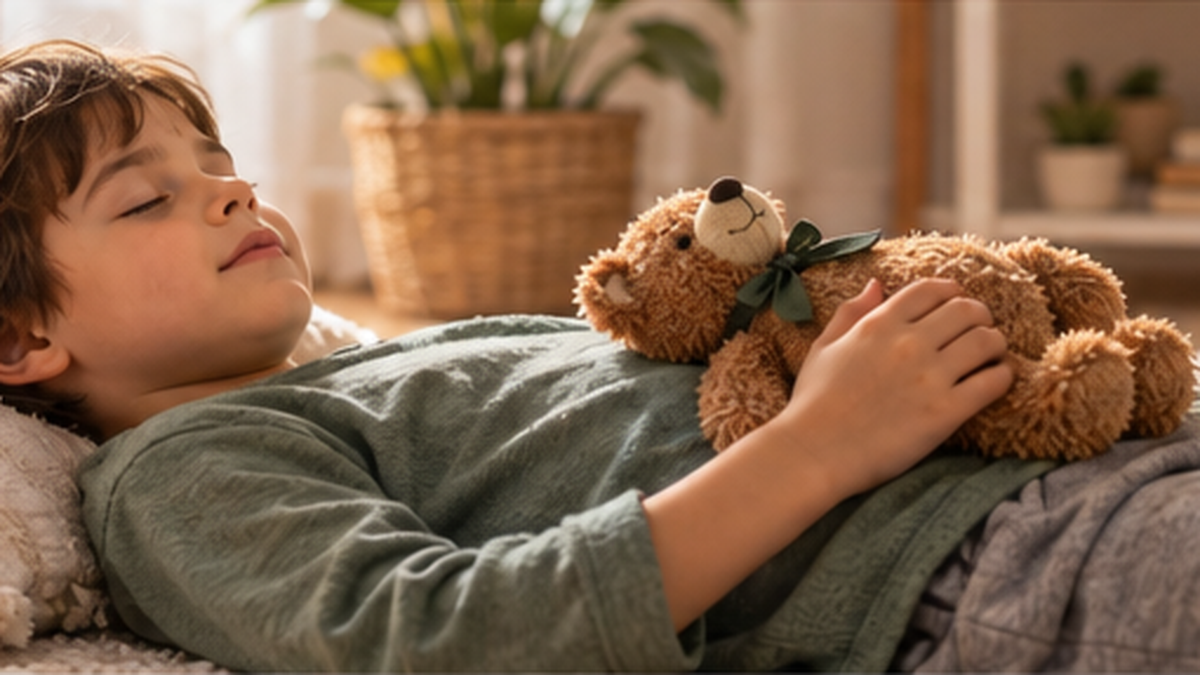
Your stuffed animal has an important job. It is going for a slow ride on your breathing. Watch your buddy for a moment. Take a gentle breath in through your nose. See if your belly can lift your buddy upward. Now slowly breathe out. Watch your buddy travel back down. Let us give your buddy another ride. Breathe in... Up they go. Breathe out... Down they go. Try not to make the ride too fast. Your buddy likes slow rides. Breathe in gently. And breathe out even more slowly. Imagine your buddy becoming sleepier each time they rise and fall. Up... and down. Up... and down. Can you feel your belly moving underneath them? Take three more slow breaths. Let your buddy ride each one. When you finish, notice whether your breathing feels different from when you started. Your buddy can help you practise again whenever you like.
This is often useful for children who dislike the word "meditation".
You can call it:
"the teddy breathing game"
"belly breathing"
"buddy ride"
or whatever feels natural in your home.
The label matters much less than the skill.
7. Relaxation Script for Kids: The Warm Rain
Best for: muscle tension, after a busy day, pre-bedtime relaxation Age: approximately 5 to 11 Time: 4 to 5 minutes
Get comfortable. Imagine you are standing somewhere warm and safe. Above you is a very soft cloud. The cloud begins to make the gentlest rain you can imagine. This is not cold rain. It is warm, comfortable rain. A few drops touch the top of your head. Wherever the warm rain touches, the muscles underneath can relax. Feel the imaginary rain across your forehead. Your forehead softens. Around your eyes. Your eyes can rest. Across your cheeks. Along your jaw. You do not need to speak. The warm rain reaches your shoulders. Let them drop slightly. It flows down your arms... over your elbows... into your hands. Your fingers can become loose. The warm rain reaches your chest and belly. Take one comfortable breath. Let your belly soften as you breathe out. Now the warm rain moves over your legs... your knees... your ankles... all the way to your toes. Imagine the rain carrying away the extra tightness your body does not need right now. Not your energy. Not your feelings. Just unnecessary tension. Take another breath. Feel your whole body resting. The rain becomes lighter... softer... and slowly stops. You are still here. Your body is still yours. It may simply feel a little more relaxed.
Should a relaxation script tell children to "let go" of feelings?
It is usually better to distinguish between physical tension and emotion.
A child does not need to let go of sadness, anger or fear simply because an adult finds the emotion uncomfortable. A relaxation practice can help soften a clenched jaw or raised shoulders while still leaving room for the child to say:
"I am upset because that happened."
Relaxation and emotional honesty can exist together.
8. Worry Meditation for Kids: Clouds in the Sky
Best for: repetitive worries, overthinking, anxious thoughts Age: approximately 7 to 12 Time: 4 to 5 minutes
One useful mindfulness skill is learning that a thought can be noticed without automatically being treated as a fact or command.
This script introduces that idea through imagery.
Sit or lie comfortably. Take one slow breath. Imagine you are looking up at a wide blue sky. A cloud appears. Imagine that one of your worries is written gently on the cloud. Maybe it says: "What if I get the answer wrong?" "What if tomorrow is difficult?" "What if someone does not like me?" Or maybe your worry says something else. You do not have to argue with the cloud. You do not have to make it disappear. Just watch it. The wind begins to move. Very slowly, the cloud travels across the sky. Another thought may appear. Put that thought on another cloud. Let that one move too. Some clouds are small. Some are big. Some move quickly. Some hang around. But you are not the cloud. You are the one noticing it. Take another slow breath. A thought can be present without becoming the whole sky. Watch one more cloud move. Notice the space around it. Feel your breathing. Feel where your body touches the floor, bed or chair. You do not have to solve every thought right now. For this moment, noticing is enough.
What if the worry comes back immediately?
That is normal.
The purpose of the cloud image is not to permanently remove a thought.
The practice is learning:
"There is the worry again."
Then returning attention to the present.
A recurring thought is not evidence that meditation failed.
9. Meditation for Big Feelings: Cooling the Volcano
Best for: frustration and anger after the emotional peak has passed Age: approximately 5 to 11 Time: about 4 minutes
This practice is not intended for the middle of an intense meltdown.
When a child is screaming, panicking, hitting, running away or unable to process spoken language, safety and connection come first. Use a meditation once the child is able to listen again.
Imagine there is a volcano inside your body. Sometimes the volcano is quiet. Sometimes it becomes hot. Maybe you feel the heat in your face. Maybe your fists become tight. Maybe your belly feels strange. Maybe your heart beats faster. The volcano is not bad. It is telling you that a big feeling is here. Notice where your volcano feels hottest today. Now breathe in slowly through your nose. As you breathe out, imagine cool air moving toward the hot place. Breathe in. Slowly breathe out. Imagine the lava becoming a little less hot. You do not have to make the volcano disappear. You are giving it time to cool. Take another slow breath. Ask yourself: "What feeling is here?" Angry? Hurt? Frustrated? Embarrassed? Tired? Something else? Naming the feeling does not make it bigger. You are simply noticing what your volcano is trying to tell you. Take one last slow breath. The feeling may still be here. But perhaps there is now a little more space around it. When you are ready, decide what you need next. Maybe you need to talk. Maybe you need some quiet. Maybe you need help. Maybe you need a hug. You can choose your next step after the volcano has cooled.
Why not force breathing during a meltdown?
A child in a highly activated state may hear "take a deep breath" as another demand.
Sometimes a better first response is:
"I am here."
"You are safe."
"We can talk when your body is ready."
Once the intensity drops, breathing can become an option rather than an instruction.
10. Focus Meditation for Kids: Ready to Begin
Best for: before school, homework, tests, music practice or sport Age: approximately 7 to 12 Time: about 3 minutes
Meditation does not always have to make a child sleepy.
Sometimes the goal is simply to gather scattered attention before beginning a task.
Sit comfortably with your feet supported if possible. Look at one spot in front of you. Take a slow breath in. Breathe out. Notice your feet. Feel the ground underneath them. Notice your hands. Let them rest. Now listen for three sounds. First sound... Second sound... Third sound. Bring your attention back to your breathing. Ask yourself: "What is the one thing I am about to do?" Not everything you need to do today. Just the next thing. Maybe it is one maths page. One test. One paragraph. One lesson. One conversation. Imagine placing everything else outside a circle for a little while. Inside the circle is only the next task. Take another breath. You do not need to know how the whole thing will go. You only need to begin. Feel your feet. Feel your hands. Look around. When you are ready, start with the first small step.
A note about focus
A short grounding practice can help some children settle before a task, but meditation should not be used to imply that every concentration difficulty is a matter of effort.
If attention problems are persistent across settings and are interfering with learning or daily life, discuss the pattern with the child's school and an appropriate healthcare professional.
Bonus practice: Three Good Things
Best for: bedtime, family routines, ending the day Age: approximately 5 to 12 Time: 3 to 5 minutes
Gratitude practices are often more natural when children are not expected to produce profound answers.
"Pasta tasted good today" counts.
"So did playing with the dog."
Think about your day. You do not have to decide whether it was a good day or a bad day. Days can contain many different things. See if you can remember one small thing that felt good. Maybe someone smiled at you. Maybe you ate something you liked. Maybe you laughed. Maybe you finished something difficult. Hold that moment in your mind for one breath. Now think of a second thing. It can be tiny. A comfortable chair. A game. Sunshine. Rain. A friend. A pet. Hold that memory for one breath. Now find one more. Three good things from one whole day. Notice how remembering them feels in your body. You do not need to ignore the difficult things. The difficult parts of the day happened too. You are simply remembering that they were not the only parts. Take one slow breath. Keep whichever good moment you would like to carry with you.
How long should kids meditate?
There is no universal ideal duration.
For many children, shorter is better.
A practical starting point is:
| Approximate age | Suggested starting duration |
|---|---|
| 4 to 6 | 1 to 3 minutes |
| 7 to 9 | 3 to 5 minutes |
| 10 to 12 | 5 to 10 minutes |
These are guidelines, not rules.
A four-year-old may happily listen to a seven-minute bedtime visualization. A ten-year-old may strongly prefer two minutes of breathing.
Engagement matters more than reaching a target duration.
A child who willingly practises for three minutes several times a week is building a more useful habit than a child who is forced through a long session.
How to adapt meditation scripts by age
Ages 4 to 6
Younger children usually respond well to:
- animals
- colours
- movement
- soft toys
- very short stories
- sounds
- simple sensory instructions
Instead of:
"Observe the sensations associated with breathing."
try:
"Put Teddy on your belly and give Teddy a slow ride."
Keep explanations short. Let the experience teach the idea.
Ages 7 to 9
Children in this range can often follow slightly longer imagery and begin to connect body sensations with feelings.
Useful themes include:
- clouds
- stars
- weather
- gardens
- beaches
- body scans
- sounds
- simple emotional naming
You can begin asking questions such as:
"Where do you feel nervousness in your body?"
"What tells you that you are starting to get angry?"
Ages 10 to 12
Older children may reject practices that feel too childish.
Use direct language and respect their independence.
Instead of:
"Imagine a magical balloon taking all your worries away."
try:
"Notice the thought. You do not need to solve it right now."
Some older children would rather use headphones and a recording than have a parent read to them. That preference can be respected.
The Holistic Care's Stillness Library can be useful for children who prefer guided audio.
What about teenagers?
Teenagers deserve their own approach.
Language that works beautifully for a seven-year-old may feel patronizing to a fifteen-year-old. Teens often benefit from more autonomy, more direct explanations and examples connected with school pressure, identity, relationships, sleep, sport and social media.
If your child has moved into adolescence, use age-appropriate practices rather than simply extending a children's script.
Can guided meditation help children with anxiety?
Guided meditation may help some children manage everyday worry by practising slower breathing, body awareness, present-moment attention and a different relationship with repetitive thoughts. Research on youth mindfulness programmes suggests modest benefits for anxiety and stress in some settings, but meditation is not a substitute for mental health treatment when anxiety is persistent, severe or disabling.
A useful distinction is between:
"I feel nervous about tomorrow's spelling test."
and:
"Anxiety is repeatedly preventing me from sleeping, going to school, eating normally, spending time with friends or doing things I used to enjoy."
The first may be supported by reassurance, a breathing practice and a short guided meditation.
The second deserves professional attention.
Meditation can be part of a larger support plan. It should not carry the burden of treatment by itself.
Does guided meditation help children sleep?
A gentle meditation can be one part of a calming bedtime routine.
The value often comes from what the routine reduces:
- stimulation
- problem-solving
- bright screens
- rapid conversation
- switching between activities
and what it adds:
- a familiar sequence
- slower breathing
- a quiet voice
- reduced physical tension
- one simple focus
Think of bedtime meditation as a wind-down tool, not a guaranteed way to make a child fall asleep.
If a child has persistent insomnia, loud snoring, breathing pauses during sleep, severe bedtime anxiety, frequent night waking or significant daytime exhaustion, discuss it with an appropriate healthcare professional.
What if my child cannot sit still?
Then do not require stillness.
A child can practise mindful attention while:
- lying on the floor
- holding a stuffed toy
- swaying gently
- tracing a finger around the opposite hand
- walking slowly
- stretching
- looking at a candle-like light source that is safe and appropriate
- listening for sounds
- noticing objects of different colours
For some children, movement supports attention.
The purpose of meditation is not to make a child look meditative.
The purpose is to practise noticing.
What if my child refuses to meditate?
Do not make mindfulness into a battle.
If every practice begins with:
"Sit down."
"Stop moving."
"Close your eyes."
"Listen properly."
the child may quickly learn that meditation is another way adults control behaviour.
Offer choices instead:
"Would you like the star meditation or the breathing buddy?"
"Would you rather sit or lie down?"
"Eyes open or closed?"
"Two minutes or five?"
Sometimes changing the name is enough.
Try:
- quiet story
- breathing game
- body check-in
- imagination exercise
- reset
- wind-down time
The name is less important than the skill.
Should children close their eyes during meditation?
No.
Closing the eyes is optional.
Some children concentrate better with their eyes closed. Others feel safer or more comfortable keeping them open.
A simple instruction is:
"Close your eyes if you would like, or look gently at one spot."
That small choice supports a sense of agency.
It is especially useful for children who find closing the eyes uncomfortable for sensory, emotional or personal reasons.
When not to use a meditation script
Meditation can be useful, but timing and context matter.
During the peak of a severe meltdown
A child who is extremely distressed may not be able to process a spoken script.
Start with immediate safety, connection and reduction of stimulation.
Meditation can come later.
As punishment
Avoid:
"You are angry, so go meditate."
That teaches the child that mindfulness is a consequence for behaviour adults dislike.
To stop a child from talking about something important
If a child is upset because something happened, listen to them.
Calm can support a later conversation. It should not be used to avoid the conversation.
When the practice increases distress
Stop if a child becomes frightened, dizzy, increasingly agitated or uncomfortable.
You can switch to something more external, such as naming five things in the room or feeling the feet on the floor.
Mindfulness should be adapted to the child, not the other way around.
Using guided meditation scripts in the classroom
Teachers do not need a twenty-minute meditation session to introduce mindful attention.
One or two minutes can be useful during transitions.
Possible moments include:
- at the beginning of the day
- after lunch
- after physical education
- after a noisy transition
- before a test
- before independent reading
- before a difficult classroom discussion
A very short classroom script might be:
Put both feet on the floor if that is comfortable. Take one easy breath. Notice one sound outside the room. Notice one sound inside the room. Feel your feet again. Look at the first thing you need to do. Begin with that.
Avoid forcing children to close their eyes. In a classroom, open-eye grounding is often easier and more inclusive.
A simple seven-day meditation routine for kids
Parents often ask which practice to start with.
You can keep the first week simple:
Day 1: Slow Breath Anchor Day 2: Breathing Buddy Day 3: Five-Minute Calm Day 4: Safe Place Guided Imagery Day 5: Body Scan Day 6: Let the child choose a favourite Day 7: Three Good Things before bedtime
At the end of the week, ask:
"Which one would you like to do again?"
That answer is more useful than trying to identify one universally perfect technique.
A practice becomes valuable when it is usable in real life.
Frequently asked questions
What is the best guided meditation for kids?
There is no single best meditation for every child. Beginners often respond well to simple belly breathing because it is physical and easy to understand. Bedtime meditation can suit children who need help winding down, while guided imagery often appeals to children with strong imaginations. The best practice is usually one the child is willing to repeat.
What age can children start meditation?
Children around age four or five can begin very simple mindfulness activities such as belly breathing, listening to sounds, noticing colours or feeling their feet on the floor. Formal meditation is not necessary. Younger children often do best with one to three minutes of playful, sensory practice.
How long should a child meditate?
Start with two to five minutes. Older children may gradually enjoy five to ten minutes, but longer is not automatically better. A short practice that a child willingly repeats is generally more useful than forcing a longer session.
Can I read these meditation scripts word for word?
Yes. Reading from a script can make it easier to stay slow and consistent. Once a script becomes familiar, personalize it with details that suit the child, such as a favourite animal, place, colour or soft toy.
What is guided imagery for children?
Guided imagery is a relaxation or mindfulness practice in which a child is invited to imagine a scene or sensory experience. They may picture a safe place, warm light, a beach, clouds or a quiet forest while also noticing breathing and body sensations.
Can guided imagery help a child with anxiety?
Guided imagery may help some children with situational worry or physical tension. A randomized study found benefits for children using relaxation-guided imagery around minor surgery, but that finding should not be generalized into a claim that guided imagery treats childhood anxiety disorders. Persistent or disabling anxiety needs appropriate professional assessment and support.
What is a good bedtime meditation for kids?
A good bedtime meditation uses slow breathing, simple imagery and progressive relaxation without asking the child to work hard. The Sleepy Star script above is designed for this purpose. Read slowly and allow the practice to end quietly.
What if meditation makes my child more restless?
Stop or shorten the practice. Try movement, sensory grounding, listening to sounds or the Breathing Buddy exercise instead. Mindfulness does not require stillness.
Can children meditate with their eyes open?
Yes. Looking softly at one object or a spot on the floor works well. Closing the eyes is a choice, not a requirement.
Should I use meditation when my child is having a tantrum?
Usually not during the most intense stage. Prioritize safety and connection first. Introduce a breathing or grounding practice once the child can listen and engage again.
Can meditation replace therapy?
No. These scripts are educational wellbeing practices, not mental health treatment. If anxiety, low mood, trauma responses, sleep problems or behavioural difficulties are persistent, severe or interfering with daily life, seek support from an appropriately qualified professional.
The real aim is not a perfectly calm child
It is easy to turn mindfulness into another performance standard.
A child sits still, therefore the meditation "worked".
A child keeps moving, therefore it "didn't work".
That misses the point.
Children will still become angry.
They will worry about school.
They will sometimes struggle to sleep.
They will argue with siblings.
They will have moments when they do not want another adult telling them what to do.
Those experiences are part of childhood.
Mindfulness adds another possibility inside those moments.
A child may begin to notice:
"My shoulders are tight."
"My breathing is fast."
"I am having the thought that something bad will happen."
"I feel angry."
"I need some space."
"I can take one breath before I answer."
Those small moments of awareness are the practice.
You do not need to teach every script in this guide.
Choose one.
Read it slowly.
Notice how your child responds.
Change the language when needed.
Come back to it another day.
With repetition, the adult's gentle instructions can gradually become something the child recognizes for themselves:
Pause. Notice. Breathe. Then choose what comes next.
Continue exploring
If your child enjoys these practices, you can continue with:
- Mindfulness Games for Kids
- Breathing Exercises for Anxious Children
- Bedtime Meditation for Kids
- Stillness Library for Children
- The Holistic Care Courses
This article is for educational and wellbeing purposes. It is not medical or mental health advice. If a child is experiencing persistent or severe anxiety, sleep problems, emotional distress or behavioural changes that interfere with everyday life, consult an appropriately qualified healthcare or mental health professional.
Free Guide for Parents & Educators
Mini Mindfulness Masters
Simple practices to help children slow down, feel calm, and become more present. A free download, straight to your inbox.
No spam, ever. Unsubscribe at any time.

Written by
Mohan ChuteHead of Marketing & AI Strategy | Digital Transformation Leader | Nonduality Mindfulness Teacher | Author | Explorer of Consciousness
Mohan Chute is a rare blend of technology strategist and mindfulness teacher. With over 23 years of experience in digital marketing, AI strategy, and growth leadership, he has guided organizations through automation, analytics, branding, and digital transformation. Alongside this professional expertise, Mohan has devoted his life to exploring meditation, yoga, and nondual awareness—helping people discover balance, presence, and authenticity in a fast‑paced world.
💻 AI & Digital Expertise
As a strategist and innovator, Mohan empowers businesses to harness AI, automation, and analytics to drive growth. His leadership in go‑to‑market strategy, branding, and digital transformation positions him at the forefront of innovation—while keeping human wellbeing at the center.
🧘♂️ The Journey Within
At 17, Mohan discovered meditation on his own—a spark that ignited a lifelong journey into yoga, mindfulness, and nondual inquiry. Today, he integrates this wisdom into both personal and professional domains, showing that technology and consciousness can coexist to create meaningful impact.
🌍 Founder & Teacher
Through The Holistic Care Foundation, Mohan leads transformative programs worldwide. His Nonduality & Mindfulness‑based education initiatives support schools, colleges, and communities in cultivating calm, connected, and compassionate learning environments. For corporate teams, his programs position mindfulness as a competitive edge—enhancing creativity, reducing burnout, and fostering resilient workplace cultures.
📚 Author of Inspiring Works
Mohan’s books span audiences from children to spiritual seekers, weaving story, metaphor, and practice into accessible journeys of awareness. His published works include:
Mindful Adventures for Little Minds
In the Garden of Kindred Spirits
The Wondrous Quest: Journey to the Knower Within
I Am – The Heart of Being
Seeds of Kindness
Mindful Computing: Embracing Presence in a Digital World
The Awareness Chronicles series:
Book 1: The Magic Sketchbook
Book 2: The Movie Projector
Book 3: The Mask Maker
Book 4: The Listening River
Book 5: The True Compass
🎓 Interactive eLearning Courses
Each of these books has been transformed into interactive eLearning programs available on The Holistic Care. These courses combine storytelling, reflection prompts, creative activities, and mindfulness practices—making awareness accessible to children, teens, educators, families, and professionals.
🌈 A Guiding Light
Whether you are a student, educator, professional, or seeker, Mohan’s voice offers clarity and compassion. His mission is simple yet profound: to help people live with balance, presence, and purpose—reminding us that awareness is not the end, but the beginning.


