Our breathing is involuntary action. It occurs automatically, spontaneously, naturally. When presented clearly, it can help readers understand not just the concept itself, but how it may be...
Pranayama: More Than Breathing Exercises
The word pranayama is usually translated as "breathing control" or "breath regulation," but this translation misses the point. Prana means life force, the animating energy that underlies all living processes. Ayama means extension or expansion, not merely control. Pranayama is the practice of extending and refining the life force through conscious work with the breath.
This distinction matters practically. Breathing exercises, in the conventional sense, are techniques for improving respiratory function. Pranayama does this, but it also works on the nervous system, the quality of attention, and, in the classical understanding, the flow of prana through the subtle body. A practitioner who approaches pranayama only as respiratory training will get partial benefits. One who understands the full scope of the practice will get considerably more.
Pranayama occupies the fourth position in Patanjali's Ashtanga yoga, following asana. This placement is deliberate. A body prepared by asana practice can sit with stability and ease, which is a prerequisite for the sustained attention that pranayama requires. Pranayama, in turn, prepares the mind for pratyahara and meditation.
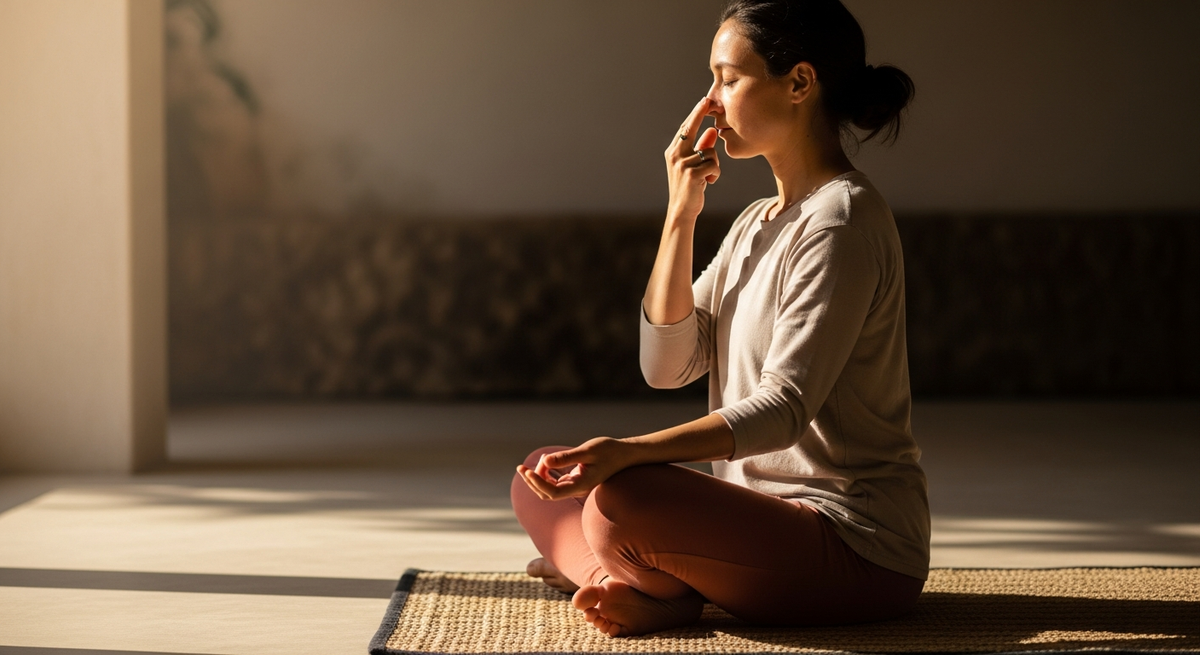
The Four Stages of Pranayama
Classical pranayama recognises four phases of the breath cycle. Each has a Sanskrit name and a specific function in the practice.
Puraka: Inhalation
Puraka is the inhalation phase. In pranayama, the inhalation is conscious, controlled, and often measured in counts. The quality of the inhalation matters: it should be smooth, continuous, and deep, filling from the lower lungs upward. Forced or gasping inhalation creates tension in the respiratory muscles and disrupts the nervous system rather than settling it.
Rechaka: Exhalation
Rechaka is the exhalation phase. In most pranayama practices, the exhalation is longer than the inhalation, often in a ratio of 1:2 (four counts in, eight counts out). The extended exhalation activates the parasympathetic nervous system through the vagus nerve, producing a measurable reduction in heart rate and cortisol. This is why even a brief period of extended exhalation breathing produces a sense of calm.
Antara Kumbhaka: Retention After Inhalation
Antara kumbhaka is the pause after a full inhalation, before the exhalation begins. This retention, when practised correctly and gradually, increases carbon dioxide tolerance, improves oxygen absorption, and, in the classical understanding, intensifies the concentration of prana in the system. Classical ratios often include a retention twice or four times the length of the inhalation.
Kumbhaka must be introduced very gradually, under qualified guidance. Forcing breath retention is one of the most common mistakes in pranayama practice and can cause dizziness, anxiety, and in extreme cases, cardiovascular stress.
Bahya Kumbhaka: Retention After Exhalation
Bahya kumbhaka is the pause after a complete exhalation, with the lungs empty. This is the most advanced of the four phases and is not suitable for beginners. It requires a high degree of nervous system stability and should only be practised after antara kumbhaka has been well established. In classical yoga, bahya kumbhaka is associated with the deeper stages of pranayama practice and with the preparation of the subtle body for meditation.
Explore More of the Subtle Body
Prana Versus Breath: An Important Distinction
The breath is the most accessible handle on prana, but it is not prana itself. Prana is the animating force; breath is one of its expressions in the physical body. This is why pranayama can produce effects that go beyond what respiratory mechanics alone would predict.
Classical texts describe five types of prana, called the panca pranas: prana (upward-moving energy, associated with the chest and breath), apana (downward-moving energy, associated with elimination and the lower body), samana (equalising energy, associated with digestion), udana (ascending energy, associated with speech and consciousness), and vyana (pervasive energy, circulating throughout the body). Pranayama practices are understood to work on all five, not only on the respiratory function of prana proper.
The Eight Classical Pranayamas of Hatha Yoga
The Hatha Yoga Pradipika, one of the primary classical texts, describes eight pranayamas: Surya Bhedana (right nostril breathing, activating Pingala), Ujjayi (victorious breath, with gentle throat constriction), Sitkari (cooling breath through clenched teeth), Sitali (cooling breath through a rolled tongue), Bhastrika (bellows breath, rapid and forceful), Bhramari (humming bee breath), Murccha (swooning breath), and Plavini (floating breath).
Of these, Ujjayi and Nadi Shodhana (alternate nostril breathing, sometimes added to the classical list) are the most widely taught and most suitable for regular practice by beginners and intermediate practitioners. Bhastrika and Surya Bhedana are more stimulating and require greater preparation.
Featured Programme
The I AM Programme
A structured nondual mindfulness programme for adults, including pranayama, meditation, and deep inquiry into the nature of awareness.
Explore the ProgrammeHow to Begin a Pranayama Practice Safely
Starting Points: What Every Beginner Should Know
The single most important piece of guidance for beginning pranayama is this: never force the breath. Any practice that produces dizziness, anxiety, chest tightness, or a sense of urgency is being done with too much effort. The breath should feel extended and refined, not strained.
Begin with a simple ratio: four counts inhale, four counts exhale, with no retention. Practise this for two to four weeks before introducing any kumbhaka. The goal in the beginning is to familiarise the nervous system with conscious breathing, not to achieve dramatic effects. Many practitioners find that this simple practice alone produces significant improvements in sleep, concentration, and stress response within the first few weeks.
Duration and Consistency: Building the Foundation
Ten to fifteen minutes of daily pranayama practice, consistently maintained over months, produces more lasting benefit than occasional longer sessions. Consistency is the essential variable. Pranayama practice is most effective when done at the same time each day, ideally in the morning before the day's activity begins, when the mind is quiet and the stomach is empty.
Pranayama is one of the most powerful tools in the yoga system, and also one of the most underused. Most practitioners spend years on asana before discovering that a daily pranayama practice produces more profound changes in mental clarity, emotional stability, and meditative depth than any amount of physical yoga on its own.
Teaching Note from Shital Chute
Pranayama is one of the topics I get the most questions about internally, because the terminology, purak, rechak, kumbhak, can sound intimidating before you realize it is simply naming inhale, exhale, and the pause in between. What I find genuinely useful to tell people new to this is that they are already doing a rough, unconscious version of pranayama every time they sigh out a long breath after a stressful moment, the formal practice just makes it deliberate and structured. I try to steer readers away from treating breath retention (kumbhak) as a badge of honor to push through, since that is exactly where people get into trouble. The framing I care most about sharing is that slow, steady, comfortable breathing is where almost all the everyday benefit lives, and the more advanced retention work is something to build toward gradually, ideally with a qualified teacher watching how you respond.
Frequently Asked Questions
What do purak, rechak, and kumbhak actually mean?
These are the three classical phases of a pranayama breath cycle. Purak is the inhalation, rechak is the exhalation, and kumbhak is the retention or pause, which can be held after the inhale, after the exhale, or both, depending on the specific technique being practiced.
Is pranayama safe for everyone to try?
Gentle, unforced breathing exercises are generally safe for most healthy people, but techniques involving longer breath retention or forceful breathing should be approached cautiously, especially for people who are pregnant or who have high or low blood pressure, heart conditions, glaucoma, or respiratory conditions. If you have any of these, it is worth checking with your doctor before starting a more intensive practice.
Do I need a teacher to learn pranayama, or can I start on my own?
Simple techniques like slow, even breathing or basic alternate nostril breathing without retention are reasonable to try on your own, ideally starting with just a few minutes at a time. Anything involving longer breath holds or more advanced kumbhak work is best learned from a qualified teacher who can watch how your body responds and adjust the pace accordingly.
How long should a beginner practice pranayama each day?
Many beginners start with just five to ten minutes a day, focusing on slow, comfortable breathing rather than intensity or duration. Consistency matters more than length, so a short daily practice tends to be more useful than an occasional long session.
What is the difference between pranayama and just taking deep breaths?
Ordinary deep breathing is unstructured, while pranayama refers to specific, named techniques with a defined ratio or pattern between inhale, exhale, and retention, often practiced in a seated posture with attention on the breath. The structure is what allows pranayama to be taught, practiced consistently, and built up gradually over time.
Free Guide for Parents & Educators
Mini Mindfulness Masters
Simple practices to help children slow down, feel calm, and become more present. A free download, straight to your inbox.
No spam, ever. Unsubscribe at any time.

Written by
Shital ChuteMarketing Lead, The Holistic Care | Mindfulness & Behavioral Health Educator
Shital Chute leads Marketing at The Holistic Care, where she shapes how the platform's mindfulness courses, books and free resources reach the families, schools and workplaces who need them. Alongside this role, she is a passionate advocate and educator for mindfulness and behavioral health, drawing on that perspective to help shape content that is genuinely useful, not just promotional.
Her work at The Holistic Care sits at the intersection of communication and care: translating research-backed mindfulness practices into clear, practical guidance for parents, teachers and adults navigating everyday stress.


