Learn the foundations of Trataka steady gazing shasta karma, why it matters, and how to explore the practice with more awareness, steadiness, and safety.
Trataka: The Yoga Practice of Steady Gazing
Trataka is one of the six shatkarmas, the classical cleansing practices of Hatha yoga described in texts such as the Hatha Yoga Pradipika and the Gheranda Samhita. While the other shatkarmas, such as neti and nauli, work primarily on the physical body, trataka operates at the intersection of body and mind. It trains the eyes, stabilises attention, and prepares the practitioner for deeper states of meditation.
The word trataka comes from the Sanskrit root meaning "to gaze" or "to look steadily." The practice involves fixing the gaze on a single point without blinking for an extended period. When done regularly, it produces measurable changes in concentration, mental clarity, and, according to classical texts, sensitivity to subtle energy.
Despite its ancient roots, trataka is one of the most accessible and practical yoga techniques available. All you need is a candle and a quiet room.
Related Practices and Resources
How Trataka Works: The Shatkarma Mechanism
The shatkarmas are understood in classical yoga as purification practices, not as ends in themselves but as preparations for pranayama and meditation. The logic is straightforward: if the body and senses are burdened with accumulated tension and impurity, deeper practices are difficult to sustain.
Trataka works on several levels simultaneously. At the physical level, it strengthens the extrinsic muscles of the eye and lubricates the eye surface through the involuntary tearing that occurs after sustained gazing without blinking. At the neurological level, holding a fixed gaze suppresses the saccadic eye movements that normally accompany scattered thinking. The mind tends to follow the movement of the eyes, so when the eyes are still, the mind becomes still.
At the energetic level, traditional texts associate trataka with activation of Ajna chakra, the energy centre located between and slightly above the eyebrows. Whether or not one accepts the chakra model, the practical experience of practitioners consistently reports a heightened sense of awareness in that region during and after trataka.
Outer Trataka and Inner Trataka
Outer Trataka: Bahir Trataka
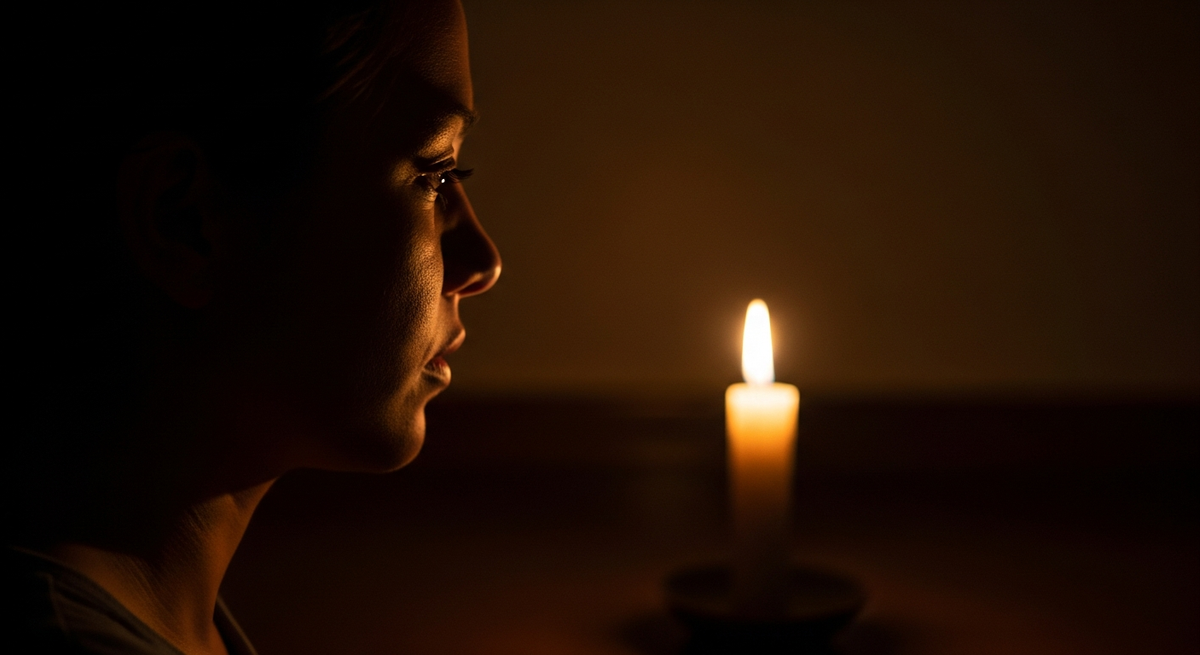
Outer trataka (bahir trataka) involves gazing at an external object. The most commonly used object is a candle flame, and for good reason. The flame is bright enough to hold attention effortlessly, its slight movement keeps the visual system engaged without creating distraction, and the warm colour is less fatiguing than cold or blue light. Other objects used in outer trataka include a black dot on white paper, the tip of the nose (nasagra drishti), the rising sun, the moon, or a bindu (small circular mark) on the wall.
The candle should be placed at eye level, roughly an arm's length away, in a room free from draughts so the flame remains steady. The practitioner sits in a comfortable meditation posture and gazes at the flame without blinking for as long as possible. When the eyes begin to water or the urge to blink becomes irresistible, the eyes are gently closed and the practitioner tries to visualise the afterimage of the flame at the eyebrow centre. When the image fades, the eyes are opened again and the outer gaze resumes.
Inner Trataka: Antar Trataka
Inner trataka (antar trataka) involves holding the mental image of the object with eyes closed. This is considered the more advanced form of the practice. The practitioner works to sustain the internal visualisation without the support of the external object, which requires a considerably higher degree of concentration. Over time, inner trataka becomes a gateway to pratyahara (withdrawal of the senses) and to the deeper stages of dharana and dhyana.
Benefits of Trataka: Concentration, Eye Health, and the Pineal Gland
Concentration: Training the Attentional System
The most widely reported benefit of regular trataka is a significant improvement in concentration. The practice is a form of structured attentional training. Every time the mind wanders from the flame and the practitioner returns it, that is one repetition of concentration. Over weeks and months of practice, this builds an attentional capacity that transfers directly to meditation, study, and any task requiring sustained focus.
Eye Health: Strengthening and Cleansing
The involuntary tearing that occurs during trataka is not a side effect to be avoided. Classical texts consider it a cleansing mechanism, removing impurities from the eyes and surrounding tissues. Practitioners who spend long hours working on screens often report that regular trataka reduces eye fatigue and improves the clarity of vision over time.
The Pineal Gland: An Ancient Claim
Several traditional texts, and many modern yoga teachers, connect trataka with stimulation of the pineal gland, sometimes called the "third eye." The pineal gland does regulate circadian rhythms through melatonin production and is sensitive to light, but the specific mechanism by which trataka might influence it is not established in current neuroscience. The claim deserves neither uncritical acceptance nor dismissal. What can be said with confidence is that the practice produces a distinctive quality of inner luminosity that experienced practitioners describe consistently across cultures and traditions.
Practical Guidance: Duration, Frequency, and Contraindications
Duration and Frequency: Starting Points
Beginners should start with two to three minutes of outer trataka per session, gradually building to ten or fifteen minutes over several weeks. The practice is traditionally done once daily, ideally in the early morning or at dusk when natural light is low and the candle flame is most visible. Most practitioners find that a daily practice of ten minutes produces noticeable changes in concentration within four to six weeks.
Contraindications: Who Should Avoid or Modify
Trataka is not appropriate for everyone without modification. Those with active eye conditions, including glaucoma, conjunctivitis, or retinal disorders, should consult an eye specialist before practising. Epilepsy is a contraindication for candle gazing specifically, since flickering light can trigger seizures in susceptible individuals. Alternatives such as a black dot or a bindu mark are safer in such cases. People with significant myopia may find the practice more comfortable with glasses on.
Anyone who experiences persistent headaches, visual disturbances, or unusual sensitivity after trataka should reduce the duration or pause the practice and consult a teacher.
Featured Programme
The I AM Programme
A structured nondual mindfulness programme for adults, working with attention, awareness, and the deeper dimensions of yoga practice.
Learn MoreBeginning Your Trataka Practice
Trataka is a practice best introduced gradually. Begin with five minutes of outer trataka at a candle flame, preferably in the same place and at the same time each day. Keep a practice journal to note changes in your concentration, dream life, and general mental clarity. These often shift before you notice any dramatic change in the meditation sessions themselves.
As the practice stabilises, introduce the inner phase, holding the afterimage with eyes closed for as long as possible before reopening. The ratio of outer to inner trataka can shift over time, with more emphasis placed on the internal phase as concentration deepens.
Trataka is one of the clearest demonstrations that yoga is not primarily a physical practice. It requires nothing of the body except stillness. What it asks of the mind is everything.
Teaching Note from Shital Chute
Trataka is one of the shatkarma practices I find easiest to explain to someone brand new to yoga, since the instruction itself is simple, you gaze steadily at a fixed point, traditionally a candle flame, without blinking for as long as comfortable. What I have noticed is that readers are often surprised this counts as a cleansing practice at all, since it does not involve any of the more intense shatkarma techniques. My honest framing note is that this is genuinely one to ease into slowly, since staring without blinking can bring on eye strain and watery eyes quickly if you push past your comfort. I also think it is worth being upfront that anyone with existing eye conditions, or anyone who is sensitive to flickering light, should check with a doctor before adding a candle based version to their practice.
Frequently Asked Questions
What is trataka and how is it practiced?
Trataka is a yogic cleansing practice, one of the six shatkarmas, that involves gazing steadily at a fixed point, most commonly a candle flame, without blinking for as long as it remains comfortable. After the gazing phase, practitioners typically close their eyes and try to hold the afterimage of the flame in the mind's eye.
What is trataka supposed to help with?
Traditionally, trataka is described as helping improve concentration, calm the mind, and strengthen the eyes, and many practitioners today use it as a simple focusing practice before meditation. These are traditional and commonly reported benefits rather than clinically established medical claims.
Is it safe to stare at a candle flame without blinking?
For most healthy people, short sessions of a few minutes are generally considered safe, but it is important to build up gradually, since forcing yourself not to blink for too long can cause eye strain, watering, or irritation. Stop and blink normally as soon as your eyes feel strained rather than pushing through discomfort.
Who should avoid or be cautious with trataka?
People with existing eye conditions such as glaucoma, cataracts, or other diagnosed eye disorders should check with their eye doctor before practicing. It is also worth being cautious if you have a history of seizures or photosensitive epilepsy, since some people can be sensitive to flickering light sources like a candle flame, so speaking with a doctor first is a sensible precaution.
Do I need a real candle to practice trataka, or can I use something else?
A candle flame is the classical and most common object used, but some practitioners also use a fixed point like a small dot, an image, or a distant object instead, especially if an open flame is not practical or safe in their setting. The key element is a steady, unmoving point of focus, not the specific object chosen.
Free Guide for Parents & Educators
Mini Mindfulness Masters
Simple practices to help children slow down, feel calm, and become more present. A free download, straight to your inbox.
No spam, ever. Unsubscribe at any time.

Written by
Shital ChuteMarketing Lead, The Holistic Care | Mindfulness & Behavioral Health Educator
Shital Chute leads Marketing at The Holistic Care, where she shapes how the platform's mindfulness courses, books and free resources reach the families, schools and workplaces who need them. Alongside this role, she is a passionate advocate and educator for mindfulness and behavioral health, drawing on that perspective to help shape content that is genuinely useful, not just promotional.
Her work at The Holistic Care sits at the intersection of communication and care: translating research-backed mindfulness practices into clear, practical guidance for parents, teachers and adults navigating everyday stress.


