
You lose the thread of a Yoga Nidra recording, then hear the voice again. That small return may tell you more about awareness than a flawless session.
At some point in a Yoga Nidra recording, the voice may ask you to notice the right thumb. A few moments later, you realise that you were thinking about tomorrow, or that you cannot remember hearing the last five instructions. Then the voice reaches you again.
It is tempting to call this a mistake. You were meant to pay attention, and you did not. Yet the interesting part of the moment is that you noticed. For a second, the story about tomorrow loosened its hold. You heard the room, felt the body resting and found yourself here again.
This is one of the things I value in Yoga Nidra. It gives attention a gentle place to return to. The practice does not require a perfect chain of awareness from the first instruction to the last. It invites us to discover what happens when we stop trying to hold the entire experience together.
There is an important distinction here. Yoga Nidra is not merely a recording that makes you sleepy. It is a guided way of resting while becoming curious about experience. Some people use it before bed. Some use it during the day. Either way, the question is less “How do I get to the end without wandering?” and more “What is it like to return?”
Listening without collecting instructions
In much of daily life, listening is an effort to retain information. We listen for the name, the number, the action point, the thing we must remember later. A guided practice can feel strange because it asks for another kind of listening. The instruction arrives, you notice what you can, and then it passes.
You are not preparing for an examination on the order of body parts. You do not need to chase the voice when it moves ahead. If it says “left palm” while your attention is still with the shoulder, there is no penalty. You may feel the palm now. You may hear the next instruction. The practice continues.
The voice is useful precisely because it relieves you of some of the work of directing yourself. It offers a sequence and a pace. Your part is simpler: listen, notice, drift if you drift, and return when returning happens.
That sounds easy until we meet our habit of doing a good job. We can turn even rest into an assignment. Am I following properly? Is my breathing slow enough? Did I choose the right intention? Those questions are understandable, but they add another layer of effort to a practice meant to allow effort to soften.
The next time you listen, see what happens if you let one instruction be enough. There is no need to store it. Feel the part of the body named, even if the feeling is faint, and let the recording move on.
Why move attention through the body?
The rotation of awareness through the body is a familiar feature of many Yoga Nidra practices. A guide may move from hand to arm, face to chest, leg to foot. To someone new, it can sound oddly specific. Why name the thumb at all?
One answer is that specificity makes attention concrete. “Relax” can become a large and unhelpful command. “Notice the right thumb” gives the mind a small, possible task. You need not achieve calm. You only need to discover what, if anything, is present in that place.
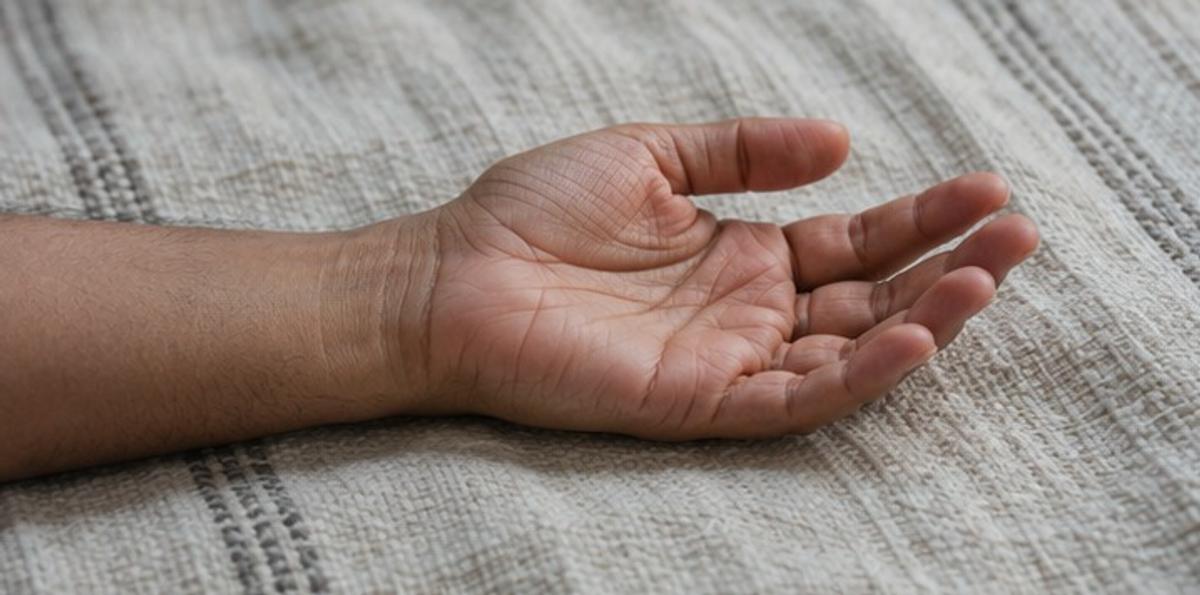
Another answer is that the body is where the day has been happening. We may talk about being tired as if tiredness lives only in a thought. Then we notice the tightness around the eyes, the weight of the legs or the way the jaw has stayed ready for another conversation. The body offers information we have been too busy to hear.
The practice is not an exercise in forcing sensation. Sometimes an area feels clear. Sometimes it feels vague or numb. Sometimes you cannot tell whether you are feeling the hand or imagining it. None of this requires correction. You can notice the uncertainty itself and continue.
If a particular area is painful or emotionally difficult, you may leave it alone. Feel the blanket beneath your back or listen to sounds in the room instead. You retain the right to choose where attention rests.
The space between waking and sleep
The phrase “yogic sleep” can mislead us if we take it to mean that sleep is the only desirable outcome. During Yoga Nidra, a person may remain clearly awake, feel drowsy, drift in and out of hearing, or fall asleep. There is no single experience that proves the session was real.
At bedtime, falling asleep may be welcome. If the recording helped you settle, you need not wake yourself to complete the exercise. During a daytime practice, you may prefer a guide that includes a clear return to the room so you can continue with the day.
Resting with some awareness can feel different from ordinary sleep. You hear the voice, perhaps lose it, then hear it again. The body is supported and there is less need to make decisions. This may be a valuable pause, but it should not be described as a replacement for sleep. Our bodies still need sufficient sleep, and a recording cannot guarantee it.
I think some of the disappointment people feel with Yoga Nidra comes from measuring it against a promised state. They expected a blank mind or immediate sleep. What they encountered was a mixture of quiet, thought, sound and occasional impatience. That mixture is ordinary human experience. The practice gives us a way to meet it without demanding that it disappear.
Silence is not the absence of thought
There can be a moment after the guide speaks when nothing needs to be answered. The room is still there. Thoughts may still appear. Yet you do not have to follow each thought to its conclusion.
That is the kind of silence I find interesting. It is less like switching the mind off and more like putting down the obligation to respond to everything it says.
Imagine hearing a car outside during practice. Usually the mind might ask where it is going, whether it is too loud, whether you should close the window. For a moment, you can simply hear it. The sound comes and goes. Your body remains on the mat or bed. Awareness has room for both.
This is not a contest to become indifferent. If something needs your attention, attend to it. If you are uncomfortable, move. If an instruction does not feel safe or helpful, skip it. A contemplative practice should deepen your relationship with ordinary life, not ask you to withdraw from good judgment.
When we allow sounds, sensations and thoughts to appear without making each one a problem, the practice becomes less fragile. It no longer depends on complete silence or on the mind behaving in a particular way.
What about an intention?
Some forms of Yoga Nidra include a sankalpa, a short inner resolve. It can give the practice a direction, but it does not need to become another demand for self improvement.
You might choose a plain sentence that matters to you, such as “I can meet this day with patience” or “I make room for rest.” The words should be ones you can say honestly. A grand statement that feels false may create more resistance than support.
You are also free to practise without an intention. On a difficult day, “I am here” may be enough. The value of the session does not rest on finding a perfect phrase.
An intention is not a mechanism for guaranteeing an outcome. It is a way of gently remembering what matters while the body rests. Once you have said it, you can allow it to be quiet. There is no need to repeat it anxiously or check whether it has taken effect.
I would choose an intention that can accompany you into ordinary conduct. Patience might mean waiting while someone finishes a sentence. Making room for rest might mean leaving ten minutes between two commitments. The words become meaningful through how we live with them, not through the drama of saying them.
How to choose a recording
If you are beginning, choose for the moment you are in. A shorter recording can help you learn the shape of the practice. A bedtime recording may leave you where you are so that sleep can come naturally. A daytime practice may guide you back to alertness. If you want to explore a more traditional sequence, look for rotation of awareness, breath and intention.
You can find these different approaches in our Yoga Nidra guide and audio collection. The page groups recordings by use and explains what to expect. The Stillness Library also has free practices, which can be a good place to listen without making a purchase or a large commitment.
Length matters less than fit. A long recording that you cannot make space for will remain unheard. A brief recording that you return to can teach you the feel of the practice. Likewise, a voice that sounds supportive to one person may not suit another. It is reasonable to listen and choose.
Make the body comfortable before you press play. There is no benefit in lying rigidly because an imagined rule says you must. You might support your knees, cover yourself or rest in a chair. Let the volume be low but clear. If you need to be ready for a child or another person, arrange that care first where possible.
Then allow the recording to do its work without requiring a particular result from yourself.
A small experiment with returning
For your next practice, try noticing three moments rather than judging the whole session.
First, notice how you arrive. Perhaps you are tired, alert, reluctant or eager. You do not need to improve the starting point. Just recognise it.
Second, at some point you may discover that attention has gone elsewhere. The instant you notice, feel one place where your body is supported. Listen for the next words. There is nothing to make up.
Third, when the recording ends, take a moment before reaching for the next task. Notice the room again. Ask yourself whether there is anything you need now. The answer may be water, movement, more rest or simply to continue with the day.
These are small observations. They do not prove that Yoga Nidra has changed you. They let you see what actually happened, which is more useful than comparing yourself with an imagined ideal session.
If a practice consistently brings up distress, or if sleep difficulty is ongoing, seek appropriate support. Yoga Nidra can be one way to rest and reflect, but it is not medical treatment.
Featured Programme
Art of Conscious Deep Sleep
One complete 83-minute Yoga Nidra practice in five connected tracks. Voice-only MP3s, a continuous-play page and a PDF manual.
See the ProgramThe practice that continues afterward
I do not think the most valuable moment is always the deepest moment of rest. Sometimes it is the moment of return. You were absorbed in a thought. Then you heard a voice, felt the floor and knew that you could begin again from there.
That movement is available outside a recording too. In the middle of an impatient conversation, you may notice the pressure of your feet on the ground. While reaching for your phone, you may become aware of the hand reaching. After a difficult hour, you may realise you are holding your breath and let it move naturally again.
These moments are brief. They do not erase the demands of a day. They remind us that attention can return to the life we are living, even when we have been away in thought.
So if you lose the thread of a Yoga Nidra practice, there is no need to start grading yourself. Hear the next word. Feel the support beneath you. Begin again, wherever the voice has reached.
Free Guide for Parents & Educators
Mini Mindfulness Masters
Simple practices to help children slow down, feel calm, and become more present. A free download, straight to your inbox.
No spam, ever. Unsubscribe at any time.

Written by
Mohan ChuteHead of Marketing & AI Strategy | Digital Transformation Leader | Nonduality Mindfulness Teacher | Author | Explorer of Consciousness
Mohan Chute is a rare blend of technology strategist and mindfulness teacher. With over 23 years of experience in digital marketing, AI strategy, and growth leadership, he has guided organizations through automation, analytics, branding, and digital transformation. Alongside this professional expertise, Mohan has devoted his life to exploring meditation, yoga, and nondual awareness—helping people discover balance, presence, and authenticity in a fast‑paced world.
💻 AI & Digital Expertise
As a strategist and innovator, Mohan empowers businesses to harness AI, automation, and analytics to drive growth. His leadership in go‑to‑market strategy, branding, and digital transformation positions him at the forefront of innovation—while keeping human wellbeing at the center.
🧘♂️ The Journey Within
At 17, Mohan discovered meditation on his own—a spark that ignited a lifelong journey into yoga, mindfulness, and nondual inquiry. Today, he integrates this wisdom into both personal and professional domains, showing that technology and consciousness can coexist to create meaningful impact.
🌍 Founder & Teacher
Through The Holistic Care Foundation, Mohan leads transformative programs worldwide. His Nonduality & Mindfulness‑based education initiatives support schools, colleges, and communities in cultivating calm, connected, and compassionate learning environments. For corporate teams, his programs position mindfulness as a competitive edge—enhancing creativity, reducing burnout, and fostering resilient workplace cultures.
📚 Author of Inspiring Works
Mohan’s books span audiences from children to spiritual seekers, weaving story, metaphor, and practice into accessible journeys of awareness. His published works include:
Mindful Adventures for Little Minds
In the Garden of Kindred Spirits
The Wondrous Quest: Journey to the Knower Within
I Am – The Heart of Being
Seeds of Kindness
Mindful Computing: Embracing Presence in a Digital World
The Awareness Chronicles series:
Book 1: The Magic Sketchbook
Book 2: The Movie Projector
Book 3: The Mask Maker
Book 4: The Listening River
Book 5: The True Compass
🎓 Interactive eLearning Courses
Each of these books has been transformed into interactive eLearning programs available on The Holistic Care. These courses combine storytelling, reflection prompts, creative activities, and mindfulness practices—making awareness accessible to children, teens, educators, families, and professionals.
🌈 A Guiding Light
Whether you are a student, educator, professional, or seeker, Mohan’s voice offers clarity and compassion. His mission is simple yet profound: to help people live with balance, presence, and purpose—reminding us that awareness is not the end, but the beginning.


